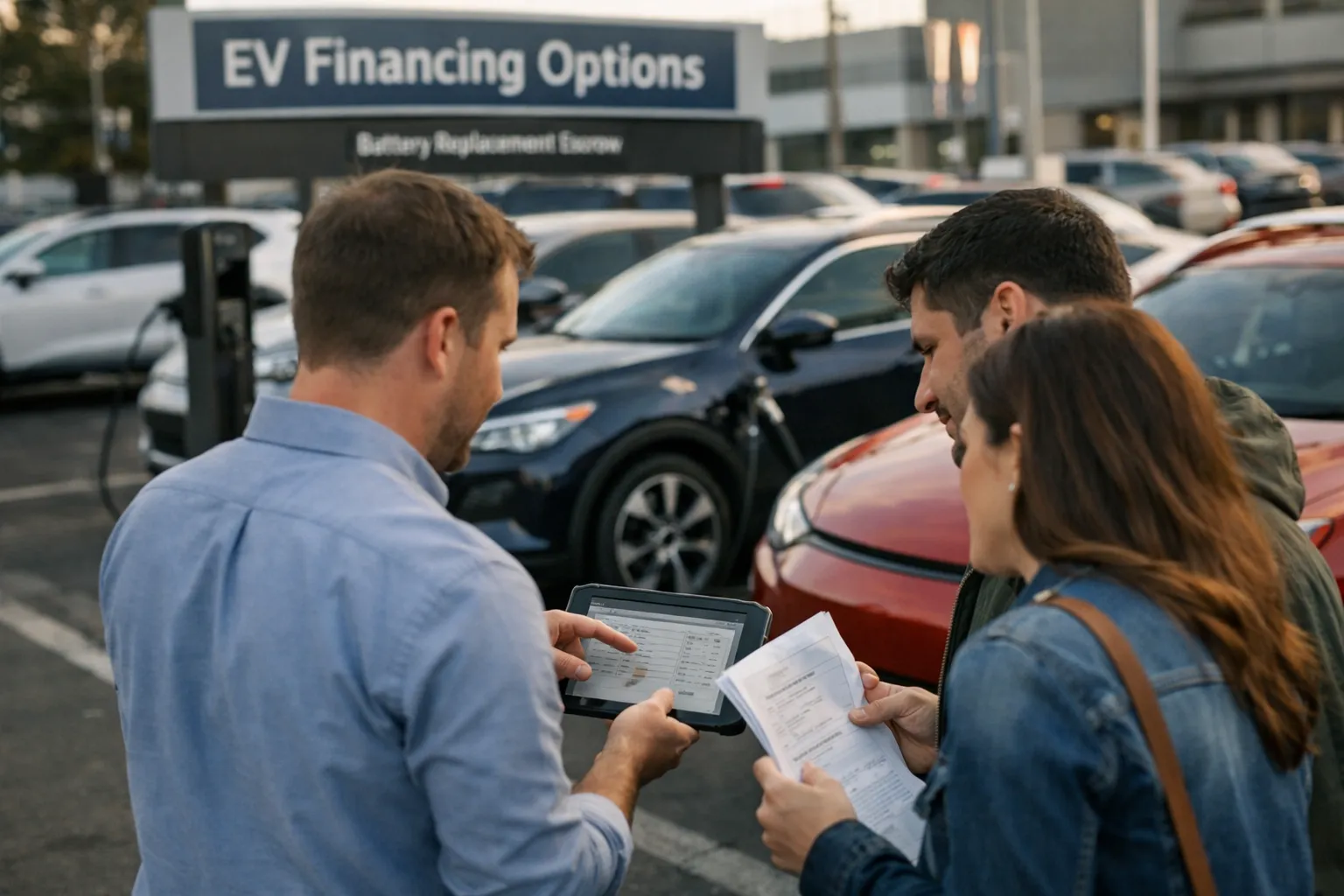
Who: auto lenders, captive finance arms and dealers across the U.S.; What: 84‑month auto loans specifically for electric vehicles that pair long terms with a battery‑replacement escrow; When: first pilots appeared in March 2026 and, as of June 24, 2026, the product is in active use beyond pilot dealerships; Where: U.S. retail and used‑EV channels; Why: to lower monthly payments while building a mechanism to cover late‑life battery repairs and protect residual value.
Why the update matters now
When these loans first appeared in March 2026 they aimed to blunt buyer anxiety about battery degradation while keeping monthly payments competitive. Three months on, the market test has broadened into a small but growing segment of retail finance. That matters to used‑EV buyers and sellers because escrow terms materially affect cash at purchase, the financed amount, resale value and dispute resolution when a battery fails late in the term.
How the battery‑replacement escrow model has evolved
- Escrow funding methods: Programs now commonly allow three approaches — (1) escrow paid up front by the buyer; (2) escrow added to the financed principal; or (3) a separate third‑party escrow deposit outside the loan. Finance disclosure practices vary by lender.
- Typical escrow sizes: Market listings and dealer disclosures in June 2026 most frequently show escrow amounts between $1,000 and $3,500, calibrated to typical mid‑range pack replacements or refurbishment rather than the full cost of some OEM swaps.
- Trigger and verification: Release rules generally require a documented state‑of‑health (SOH) below a defined threshold (commonly 65–75% capacity), or a certified diagnosis by an approved service provider. Escrow agreements increasingly specify exact diagnostic tools and data formats required for verification.
- Approved vendors and caps: Lenders often insist on OEM service centers or preapproved independent shops; agreements typically set maximum parts and labor caps and outline who pays shipping and core disposal.
- Transferability and refunds: Newer contracts are more likely to include transferability clauses (escrow follows the vehicle) but practice is inconsistent — some escrows are refunded at sale, others retained by the lender unless reassigned to a buyer.
Updated example — June 2026 numbers
To see how the combination of a longer term and an escrow changes the math, consider a $40,000 EV with an 80% financed amount ($32,000). At 7.5% APR:
- 60‑month loan: monthly ≈ $641; total interest ≈ $6,460.
- 84‑month loan: monthly ≈ $490; total interest ≈ $9,159 (about $2,700 more interest).
- If the lender finances a $2,500 escrow, the 84‑month payment rises to roughly $529/month and total interest increases further.
Bottom line: the escrow lowers your immediate cash burden if financed, but it raises the financed principal and the total interest paid over the life of the loan.
New trends and real‑world context
Since March 2026 dealers and captive finance arms have refined language about diagnostic triggers and transfer rules after early consumer questions about refunds and dispute timing. Dealers report two practical results: (1) escrows help move price‑sensitive buyers into EVs by reducing monthly payments; (2) some buyers opt to pay the escrow up front to avoid adding it to the principal.
At the same time, independent repair shops and battery‑refurbishment firms are pressing to be added to approved vendor lists; several regional auctions and certified‑preowned programs are experimenting with escrow transfer processes to keep resale channels liquid.
Impact: who wins and who should be cautious
Winners: buyers who need lower monthly payments and are comfortable with long ownership horizons; lenders that reduce late‑term collateral losses; dealers that can close price‑sensitive sales.
Risks: higher lifetime interest, potential escrow shortfalls versus expensive OEM replacements, disputes over whether a battery meets the escrow trigger, and complexity at trade‑in or resale. For buyers planning to sell inside the 84‑month window, unclear transferability can create unexpected costs or lost escrow funds.
Reactions from stakeholders
"Escrows are a sensible innovation if they are transparent and transferable," a consumer‑advocacy representative told Car Buying Guide on June 17, 2026. "But we are seeing confusion in contracts about refunds and diagnostic standards — regulators should watch disclosures closely."
A finance executive at a regional lender who asked not to be named said on June 10, 2026, "Battery escrows let us underwrite EVs more like conventional vehicles by isolating a major late‑life repair. Properly structured, they reduce repo and loss severity risk."
What buyers must ask — updated checklist (June 2026)
- Who holds the escrow and is the account FDIC/NCUA insured? Get the custodian’s name and a copy of the escrow agreement.
- What exact SOH threshold, test protocol and diagnostic report trigger release? Ask for the model of diagnostic tool and the data fields required.
- Is the escrow refundable, transferable or forfeited on sale or default? Get examples of how the dealer or auction handled similar cases.
- What costs are capped? Confirm dollar caps for parts, labor, shipping, and whether OEM premiums exceed the cap.
- How does escrow interact with warranties, GAP insurance and trade‑in valuation? Get it in writing.
- Can I substitute a commercial battery warranty or certified refurbishment plan instead of the escrow?
Negotiation levers and alternatives (what works in practice)
Buyers can often negotiate: smaller escrow (with a larger down payment), escrow transferability, or the option to provide a third‑party battery warranty in lieu of escrow. Alternatives to escrow include certified pre‑owned (CPO) programs with extended battery coverage, third‑party battery warranties from specialist insurers, or paying an independent refurbishment provider at time of repair.
Regulatory and market signals to watch
Watch for guidance from the Consumer Financial Protection Bureau and state consumer protection offices on escrow disclosure and transferability. Also monitor auction houses and CPO programs: wider adoption of transferable escrows or escrow‑tracking services would reduce resale friction. Finally, track actual claim frequencies and replacement costs published by lenders or trade groups — those data points will determine whether escrows are set at appropriate levels.
Will a lender‑held escrow count toward my loan‑to‑value (LTV) or just serve as a reserve?
It depends on how the lender structures it. If the escrow is added to the financed principal it increases LTV and is part of the amortized balance; if held separately, it may not affect LTV but still reduces your immediate cash outlay. Confirm in writing before signing.
If I sell the car before the escrow triggers, do I get the money back?
Some escrows are refundable or transferable; others are not. Recent contracts are more likely to allow transfer to a new buyer, but practice varies by lender and state. Always get the escrow refund/transfer rules in writing and ask for examples from the dealer.
Can I avoid the escrow by buying warranty coverage instead?
Often yes. Many lenders will accept a commercial battery warranty or certified refurbishment plan in place of escrow — provided the policy meets the lender’s coverage, vendor and claims‑payment requirements. Require written confirmation that an alternative warranty satisfies the lender.
What records should I keep if my battery later fails?
Keep all diagnostic reports, repair orders, the escrow agreement, and any correspondence with the lender or approved service provider. That documentation speeds verification and release of escrow funds.
Bottom line
As of June 24, 2026, 84‑month EV loans with battery‑replacement escrows are no longer a single‑dealer experiment but a growing financing option. They can lower monthly payments and address a key late‑life risk for batteries — if the escrow size, trigger rules and transferability are clear. Read documentation carefully, run total‑cost scenarios (not just monthly payment comparisons), and insist on written confirmation of escrow mechanics before you sign.