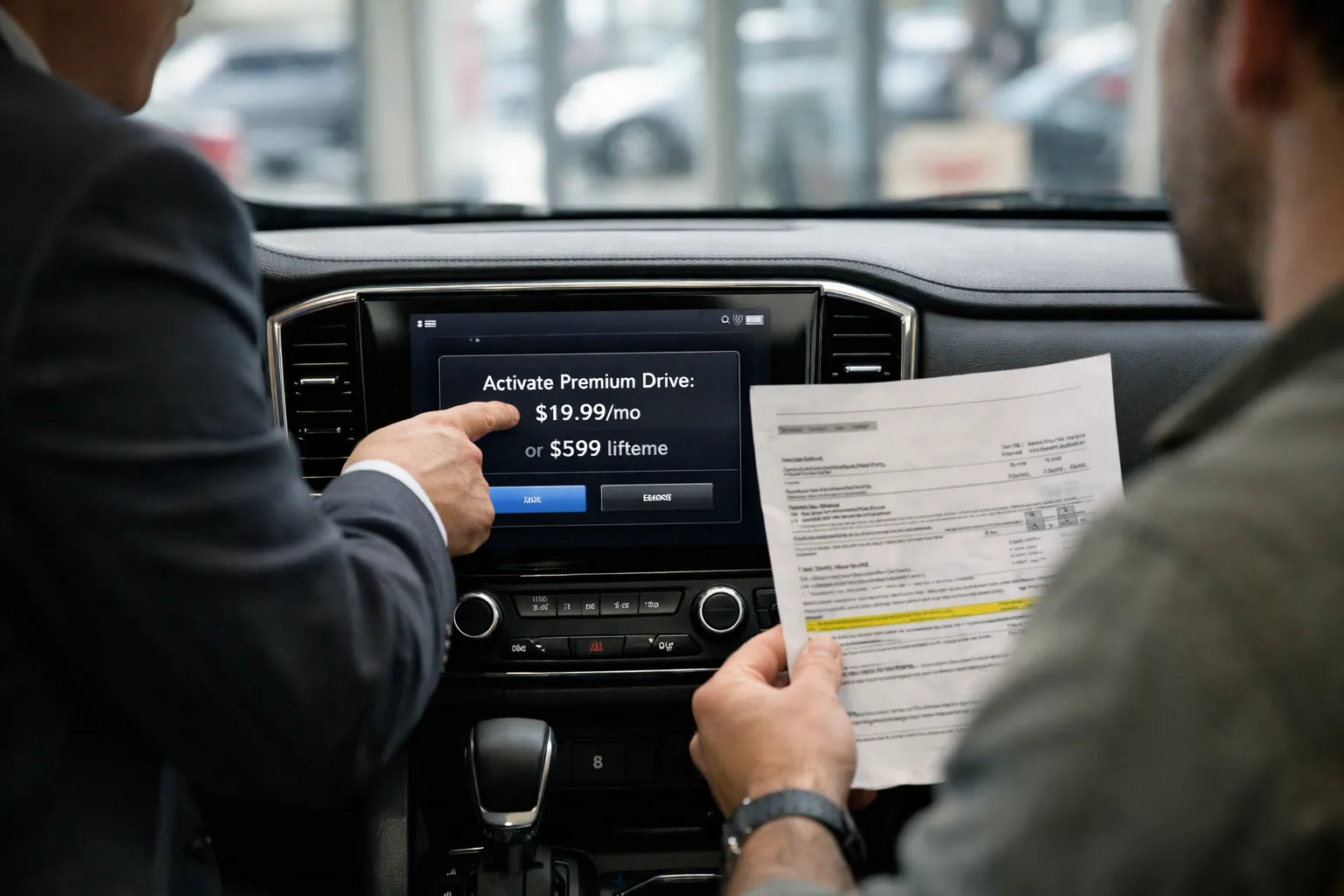
This updated June 2026 guide shows car buyers exactly how to evaluate, negotiate and document software subscriptions that come with new (and used) vehicles. It is written for people who buy cars regularly or occasionally and who want to avoid paying recurring fees that reduce resale value. The article keeps the same practical negotiation playbook from earlier in 2026 but adds the latest buyer tactics, contract language and real-world context that matter right now.
Why software subscriptions still matter in mid‑2026
- Ongoing shift from hardware to software: Automakers continue moving capabilities (ADAS modes, navigation data, premium connected services, in‑car commerce, EV route planning and charging access) to software-delivered, fee-based models rather than physical options.
- Ownership economics: Subscriptions convert a portion of vehicle value from upfront cost to recurring expense. That can be cheaper for short-term owners and costly for long-term owners if transferability is limited.
- Resale and trade-in impact: A vehicle advertised as “full ADAS” can lose value if that ADAS is account-locked and cannot transfer; buyers of used cars increasingly ask for clear proof of transferable licenses.
- Negotiation point: Dealers and OEMs view subscriptions as margin opportunities. That makes them negotiateable: you can ask for included terms, discounts, transfer guarantees or cash equivalents.
Prerequisites — what to know before you shop
Before you go to a dealership or start comparing listings, do this groundwork:
- Review OEM policy pages: Visit the manufacturer's subscription/support pages and your model’s configurator. Look for exact feature names (e.g., "Highway Assist Pro", "Live Map Updates") and SKU/ID numbers.
- Know your ownership horizon: Estimate how long you plan to keep the car. This drives the break-even math between monthly plans and one-time activations.
- Prepare VIN and account questions: If buying used, get the VIN before inspection and ask the seller to show OEM account screens or transfer paperwork.
Step 1 — Identify what’s subscription-only
Do this early — before test drives or personalization. Exact feature names matter.
- List every feature in the car that could be software-locked: ADAS modes, premium navigation with live traffic and map updates, manufacturer-branded connected services (concierge, stolen-vehicle tracking), EV charging and routing subscriptions, in‑car app store purchases, and any “enable/upgrade” options the dealer mentions.
- Ask the dealer or check the OEM's online configurator for SKU/ID and whether the feature is available as a one-time purchase, subscription, or both.
- Record screenshots or print the configurator pages showing prices and terms. Those screenshots are evidence if a verbal promise is later disputed.
Step 2 — Compare pricing structures and run the math
Determine the break-even point for one-time purchases vs subscription payments and compare to your ownership plan.
- Note the exact one-time activation price and the monthly or annual price. Example: monthly $19.99 vs one-time $599 → break-even ≈ 30 months (599 ÷ 19.99 ≈ 30).
- Include financing cost if you intend to roll a one-time fee into the loan: adding $599 to a 60‑month loan at 6% APR adds about $11/month in interest — include that when comparing to a subscription fee.
- Factor in resale: if the one-time fee does not transfer, the present value of a lost transferable benefit should be subtracted from resale expectations.
Step 3 — Confirm transferability and how transfers work
Transferability is the single most important subscription attribute for resale value.
- Ask whether the subscription is VIN‑tied (transfers automatically) or account‑tied (may not transfer without OEM action).
- If account‑tied, ask whether the OEM offers paid transfers, pro‑rated refunds, or a buyer-sell mediation process; get the policy page or support email as proof.
- For used cars, perform a live transfer check: with the seller present, call OEM support with the VIN and confirm the feature status and transfer procedure. Record the call reference number.
Step 4 — Negotiate with sequence and leverage
Negotiate in layers: vehicle price first, then subscription items.
- Negotiate total vehicle price and trade-in separately: Lock the vehicle price before discussing subscriptions to avoid trade-offs hidden in finance terms.
- Ask for included subscription months: Request that the dealer include 12–36 months of a named subscription at no charge. Dealers often have promotional allowances or floorplan levers.
- Counter one-time activation fees: If the dealer insists on selling a one-time lifetime license, offer a capped one-time payment you’re willing to finance or ask the dealer to amortize it into the sale price at no markup.
- Demand transferability language: Ask for contract language guaranteeing transfer or dealer reimbursement if the OEM refuses transfer. Get the OEM policy page attached to the contract if available.
- Use competing offers: If a rival brand includes similar services permanently, use that as a bargaining chip to secure inclusion or price concessions.
Step 5 — Document everything in the sales contract
Verbal promises are worthless without line-item documentation.
- List subscriptions by exact product name, SKU/ID, price and term on the purchase agreement or an addendum.
- Include transferability commitments: for example, "Manufacturer subscription [exact name] (SKU [#]) transfers with the vehicle to any subsequent owner without fee; if manufacturer denies transfer, dealer will reimburse buyer $[amount] within 60 days."
- If a free trial is promised, include start/end dates and whether the trial auto‑enrolls into paid status and whether cancellation is buyer‑initiated or automatic.
- Specify whether any activation fee is financed and whether interest will apply; show the financed amount and monthly payment impact separately on the contract.
Sample negotiation scripts — updated for 2026
- Initial ask: "I want the premium connected package [exact name/SKU] included for 24 months. Please list it as a line item on the purchase agreement."
- If dealer resists: "If you can't include 24 months, reduce the one-time activation fee to $[X], or include 12 months plus a $200 credit toward transfer if the OEM won't transfer later."
- On transferability: "Please add: 'Manufacturer subscription [name/SKU] will transfer to subsequent owners; if transfer is denied, dealer will reimburse buyer $[amount] within 60 days and will pursue OEM remediation.'"
Buying used in 2026 — extra precautions
Used-car transactions are where subscription issues most often cause buyer surprises. Follow these steps:
- Ask the seller to log into their OEM account and show the active subscriptions and transfer policy. Take screenshots and note the account name and email.
- Call the manufacturer’s customer service with the VIN and seller present; request a transferability confirmation and a reference ID for the call. If the OEM provides a written transfer authorization, get a copy.
- If the subscription is non-transferable, demand a price reduction equal to the present value of the lost service, or a written seller refund for the unused portion of any paid subscription.
- Prefer vehicles with VIN‑based licenses or models where OEM policy explicitly allows transfers; such cars retain higher resale value and are easier to re-sell.
Financing, insurance, taxes — practical effects
- Financing: Rolling a one-time activation into the loan increases the financed amount and interest paid. Ask the lender to show how much interest the activation will add over the loan term.
- Insurance: Advanced safety tech can influence premiums. Confirm with your insurance agent whether a paid ADAS subscription materially changes your rate.
- Taxes: One-time activation fees can be taxable at purchase in some states; monthly subscriptions may be treated as services subject to local sales tax. Ask your dealer’s finance office to itemize tax treatment.
Dispute and escalation — documented steps
If a dealer promises something that the OEM later refuses, take these steps:
- Preserve all communications: purchase agreement pages, screenshots of the OEM policy, call reference numbers, emails and salesperson text messages.
- Contact the OEM customer relations with VIN and contract reference, request written confirmation or remediation and keep the response record.
- Escalate at the dealer: ask to speak with the sales manager, finance director and general manager. If unresolved, file a complaint with your state consumer protection agency and retain evidence for small‑claims court if necessary.
Checklist: before you sign (updated for June 2026)
- All included subscriptions are listed by exact name and SKU on the purchase agreement.
- Transferability of each subscription is confirmed in writing (OEM policy printout or contract clause).
- Break‑even calculation completed for each feature based on your planned ownership period and financing costs.
- Deal structure shows how subscription fees are paid and whether they are financed or paid up front.
- You have call reference numbers or written confirmations for any OEM promises made during negotiation.
Real-world scenarios — how to apply the math
- Short ownership (under 30 months): Monthly subscription may be cheaper. Ask the dealer to include months equal to your ownership window as a condition of purchase.
- Medium ownership (3–5 years): Compare one-time price vs monthly with financing interest; try to negotiate a reduced one-time activation or multi-year inclusion.
- Used car with non-transferable ADAS: Demand a price reduction reflecting the present value of the lost feature or insist seller obtains OEM transfer authorization in writing before closing.
Pro tips — advanced tactics for better results
- Ask for OEM confirmation email: Request the manufacturer to email a transferability statement to both you and the dealer — it’s stronger evidence than a verbal claim.
- Use a time‑boxed escrow: If transferability is unresolved at closing, set aside an agreed payment in escrow to be released if OEM confirms transfer within a set period.
- Value trade in dollars, not features: If the dealer won’t budge on subscriptions, ask instead for cash off MSRP, lowered interest rate, or service credits you can use regardless of software status.
- Check app-store purchases: Some in‑car apps and media subscriptions are reversible; others are account-locked. Treat them the same way as OEM subscriptions.
FAQ
Are automakers required to make subscriptions transferable?
No universal federal rule mandates transferability. Transfer policies are set by individual manufacturers and vary by feature. Always confirm with the OEM and get written proof of transfer terms before you buy.
Should I ever pay a lifetime activation fee?
Potentially — if you plan to keep the car longer than the break-even period and the one-time fee transfers with the car or you don't plan to sell. If the one-time fee is account-tied or non-transferable, treat it cautiously and negotiate a price reduction or warranty of transferability.
What if the dealer refuses to put subscription promises in writing?
Walk away or insist on adding an addendum signed by the dealer and buyer. If the dealer refuses, that refusal itself is a negotiation signal — consider other dealers or brands that provide clearer terms.
How do I value a non-transferable feature when buying used?
Estimate the remaining subscription term and calculate present value of continued monthly fees, or use the one-time activation price pro-rated for remaining useful life. Negotiate a price reduction or seller refund accordingly.
Are there third-party services that verify subscription status?
Yes—some VIN-history and concierge services now offer to check active OEM subscriptions or provide transfer assistance. Use them as supplemental verification, but always get direct confirmation from the OEM when possible.
Bottom line
Software subscriptions are now a standard part of the car market. The most valuable actions you can take are straightforward: identify subscription‑only features early, run the break‑even math including financing, confirm transferability in writing, and put any deal terms on the purchase agreement. With those steps — and a few advanced tactics for leverage — you can prevent surprise recurring costs and protect a vehicle’s resale value.
Templates (updated)
Email to OEM to request transfer confirmation:
Subject: Transferability confirmation request — VIN [insert VIN]
Dear [Manufacturer Customer Service],
I am purchasing vehicle VIN [VIN] on [purchase date]. Please confirm in writing whether the following subscription(s) transfer to subsequent owners (list exact names and SKUs). If transfer is not available, please describe the OEM policy for pro-rated refunds or paid transfers and provide the relevant policy link or reference number.
Thank you,
[Your name, email, phone]
Contract clause to request from dealer:
"Manufacturer subscription [exact name] (SKU [#]) will transfer with the vehicle to any subsequent owner without fee. If manufacturer denies transfer, dealer will reimburse buyer $[amount] within 60 days and will pursue remediation with the manufacturer on buyer's behalf."
Use these templates and adapt the math to your numbers. The goal: convert subscription language from vague marketing copy into explicit, enforceable elements of the sale.