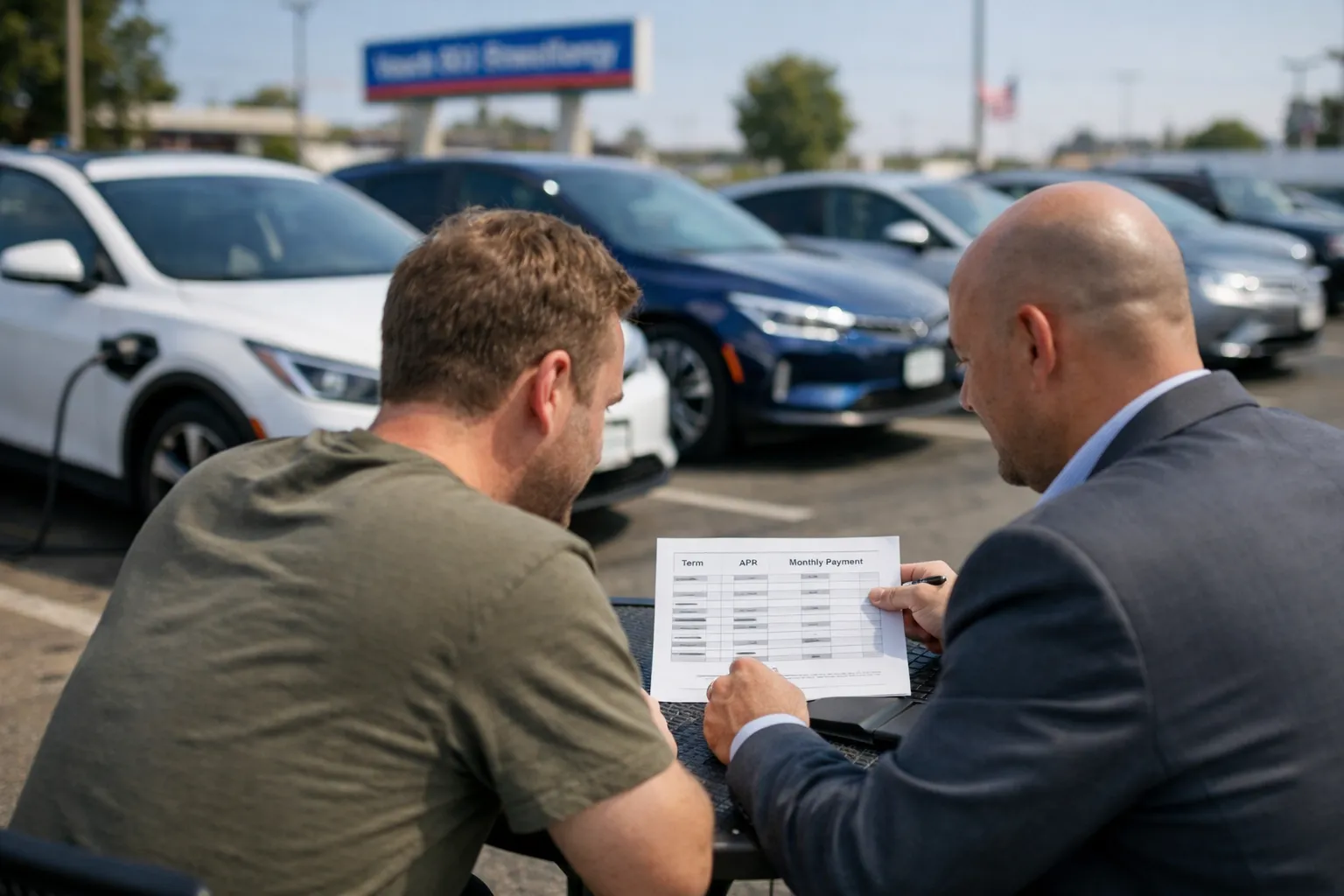
Who: used‑EV buyers and auto lenders in the United States. What: an expanded roll‑out of 96‑month (eight‑year) loan options for late‑model used electric vehicles. When: updated guidance and market signals through November 2026. Where: dealer lots, captive finance arms and online retail platforms nationwide. Why it matters: longer terms lower monthly payments but materially increase total interest paid, deepen negative‑equity risk and lengthen exposure to battery decline and obsolescence—risks that have become clearer in 2026 as more lenders scale the product.
Context: how we got here
Longer auto loans have been rising for more than a decade as buyers sought lower monthly payments. In 2024–25, lenders began explicitly applying that playbook to used EVs to accommodate higher late‑model prices and persistent demand for electrified cars. By late 2026 the product has broadened: captive finance arms and several national banks are offering 96‑month terms more often on certified pre‑owned (CPO) and low‑mileage EVs, while dealer channels push the option as a way to move pricier inventory.
Why now? Two forces converged. First, supply of late‑model used EVs increased as lease returns and off‑lease fleets hit the market, pushing inventory levels up but keeping prices elevated relative to equivalent internal‑combustion vehicles (ICE) because replacement battery costs and repair uncertainty still weigh on used valuations. Second, macro financial conditions in 2026—consumer credit demand staying firm alongside competition among lenders—made longer‑term products attractive for originations and dealer-sales strategies.
What’s changed since September 2026
- Broader lender participation: Several larger captive finance groups and regional banks amplified marketing of 96‑month products for qualified buyers on certified pre‑owned EVs through October 2026. That has made the option commonplace on dealer paperwork and digital retail menus.
- Underwriting refinements: Lenders are increasingly adding EV‑specific underwriting checks—minimum remaining battery warranty, mileage caps, and requirements for manufacturer CPO certification—to limit losses tied to battery failure.
- Ancillary product growth: Demand for extended battery warranties, third‑party battery diagnostics at point of sale, and gap insurance has risen noticeably; warranty providers report higher take rates on EV‑specific policies in 2026.
- Regulatory attention: Consumer advocacy groups and regulators have reiterated scrutiny of long‑term auto loans because of negative equity and payment shock risks. The Consumer Financial Protection Bureau (CFPB) and several state departments of motor vehicles have published consumer alerts in 2026 highlighting long‑term lending risks for used vehicles, including EVs.
How the math shifts with 96 months (practical example)
Monthly savings can look substantial—stretching a $30,000 financed balance from 60 to 96 months can lower the payment by roughly 25–35% at the same nominal rate. But that same buyer pays interest for 60% more months. In practice, many buyers end up paying several thousand dollars more in total interest across the loan, and they remain more likely to be “upside‑down” (owing more than the car is worth) for a longer period if depreciation or battery value falls faster than expected.
EV‑specific risks sharpened by long terms
- Battery life vs. loan life. Most manufacturer battery warranties remain the market standard—commonly 8 years or 100,000 miles. A 96‑month loan can fully overlap with the warranty window, but it also means large out‑of‑warranty months remain while a buyer may still owe a sizeable balance. Verify the exact battery warranty (years and mileage) for the model and VIN you’re buying.
- Range loss and resale value. State‑of‑Health (SoH) reductions and diminished charging speed materially affect resale prices for EVs. Third‑party market data in 2026 shows that buyers place an increasing premium on documented SoH and CPO battery certifications when shopping used EVs.
- Obsolescence and incentives. Rapid improvements in battery density and charging infrastructure continue to compress the competitive set for older EVs. If new‑car incentives or tax credits for new EVs return in force, used EV prices can adjust downward more quickly.
What buyers must verify before signing (updated checklist)
- Compare total cost across terms. Ask for a full amortization schedule and the total interest paid over 60, 72 and 96 months. Don’t optimize on monthly payment alone.
- Confirm battery warranty specifics for the exact VIN. Document years remaining, mileage remaining, and exactly what failures are covered (capacity, cell defects, module replacement).
- Obtain a recent battery SoH report. Use manufacturer diagnostics when possible or an independent provider such as Recurrent (battery analytics) or an OEM‑authorized dealer report. Get the SoH in writing and add it to the purchase record.
- Check CPO status and exclusions. Certified pre‑owned programs often include additional battery coverage or condition checks—verify what’s included and for how long.
- Confirm prepayment, refinancing and transfer rules. Ask whether the contract carries prepayment penalties; confirm the lender’s policy on refinancing if you plan to shorten the loan after 12–24 months.
- Price the extended warranty and gap insurance separately. Compare dealer offers with standalone third‑party products—dealer markup on warranties can be large.
- Project resale scenarios. Use Kelley Blue Book, Edmunds, and auction comps to model trade‑in value at 3 and 5 years under optimistic and pessimistic SoH outcomes.
Negotiation levers that work in 2026
- Demand a lower APR for the 96‑month product or negotiate dealer price first—don’t let monthly payment frame the conversation.
- Offer a larger down payment or a trade that reduces initial loan‑to‑value (LTV); even 5–10% additional down payment reduces negative equity risk sharply.
- Insist on written SoH certification and a battery warranty buy‑back clause—if the battery falls below a stated capacity within a period, negotiate a partial refund or warranty extension.
- Plan to refinance: if rates or your credit profile improve, refinance to a shorter term within 12–36 months to reduce total interest and LTV exposure.
Market impact and who is affected
Retail prices for used EVs have been influenced by the wider availability of long‑term finance: longer terms increase effective affordability and can prop up retail prices in the near term. That benefits sellers and lenders aiming for originations, but it can prolong market corrections when battery issues or supply shifts occur. Insurers and warranty firms are expanding EV‑specific offerings; dealers increasingly view extended battery coverage as a sale accelerant. For individual buyers, the tradeoff is clear: access today versus financial exposure tomorrow.
Reactions from industry watchers
Automotive data firms and dealers interviewed in late 2026 describe the change as a calibrated response: lenders want to grow used‑vehicle originations while mitigating loss through stricter CPO criteria and battery checks. Consumer advocates continue to press for clearer disclosures about total loan costs and battery‑related risks. Regulators have ramped consumer alerts and urged lenders and dealers to present total cost and warranty information prominently in advertising and contracts.
What to watch next
- Automakers’ battery‑certification programs: expansion of OEM remanufactured battery programs or standardized third‑party certifications would reduce buyer uncertainty.
- Refinancing flows: if a wave of 96‑month refinances to shorter terms emerges in 2027, that will indicate whether the product was used as a bridge or a permanent structure.
- Regulatory action: expect more state guidance and potential disclosure requirements on long‑term used‑vehicle financing and EV‑specific warranty coverage.
Bottom line
96‑month loans for used EVs are now a mainstream option in November 2026. They lower monthly payments and expand access, but they also increase total interest paid and lengthen exposure to battery and obsolescence risk. Treat a long loan as a tool: compare total cost, require VIN‑level battery proof and warranty terms in writing, negotiate price and rate, and plan for an early refinance if that reduces your total cost and negative‑equity window.
Can I finance a used EV for 96 months and still come out ahead?
Yes—if you do three things: buy at a conservative price, secure verifiable battery health and warranty coverage, and have a refinance or payoff plan within a few years. Without those safeguards, the expected total cost and negative‑equity risk rise substantially.
How do I get a reliable battery State‑of‑Health (SoH) report?
Ask the selling dealer for a manufacturer diagnostic on the VIN or order an independent SoH analysis from a reputable vendor (for example, services that analyze telematics or perform an on‑vehicle diagnostic). Get the report in writing and keep it with your purchase documents.
Are extended battery warranties worth it?
They can be—particularly for models where battery replacement costs are high and the remaining OEM warranty is short. Price the dealer’s warranty against third‑party options and weigh the claim limits, exclusions and deductible. If a warranty reduces your downside materially, it may justify part of the incremental cost of a longer loan.
Should I assume prepayment and refinance will be easy?
No. Always confirm prepayment penalties and lender refinancing policies before signing. Some lenders allow early payoff without penalty; others assess fees or require a minimum retained term. Put the policy in writing and plan contingencies.