
Introduction — What you'll learn and who this is for
This August 2026 update tells prospective buyers exactly what to check when purchasing a certified pre‑owned (CPO) electric vehicle. If you’re shopping for a used EV—examples commonly offered as CPOs in 2026 include Hyundai/Kia Ioniq‑series and EV6, Chevrolet Bolt EUV, GM Ultium crossovers, Ford Mustang Mach‑E, and a steady supply of Tesla Model 3/Y inventory—this guide explains how to verify battery health, confirm warranty and software transferability, test charging behavior, and negotiate price. The aim: reduce the single biggest financial risk with used EVs—the battery—while accounting for mid‑2026 developments (broader NACS deployment, more standardized battery reporting, and more visible secondary‑market refurbishment).
Prerequisites / Context — What matters in August 2026
Three market shifts through mid‑2026 change buyer priorities:
- Connector and network normalization: NACS (Tesla‑style) is now the de‑facto DC fast‑charge connector on most new U.S. EVs and is supported natively by most major networks (Electrify America, EVgo, ChargePoint) or via verified adapters. That reduces compatibility friction—but legacy vehicles still require verified adapters. Always confirm physical inlet and adapter certification for the specific vehicle and charger.
- More standardized battery reporting: Several OEMs and independent analytics firms (for example, Recurrent and a growing number of dealership portals) now deliver a standardized battery‑health or capacity certificate at point of sale. These reports vary in depth; insist on an OEM‑generated SOH (state‑of‑health) or capacity readout when available.
- Software and subscription complexity: Advanced driver assistance systems, premium navigation, and cloud services remain commonly offered as subscriptions. Some features transfer automatically; others require a new owner purchase. Expect clearer disclosure from reputable CPO programs, but verify in writing.
Regulatory tools and public resources to use: run the vehicle VIN through the NHTSA recall lookup and the OEM’s VIN portal to confirm open recalls, active service campaigns, and warranty status prior to purchase.
Step 1 — Narrow models and set realistic expectations
- Choose models with documented battery performance & service access. Favor models with known active thermal management and an established service network. In 2026, mainstream safe choices still include Hyundai/Kia Ioniq/EV6 models and many GM Ultium vehicles; Tesla CPO inventory follows Tesla’s own process. Check owner forums, Consumer Reports testing summaries and manufacturer TSBs for model‑specific issues.
- Avoid early passive‑cooled packs in hot climates. Early generation passive‑cooled packs (older Nissan Leaf varieties and some first‑generation models from the early 2010s) remain more variable in longevity. If you live in a hot climate or plan frequent high‑power DCFC use, prioritize packs with liquid cooling or documented thermal controls.
- Set price ranges using multiple, current comps. Use OEM CPO listings, Edmunds, KBB and private‑sale comps. In 2026 the growing supply of returned leases continues to increase CPO inventory in many markets; this often gives buyers leverage—especially on high‑demand but high‑supply models.
Step 2 — Obtain VIN, CPO paperwork, and OEM diagnostics before visiting
- Demand the VIN, full OEM CPO inspection report, and service history. Confirm the inspection explicitly covered battery diagnostics, high‑voltage system checks, and whether any software safety updates were applied.
- Request an OEM SOH/capacity certificate or equivalent export. Many OEMs and certified dealers can produce a printed or digitally signed report that shows pack capacity versus original, logged diagnostic trouble codes, and thermal management status. If the dealer refuses or cannot produce an OEM readout, treat that as a material red flag.
- Ask for recent charging session logs or export. Not all dealers will have this, but several OEMs and analytics firms enable export of recent charging events. Frequent high‑power DCFC sessions can accelerate degradation; a pattern of daily DC fast‑charging deserves a price adjustment.
- Check recall and warranty status yourself. Run the VIN through NHTSA and the OEM owner portal. If a battery or high‑voltage recall or service campaign is open, obtain written confirmation that the remedy will be completed before sale.
Step 3 — On‑lot tests to run (do these during your visit)
- Perform a charging acceptance test. Either on‑site or at a nearby public DCFC, document initial kW, any delays, taper behavior, and logged errors. Use a phone to record the charger screen and vehicle display. Consistent poor acceptance or immediate tapering well below expected kW suggests battery, BMS, or thermal control issues.
- Do a realistic drive and range check. Drive 20–40 miles mixing highway and local roads, then compare the displayed remaining range to pack percentage and EPA estimates. Discrepancies greater than the typical margin for your model are a reason to investigate further.
- Verify software, account, and subscription transferability. Log into any OEM or manufacturer apps with dealer assistance to confirm which connected services will move with title transfer. Get written confirmation for ADAS feature transfer or a dealer credit if those features will not transfer.
- Ask for a recent software‑update log. Software updates can change charging behavior and range estimation. Confirm the vehicle has received safety and BMS updates (documented by date and version when possible).
Step 4 — Commission an independent EV‑specialist pre‑purchase inspection (PPI)
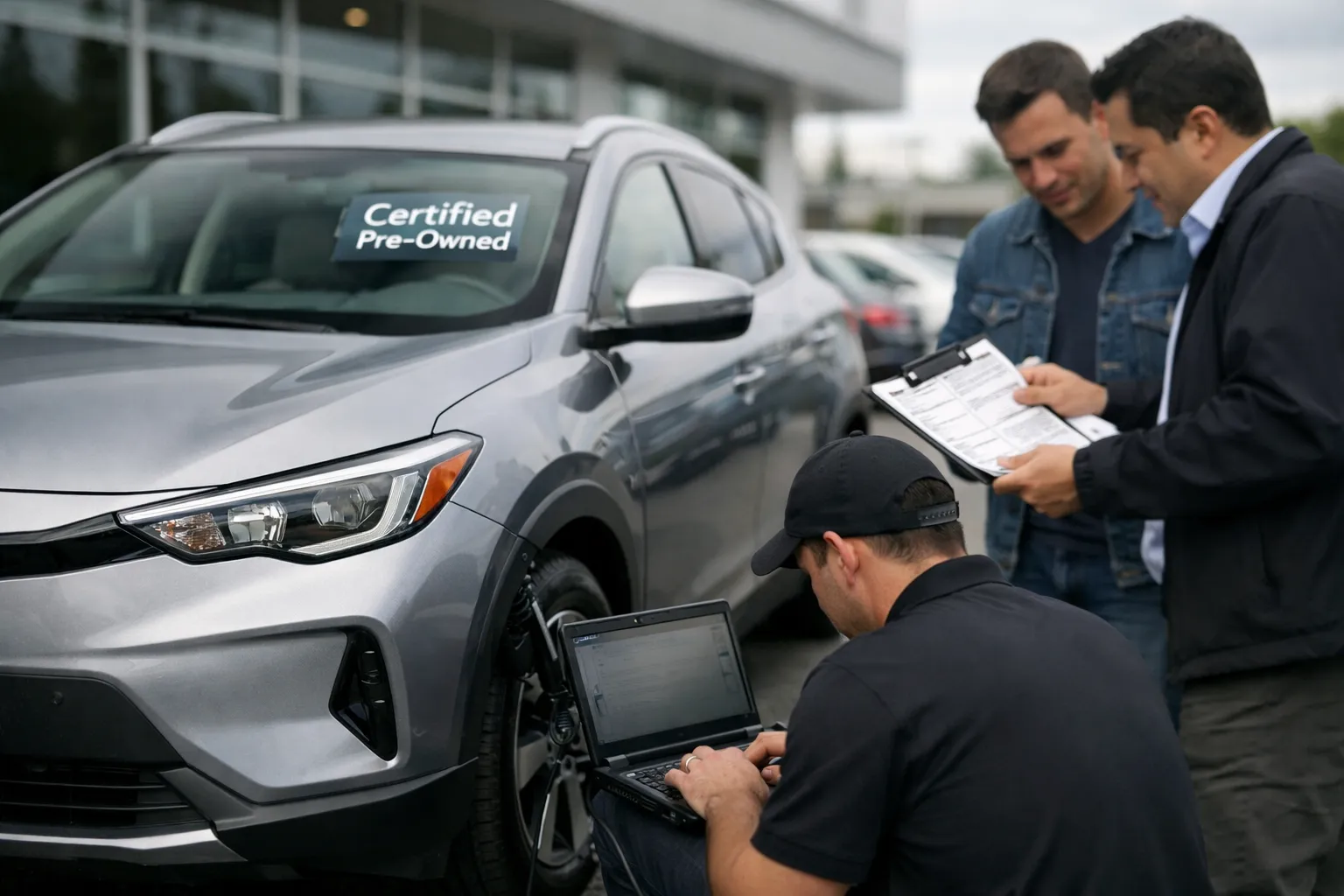
- Hire an EV‑certified technician. A PPI should validate thermal management, inspect high‑voltage cabling and charge ports, read any accessible pack‑level fault data using aftermarket tools, and inspect coolant lines and pumps. Use specialist services recommended by EV owner groups or your local EV shop—general PPIs commonly miss EV‑specific failure modes.
- Use third‑party battery analytics when useful. Independent firms (for example, Recurrent and others) can analyze charge patterns and estimate degradation trends when telematics are available. Treat these analyses as complementary to OEM SOH reports and expert inspections.
How to interpret battery SOH in August 2026
SOH reports express remaining usable capacity as a percentage. Use these practical benchmarks as a starting point (adjust for model, climate, and charging history):
- 1–3 years old: ~92–99% SOH is common for modern liquid‑cooled packs.
- 3–6 years old: ~80–92% SOH is typical, though variation grows with climate and heavy DCFC usage.
- Under ~70–75% SOH: Treat as a warning unless the price accounts for refurbishment or replacement.
Why this matters: battery replacement or major refurbishment is the single largest EV repair cost. Modern lithium‑ion packs generally lose capacity roughly 1–3% per year under normal mixed use; heavy DC fast‑charging and sustained high ambient heat accelerate loss. Use OEM warranty status and recent repair history to gauge near‑term risk.
Valuing battery replacement risk and negotiating price
- Get replacement and refurbishment quotes. Ask the dealer for OEM replacement quotes and obtain independent estimates for refurbished modules. In many markets in 2026, refurbished modules or module‑level repair can reduce cost materially versus a full OEM pack—get written estimates from both sources.
- Calculate a prorated adjustment with an example. Example method: if an OEM full pack replacement quote is $12,000 and measured SOH is 80% (20% wear), treat the theoretical remaining battery value as $9,600 and $2,400 as wear. Negotiate a price reduction roughly equal to that wear value, or request a prorated extended battery warranty covering the pack health for a defined period/mileage.
- Use remaining OEM warranty as leverage. Active 8‑year/100,000+ mile battery warranties materially reduce near‑term risk and should be reflected in price. If close to the warranty limit, negotiate accordingly or secure extended coverage.
- Consider conditional escrow or holdback. Ask the seller to place a portion of the purchase price in escrow until an agreed‑upon independent battery health verification is completed within a short window after sale.
Practical ownership checks after purchase
- Home charging compatibility: Verify onboard AC charging rate (for example, 7.2 kW vs 11 kW) and confirm whether your home EVSE and electrical service support it; have an electrician confirm circuit capacity if upgrading from a 1‑phase to 2‑ or 3‑phase setup where applicable.
- Software updates and account transfer: Ensure the seller completes any required OEM account transfer steps and that software is updated to the latest safety/BMS version before you take delivery.
- Service access and parts availability: Confirm local dealer and independent shop capability for your model; some newer brands expanded service footprints in 2025–26, but gaps remain in parts availability for some models.
- Record keeping: Retain copies of every diagnostic report, CPO paperwork, software update record and any subscription transfer receipts; these documents support warranty claims and future resale.
Common mistakes to avoid
- Accepting only verbal assurances—insist on printed/digital OEM SOH reports and written warranty terms.
- Skipping a true charging session—don’t rely solely on a short test drive; a DCFC and Level 2 test reveal real charging behavior.
- Ignoring subscription costs—factor recurring fees (navigation, premium connectivity, ADAS subscriptions) into total cost of ownership.
- Assuming all software features transfer—get explicit, written confirmation of which connected services will transfer to you.
Pro Tips
- Bring a charging‑app‑savvy friend: An experienced friend can speed charger rosters, adapters, and charger authentication while you review paperwork.
- Request a recent charge‑curve export: Some dealers can provide a CSV of recent charging sessions or a charge curve screenshot showing initial kW and taper behavior—this helps estimate stress history.
- Negotiate a battery‑top‑up warranty: Many dealers will add a 6–12 month prorated battery health warranty or extend CPO protection at close—ask for it in writing.
- Consider one‑owner, lease‑return CPOs: Vehicles maintained by OEM programs or single‑owner fleet returns typically have cleaner logs and predictable maintenance histories.
Sample timeline and checklist (practical)
- Pre‑shopping (1–3 days): select models, request VINs for target listings and ask for SOH reports up front.
- Dealer screening (same day): confirm VIN, request OEM SOH and recent update logs before visiting.
- On‑lot testing (1 day): complete test drive, Level 2 and DCFC checks, confirm paperwork and subscription transfer policy.
- Independent PPI (1–4 days): schedule and review EV specialist inspection and any battery analytics reports.
- Negotiate & finalize (1–3 days): secure any promised repairs or warranty addenda in writing and set conditional escrow if needed.
- Delivery & 30‑day follow‑up: confirm software updates, account transfers and inspect for promised fixes.
Why this matters now
As of August 2026, buying a CPO EV is more transparent than earlier in the decade: connector standards have consolidated, battery reporting is more common, and independent diagnostics are easier to obtain. Still, battery health and software/subscription transferability remain the primary financial and ownership uncertainties. Treat documentation and independent verification as non‑negotiable; that discipline protects your wallet and preserves your ownership experience.
FAQ
Is a CPO EV safer than a private‑party purchase?
Generally yes. Reputable CPO programs include a documented inspection, reconditioning and some factory‑backed warranty coverage, which reduces risk versus a private sale. However, CPO program contents vary—insist on OEM SOH diagnostics and read the exact warranty wording before you buy.
How much SOH should I accept for a 4‑year‑old CPO EV?
For modern, liquid‑cooled packs, roughly 80–92% SOH at 4 years is common; below ~75% should prompt a careful price adjustment or request for additional warranty coverage. Always factor climate and charging history—ask for charging logs if available.
Will advanced ADAS or navigation transfer with a used EV?
Sometimes. Some OEMs transfer features automatically; others treat advanced driver assistance or cloud services as subscriptions requiring a new owner sign‑up. Get explicit confirmation and, when relevant, documented proof of transfer or a dealer credit for subscription activation.
Can an independent PPI detect all battery problems?
A well‑conducted EV‑specialist PPI can identify many issues—thermal system failures, charge‑port faults, coolant leaks and accessible pack fault codes—but not every latent cell failure. Combine a PPI with an OEM SOH report and, when available, telematics/charging logs for the most complete picture.
Are NACS adapters reliable long term?
Yes when you use OEM‑approved or network‑certified adapters and follow manufacturer guidance. By 2026, major charging networks support NACS directly or through vetted adapters. Confirm the specific adapter's certification and whether its use affects warranty terms for your vehicle.
Disclaimer: This guide reflects best practices and market trends as of August 2026. It is evidence‑based but not a substitute for professional inspection, legal or financial advice. Always consult the OEM, a qualified EV technician, and your insurer or attorney for purchase‑specific questions.