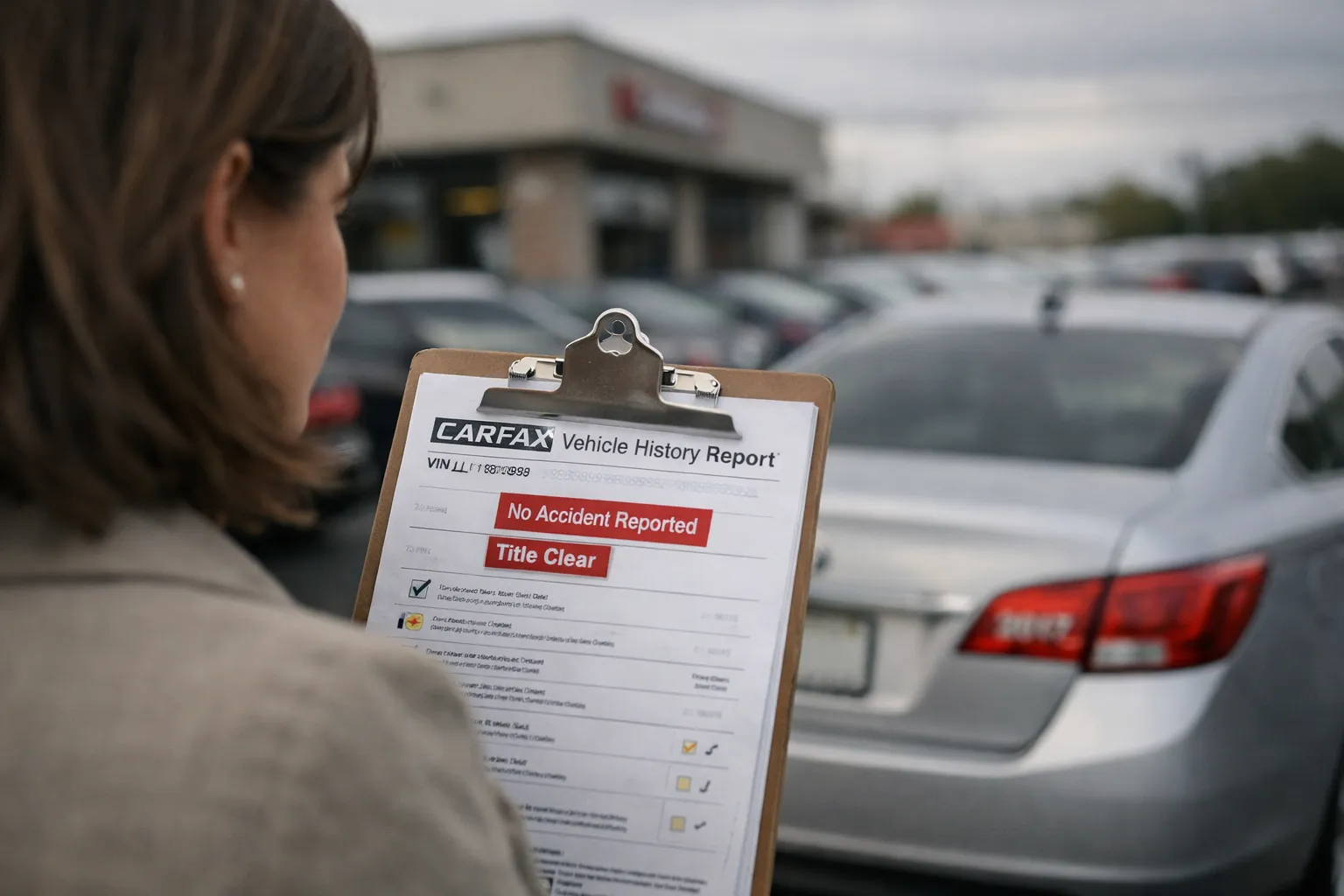
Overview — What this review covers
This update evaluates CARFAX's VIN-based vehicle history reports and its Buyback Guarantee as of July 2026. Key specs at a glance:
- What it is: VIN-driven history reports aggregating title brands, mileage records, recorded accidents, service entries, registrations, and recall matches.
- Protection: CARFAX Buyback Guarantee that (subject to terms) repurchases vehicles with undisclosed title brands that should have appeared on the report.
- Where it helps most: fast screening of title brands, mileage anomalies, and documented insurance-history incidents; common integrations with dealer listings and online marketplaces.
Background — Who makes CARFAX and who it's for
CARFAX is operated by a data-aggregation company long-established in the U.S. used-car market. Its primary audience remains retail used‑car shoppers and dealer networks who use VIN reports to accelerate listings and reduce buyer friction. Dealers frequently display free CARFAX links on listings; private sellers commonly supply a VIN and buyers buy single reports.
Features analysis — What the reports actually contain in 2026
- Title and brand data: Branded titles (salvage, rebuilt, flood, lemon law, etc.) appear when reported by states or auctions. This remains CARFAX’s strongest and most objective category.
- Mileage timeline: CARFAX aggregates odometer readings from titles, inspections, and service events to show inconsistencies that can indicate rollback.
- Accident and insurance records: Reported collisions, total-loss events, and police claims appear when an insurance or public record exists; independent-shop repairs without claims often do not.
- Service entries: Increasingly, CARFAX shows more service logs from national chains and some dealer networks, but coverage is still incomplete for independent shops and private receipts.
- Recalls and safety notices: CARFAX links to NHTSA recall lookups by VIN, but recall-repair status is mixed—manufacturers and dealers don't always push repair records into consumer databases promptly.
- Buyback Guarantee: Provides an explicit remedy for certain undisclosed title-brand omissions. Coverage is still narrow (title-brand only) and subject to eligibility windows and exclusions.
What's new or different in 2026 (market context and trends)
Several market changes matter for buyers in mid‑2026:
- EVs and battery records: Used EV volume has grown; battery condition and replacement history are now critical. CARFAX reports rarely include granular battery state‑of‑health logs—those live in OEM telematics and service portals.
- ADAS and software histories: Modern ADAS recalibration and software updates are important for safety and value. These events often occur at OEM dealers and may not be visible unless the service provider contributes records to CARFAX.
- Telematics and connected‑car data: More manufacturers retain rich telematics records (charge cycles, crash telemetry). Access to these records is uneven and, where available, typically requires OEM authorization or a dealer report.
- Title-data improvements: Federal and state efforts to improve NMVTIS reporting have reduced some instances of title washing, but gaps persist—so cross-checks remain essential.
Strengths — where CARFAX helps most (updated)
- Fast, centralized screening: It remains the quickest way to filter listings for branded titles, mileage discrepancies, and obvious red flags.
- Dealer transparency tool: Listings with free CARFAX links reduce friction and make it easier to compare history across multiple vehicles.
- Buyback guarantees as a negotiating lever: When valid, the Buyback Guarantee can push sellers or dealers to be transparent or to price accordingly.
Limitations and failure modes — what buyers still need to watch
The biggest and most persistent gaps:
- Unreported repairs: Independent-body-shop repairs, private sales repairs, and undocumented structural fixes commonly do not show up.
- EV battery and software histories: Battery replacements, thermal events, or repeated charging anomalies are often invisible to CARFAX unless recorded by a reporting service.
- Recall repairs: CARFAX may show an open recall, but whether the repair was completed is not always present—confirm directly with the manufacturer or dealer service history.
- Buyback Guarantee exclusions: The guarantee is not a bumper-to-bumper safety net—mechanical failures, prior commercial use not reflected in title branding, and many other scenarios are excluded.
Fresh real-world examples (anonymized)
Example 1: A 2019 electric crossover arrived at a buyer’s inspection with an OEM-replaced battery pack. The CARFAX report showed routine dealer service but no battery swap because the replacement was logged to the manufacturer’s telematics portal—not a data feed CARFAX received. The buyer negotiated for a battery health certificate obtained from a dealer before purchase.
Example 2: A pickup traded near hurricane season later showed extensive underbody corrosion and damaged wiring consistent with saltwater exposure. The title was clear, and the CARFAX report lacked flood branding because the original owner had repaired the truck via a private shop and did not file an insurance claim. An inspector and a detailed underbody photo series uncovered the issue.
Pricing and value — practical expectations for July 2026
Many dealers still display a free CARFAX report with listings. Buying a report directly for a private-purchase VIN is common; CARFAX offers single-report purchases and subscription bundles. Price points fluctuate, but expect pay-per-report or a small bundle for active shoppers. For serious buyers, the incremental cost of an AutoCheck, an NMVTIS check (usually low-cost), and a proper pre‑purchase inspection is modest relative to purchase price and value-preserving.
Who it's for — updated guidance
- Good fit: Browsers and comparison shoppers who want quick screening across many listings; buyers of late-model non‑EV cars where title and mileage are the main concerns.
- Not sufficient alone: Buyers of EVs, vehicles with ADAS, high-mileage or high-value models, or cars from hurricane/flood regions. In these cases, add OEM service queries, battery health reports, and an expert inspection.
Alternatives and cross-checks
Best practice is combination: use CARFAX plus at least one other check and a physical inspection.
- AutoCheck (Experian): Different data sources and a numeric score that can surface auction activity and sale clusters.
- NMVTIS: Federal title-branding source—especially valuable for confirming branded titles across states.
- Manufacturer/dealer service histories and telematics: For EVs and ADAS vehicles, request OEM service receipts or ask the dealer to pull telematics/service logs tied to the VIN.
- Independent pre‑purchase inspection (PPI): A thorough PPI — and for EVs, a battery health test — is essential.
Practical checklist for using CARFAX in July 2026
- Verify the VIN on the CARFAX report matches the vehicle’s VIN plate, door jamb, and title.
- Run an AutoCheck and an NMVTIS lookup for title-brand consistency.
- If the car is electric or has ADAS, request OEM service logs or a dealer-supplied telematics/service printout.
- Read the Buyback Guarantee terms carefully—note the claim window, required documentation, and excluded scenarios.
- Commission a focused PPI: include ADAS calibration checks, frame-level inspection, and for EVs a battery‑state‑of‑health scan.
- When in doubt, ask the seller for original service invoices and look for photo evidence of repairs (before/after pictures) or calibration paperwork.
FAQ
Is CARFAX enough to prove a car hasn't been in a serious accident?
No. CARFAX shows reported claims and public records but misses independent-shop repairs and unreported incidents. Always get a PPI and use paint-depth, frame, and structural checks to detect hidden repairs.
Will the CARFAX Buyback Guarantee cover an undisclosed flood-damaged vehicle?
Only if the flood damage resulted in a title brand that should have been on the report and if the vehicle and claim meet CARFAX's eligibility criteria and timing. Floods repaired without title branding or insurance claims are commonly excluded—file claims only after confirming the guarantee applies.
How do I check EV battery history if CARFAX doesn't show it?
Ask the seller or dealer for OEM service records, a battery-health test from a qualified EV shop, and any telematics printouts the OEM or dealer can provide. Some third-party labs also offer pack diagnostics; include that in your PPI for a used EV purchase.
Should I trust a CARFAX report provided by the dealer?
Use it as a starting point, but independently verify the VIN, run your own AutoCheck and NMVTIS, and get a PPI. Dealers can accidentally or intentionally show the wrong VIN or an incomplete report.
Verdict — the bottom line for July 2026 buyers
CARFAX remains a fast, practical first step for used‑car shoppers in mid‑2026: it aggregates multiple public and private sources, flags many title and mileage issues, and its Buyback Guarantee is a narrow but real backstop for undisclosed title brands. However, its blind spots matter more than ever—EV battery histories, ADAS/software service logs, and independent-shop repairs frequently sit outside the data feeds CARFAX receives. Use CARFAX for efficient screening, but pair it with an AutoCheck, an NMVTIS title check, and a targeted PPI (including battery or ADAS checks for modern vehicles). For buyers of EVs, vehicles from flood-prone regions, or high-dollar purchases, insist on OEM/dealer service verification or walk away—CARFAX should inform the conversation, not replace inspection and verification.