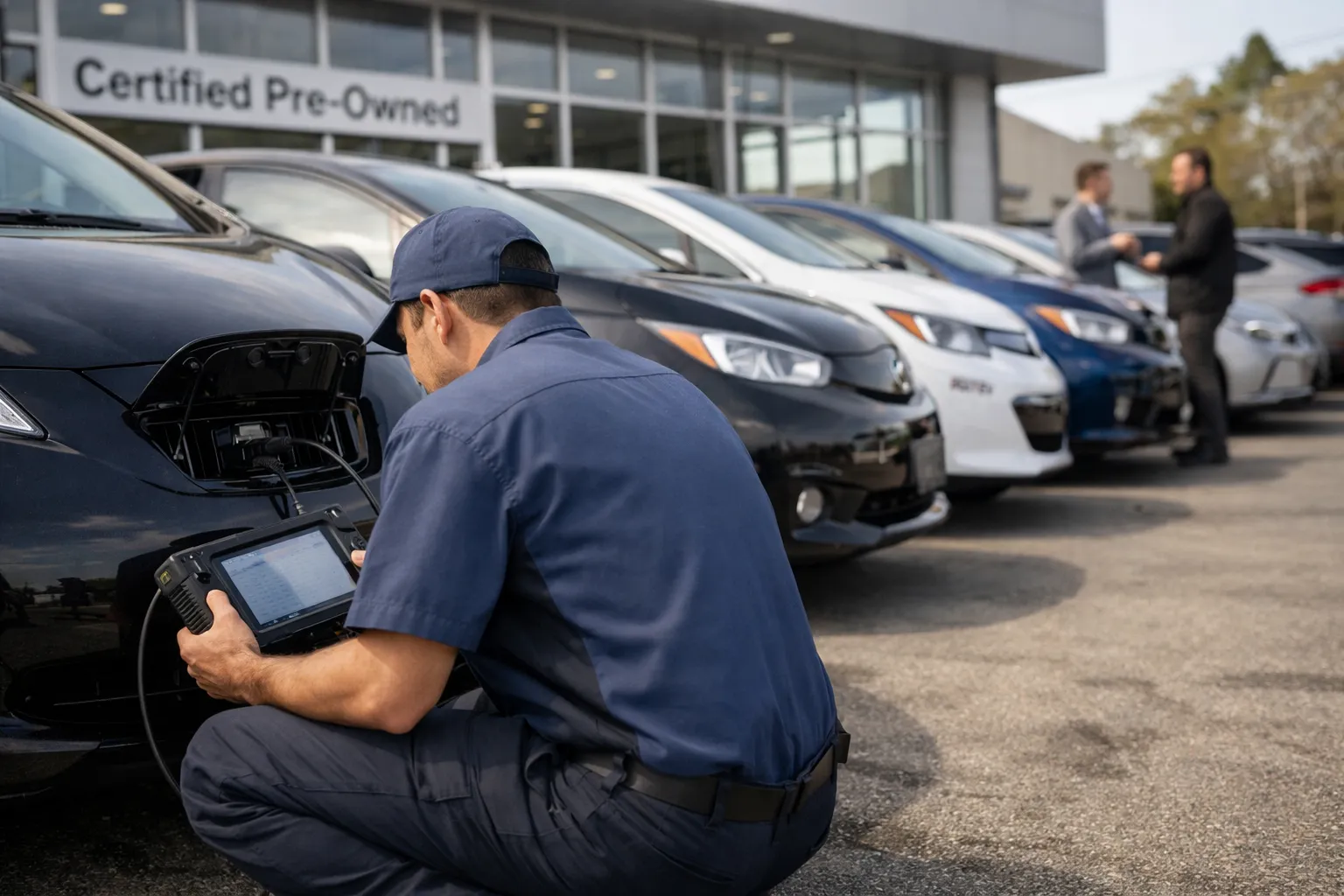
Overview
This update examines CPO (certified pre‑owned) EV premiums as of October 2026: how much the premium has changed, why it moved, what the latest regional and model-level patterns look like, and concrete, up‑to‑date tactics buyers can use now. For car‑buying enthusiasts the question is practical: when does paying a CPO markup make sense, and how large is that markup today?
Background: where the market stood and why it mattered
During the 2020–2023 run‑up in used‑vehicle values, CPO badges and manufacturer-backed battery warranties carried visibly higher price tags. From 2024 into 2025 that premium began to compress as late‑model lease returns hit the market and independent battery diagnostics became common. By October 2026 the market has moved further: CPO units still often command a premium over comparable non‑CPO EVs, but the gap is smaller, more variable by model and region, and more negotiable than it was at the peak.
Data and evidence: what changed through 2026
Multiple industry trackers, dealer networks and listing platforms show three consistent patterns in 2026:
- Supply of late‑model used EVs remains elevated. Lease return cohorts from 2021–24 continue to feed the wholesale and retail channels, increasing available certified inventory for many mainstream models.
- CPO premiums have narrowed into low single‑digit to low‑double‑digit percentage points in many mass‑market segments, compared with the larger double‑digit premiums seen in 2021–23. The compression is most pronounced on high‑volume compact crossovers and sedans.
- Regional and model dispersion is significant. Coastal metros with high EV adoption still show measurable CPO advantages for certain brands; inland and Sunbelt markets with weaker used‑EV demand show the most compression, and in some ZIP codes CPO units are priced at parity with non‑CPO listings after incentives.
What to look for in the raw data: aging CPO inventory on dealer lots, more frequent temporary incentives on certified units, and shorter days‑on‑lot for non‑CPO EVs that are paired with third‑party warranty sales. Wholesale auction signals—where many lease returns clear—continue to shape retail pricing; dealers facing floorplan costs offer financing sweeteners rather than large sticker cuts on certified units.
Why CPO premiums have continued to ease (2026 updates)
The five interlocking forces we identified earlier remain relevant in 2026, with new developments amplifying each:
1. Persistent volume from lease returns and higher used‑EV turnover
Lease maturities from 2021–24 have continued to deliver higher-than‑normal volumes of late‑model EVs. Increased OEM leasing during the EV ramp-up and more frequent short‑term lease promotions in 2022–23 mean the supply base for certified programs remains deeper than traditional CPO pipelines expected.
2. Maturing battery diagnostics and secondary market services
Independent battery‑state services (including third‑party apps and dealer‑available diagnostics) are now standard in many markets. Tools such as cell‑level capacity reports, public charging footprint checks, and service‑history apps give buyers confidence to evaluate non‑CPO EVs. Battery refurbishment and validated remanufacturing offers—now offered by several specialist firms and by a few OEMs—also reduce perceived battery risk, lowering the unique warranty value of CPO certificates.
3. Policy changes and localized incentives
Through 2026 a patchwork of state and utility programs has continued to shape demand. Several states and utilities expanded targeted used‑EV incentives or trade‑in bonus programs, supporting prices in specific metro areas. Conversely, stronger incentives or lease deals on new EVs in some regions make new vehicles relatively more attractive, pulling some buyers away from used and weakening certified premiums locally.
4. Financing dynamics and floorplan strategies
While overall interest‑rate volatility eased somewhat from 2024–25 peaks, financing still materially affects monthly‑payment comparisons. Dealers increasingly use promotional CPO financing, cash‑back packages, or maintenance credits rather than cutting sticker price—this compresses the observable price gap while preserving dealer margin. Captive lenders’ adjustments to residual assumptions on newer EVs also influence wholesale pricing and trade values.
5. OEM and dealer program evolution
Manufacturers have widened or standardized CPO eligibility for some models while tightening it for others. A few OEMs introduced more transparent warranty transfer rules or extended battery‑warranty options for certified units in 2026, increasing the perceived value of CPO for those brands. At the same time, many dealers have added third‑party warranties and return windows as alternatives to traditional CPO badges, creating more choices for buyers.
Which models and markets still carry meaningful CPO premiums?
- Luxury and low‑volume performance EVs: scarcity in certain markets still supports stronger CPO premiums—buyers continue to pay for brand assurance and dealer‑backed inspection reports.
- Batteries with limited public diagnostics: models where OEM battery management systems do not expose detailed cell‑level health to third parties often retain higher CPO value.
- Regions with used‑EV incentives: markets that offer targeted used‑EV rebates or robust infrastructure (e.g., certain coastal metros) sustain higher certified pricing for popular models.
Conversely, for high‑volume mainstream models with large lease pools—compact crossovers and affordable sedans—the CPO addition frequently amounts to a much smaller effective premium after you price out equivalent third‑party warranties and diagnostics.
Multiple perspectives: dealers, OEMs, and buyers
- Dealers tell us they seek to manage floorplan costs and often prefer bundling finance or service concessions rather than cutting sticker on certified cars; this can make “effective” CPO premiums smaller than advertised gaps.
- OEMs use CPO programs to protect brand reputation in the used market; several have added clearer warranty transfer rules in 2026 to reduce friction for buyers and to preserve residual values.
- Independent analysts note that as battery risk becomes easier to quantify, the unique insurance value of a CPO badge declines—so buyers should price the warranty as a separable product.
- Buyers increasingly rely on quantified battery‑SoH reports from providers and on nationwide search tools to arbitrage regional price spreads.
Practical, updated buying tactics — what to do right now (Oct 2026)
Use these step‑by‑step actions when evaluating a CPO EV today.
- Price the warranty separately. Ask the dealer to itemize the CPO package. Get quotes for equivalent third‑party battery and powertrain warranties to compare effective cost.
- Require an explicit battery SoH report. Request cell‑level or pack‑level health data from the dealer or run an independent test (services such as independent diagnostic firms and many third‑party inspection shops now offer validated reports).
- Confirm transferability and exclusions. Verify manufacturer battery‑warranty transfer rules, any fees, and precisely what battery degradation thresholds are covered.
- Compare effective monthly costs, not sticker price. Negotiate financing, dealer fees, and maintenance credits—dealer concessions frequently change the real premium more than a straight price cut.
- Check for local incentives and timing. Search state and utility used‑EV rebates and time purchases to end‑of‑quarter dealer cycles or local auction clearances when inventory pressure is higher.
- Consider battery‑refurb or trade‑up programs. For older packs, a validated refurbishment or reconditioned‑pack option (where available) can shift resale math in favor of a non‑CPO purchase plus warranty.
- Expand your search radius. Because premiums vary widely by ZIP code, cast a wider net and factor in transport costs—moving a car 200–400 miles can still save buyers a meaningful amount.
Case update: practical comparison (Oct 2026)
Example: Two 2023 compact EVs with comparable miles—a dealer CPO listed at $27,000 and a non‑CPO dealer trade‑in at $24,500. If the CPO bundle includes a one‑year powertrain and two‑year battery warranty valued (by independent quotes) at $1,200 and the dealer is willing to offer 1.5% below their standard retail APR on the CPO, the effective premium shrinks to a few hundred dollars when you calculate monthly payments and expected repair exposure. If a third‑party battery warranty can be had for $900 and a reputable SoH report is available, the non‑CPO option becomes clearly preferable for a price‑sensitive buyer.
Implications for buyers and the used‑EV market
For buyers: the market gives you leverage. CPO remains valuable when you cannot independently verify battery health or when an OEM’s warranty transfer rules materially reduce risk. But for many mainstream models and in many regions, a non‑CPO purchase plus validated battery diagnostics and a targeted warranty will deliver equal or better value.
For the market: expect continued segmentation. CPO will retain a role for luxury and limited‑supply models and where OEMs standardize transferable battery protections. For mass‑market models, third‑party services, battery refurbishment, and more granular data will continue to push premiums lower.
Outlook: what to watch next
- OEM warranty policy updates: any manufacturer move to standardize transferable battery warranties will increase CPO value for affected models.
- Second‑life battery markets and refurbishment scale: wider availability of validated remanufactured packs could further compress CPO premiums for older models.
- Interest‑rate moves and floorplan cost changes: falling rates would widen effective premiums, while persistent floorplan pressure will keep dealers leaning on bundled concessions.
- State and utility used‑EV incentive rollouts: new pilots or expansions in high‑demand metros can sustain higher certified prices locally.
Checklist: what to get from the dealer or seller
- Written CPO inspection report and an explicit list of covered components.
- Battery state‑of‑health or capacity report and a copy of manufacturer warranty transfer terms.
- Breakdown of price vs. added warranty/coverage line items and alternative third‑party warranty quotes.
- Financing offer in writing with APR and any promotional reductions separately stated.
- Return, exchange, or buyback terms for the certified unit, if any.
FAQs
Is a CPO EV still worth the premium in 2026?
Sometimes. It's worth paying when you cannot independently verify battery health, when the OEM offers a clearly transferable and generous battery warranty, or when the dealer's total package (financing, maintenance, return window) measurably reduces your expected ownership risk. For many mainstream models in many regions, a non‑CPO purchase plus validated diagnostics and a targeted third‑party warranty will be the cheaper, lower‑risk option.
How do I verify a battery state‑of‑health?
Ask the dealer for a cell‑ or pack‑level SoH report; if unavailable, pay for an independent diagnostic service. Look for reports that show usable capacity (kWh) versus original capacity, and any evidence of thermal events or module imbalance. Reputable third‑party services and many independent shops provide standardized reports you can use in negotiations.
Can I transfer an OEM battery warranty to a used buyer?
Policies vary by manufacturer. Some OEMs allow transfers with no fee, others require dealer paperwork or charge a transfer fee, and a few have restrictions. Always get transfer terms in writing before you finalize the purchase and factor any fees into your TCO math.
Should I buy an extended warranty on an EV battery?
Only after you quantify the remaining OEM warranty, obtain an SoH report, and compare third‑party warranty costs. Extended coverage can be good value for vehicles with uncertain battery health or for buyers planning long ownership horizons, but it’s often unnecessary when a robust OEM warranty remains and SoH is strong.
What regional signals tell me whether to hunt for a CPO?
Look at local listings: if certified units sit longer than 30–45 days, or if there are multiple similar certified listings, you likely have negotiation leverage. Conversely, tight certified supply in high‑EV metros combined with limited non‑CPO listings suggests CPO may still command a premium.
Bottom line
As of October 2026, CPO EV premiums are narrower and more conditional than they were at their peak. Buyers who use battery data, price the warranty as a separable good, and negotiate effective terms—not just sticker price—will extract the most value. The chief advantage for enthusiasts: greater transparency and more structured choices. Use that information to turn a softened premium into a better deal.