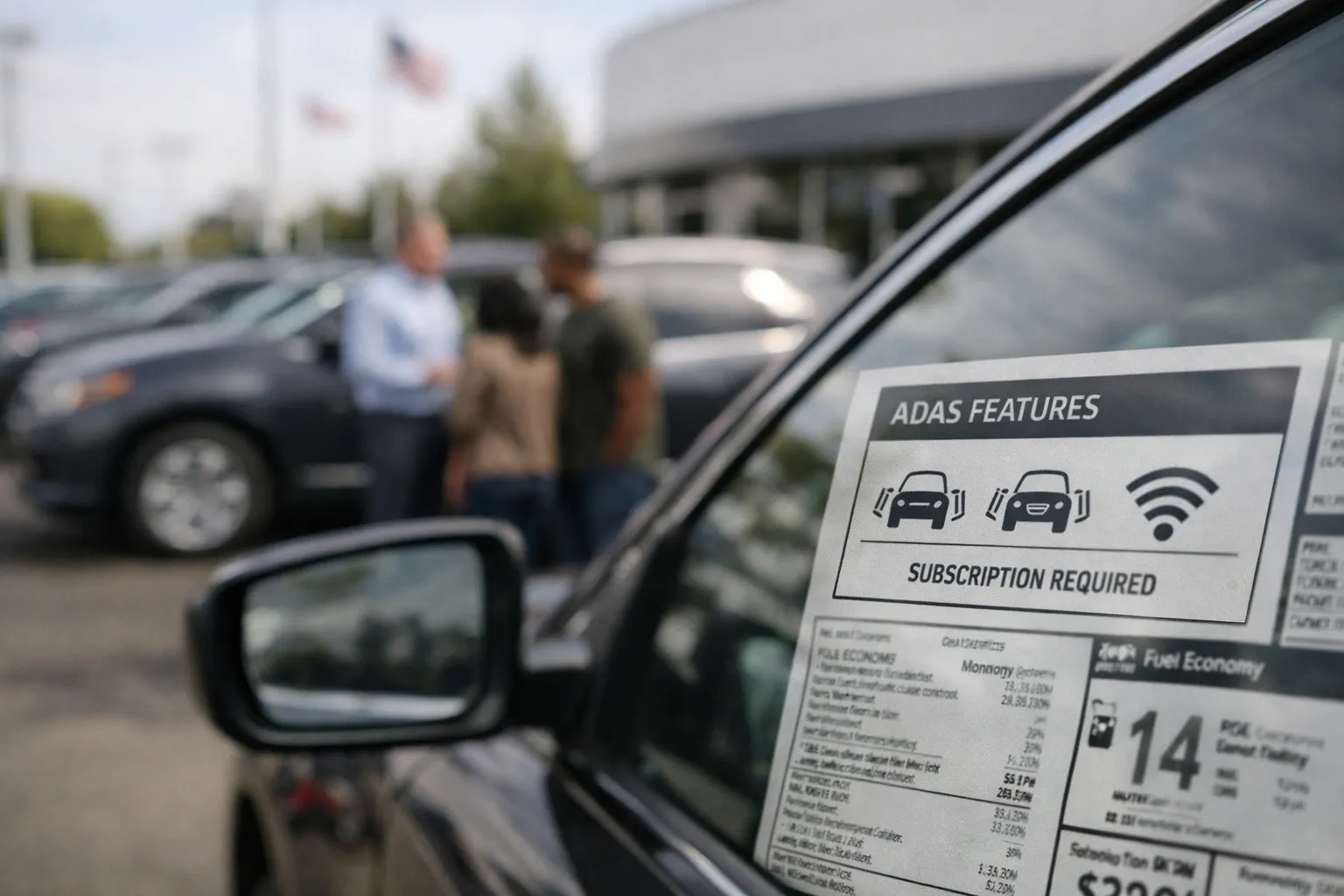
Who: The National Highway Traffic Safety Administration (NHTSA). What: A finalized federal rule requiring compact, standardized summaries of advanced driver‑assistance systems (ADAS) on new‑vehicle Monroney stickers and in dealer advertising. When: Rule finalized in April 2026; this update reflects the status as of July 2026. Where: United States. Why: To reduce buyer confusion about what driver‑assist features actually do, disclose subscription or transfer rules, and improve safety by aligning marketing with real‑world system limits.
Context: why the labels matter
Automaker brand names such as "Autopilot," "Super Cruise" and "BlueCruise" have long masked wide variation in capability and limitations. NHTSA's April 2026 rule responds to years of consumer confusion and inconsistent advertising by forcing a compact, consumer‑facing summary at point of sale. The agency framed the rule primarily as a transparency and safety measure: clearer labels should reduce misuse of partial‑automation systems and help buyers compare packages across makes and models.
What the rule requires (recap)
The rule mandates a standardized ADAS summary box on every new‑vehicle Monroney sticker and an identical summary in any dealer advertisement or online inventory entry. Required elements include:
- System names (e.g., lane‑keeping assist, adaptive cruise control, hands‑free driving)
- Declared automation level and typical operation, shown on a consumer‑friendly scale
- Core operational limits (speed ranges, road types, weather/visibility constraints)
- Whether hands‑on monitoring is required or permitted
- Subscription or paid‑feature status and whether the feature transfers on sale
- Most recent calibration or sensor repair date, if available
Labels must use a common icon set and four short bullet lines so consumers see consistent information across brands and channels.
Updated timeline and compliance dates (as of July 2026)
- April 2026: Rule finalized. Compliance clocks start.
- 18 months for Monroney stickers: compliance due October 2027 for new‑model on‑lot stickers.
- 12 months for dealer websites and printed sales materials: compliance due April 2027.
- 30 months for certified pre‑owned (CPO) inventory and dealer trade‑ins: compliance due October 2028.
These calendar targets mean dealers and manufacturers have a short runway for web updates but more time to address legacy inventory and trade‑ins.
Early implementation signals — July 2026
Since April, a number of manufacturers and large dealer groups have begun pilot implementations. Several OEMs have updated online configurators and owner portals to display abbreviated ADAS summaries voluntarily; some national dealer chains have added ADAS summary fields to their inventory software in advance of the April 2027 website deadline. At the same time, smaller independent dealers report software integration challenges, particularly for accurately reporting calibration histories and subscription transfer rules for trade‑ins.
Regulatory guidance is still evolving: NHTSA has said it will publish compliance checklists for dealers and is encouraging automakers to make subscription transfer policies machine‑readable to ease online disclosure. Consumers should expect staggered adoption — full uniformity across all dealer websites is unlikely before the April 2027 deadline.
What this means for new‑car buyers
The label is intended to bring immediate clarity on two fronts:
- Feature capability: Plain‑language limits (for example: "operates at 25–75 mph on divided highways; requires driver hands on wheel") make it easier to judge whether a package fits your driving patterns.
- Subscription and transferability: Buyers will see whether a driver‑assist function is tied to an ongoing fee, a one‑time license, or hardware activation — and whether that access passes with the vehicle sale.
In practice, vehicles with transferable subscriptions or recent calibration records are likely to command higher resale values over time; conversely, cars with non‑transferable features or overdue sensor work could face steeper depreciation. Dealers and remarketers are already preparing separate line items in online pricing tools to reflect ADAS transferability and required post‑purchase activation costs.
What this means for used‑car buyers and sellers
Dealers must label CPO and dealer‑sold trade‑ins by October 2028, but many buyers will see ADAS summaries on traded cars earlier as dealers pre‑populate listings. For private‑party sales, the rule does not mandate a standardized sticker, but buyers should ask sellers or dealers for ADAS status as part of the sale paperwork.
Key resale issues to watch: whether the OEM allows subscription transfer, any one‑time transfer fees, and whether recent repairs or calibrations are documented. Items that can materially affect value include a suspended or "locked" software feature and a required sensor recalibration costing several hundred to a few thousand dollars, depending on make and model.
Industry reaction and enforcement posture
Automaker trade groups and dealer associations have publicly expressed support for the rule's transparency goals while asking NHTSA for flexibility on historical records that some legacy vehicles lack. Consumer advocates have called for tight enforcement to prevent misleading post‑sale advertising. NHTSA has signaled it will monitor compliance on dealer websites and Monroney stickers and may pursue enforcement actions under existing consumer‑protection statutes if disclosures are false or omitted; as of July 2026 the agency says it will prioritize outreach and compliance assistance through the fall of 2026.
Practical checklist for buyers (updated July 2026)
- Review the ADAS summary on the Monroney or the dealer listing before test driving. Confirm the declared speed range, permitted road types and monitoring requirements match your needs.
- Ask explicitly whether any ADAS features require an active subscription, whether the subscription transfers at sale, and whether any transfer fee applies. Get the answer in writing.
- Request the vehicle’s ADAS software version, last update date and update history; ask the dealer to install pending safety updates prior to delivery.
- Demand documentation of recent calibrations or sensor repairs if the label lists a calibration date. If no calibration history exists, budget for a pre‑delivery scan and alignment check.
- During a test drive, verify advertised capabilities in safe, legal conditions and note any inconsistent behavior. For used cars, request a pre‑purchase ADAS inspection that includes sensor alignment and diagnostic fault‑code checks.
- When financing, ask your lender whether subscription charges should be included in loan calculations; get any agreement about subscription transfers documented in the sales contract.
What to ask your dealer and lender
Insist that contract language include:
- Explicit confirmation of ADAS transferability or written statement of non‑transferability;
- Any promised software updates or calibrations to be completed before delivery;
- Who pays for post‑sale activations or one‑time transfer fees, if applicable;
- Clear line‑item disclosure of ongoing subscription costs in the buyer’s pro forma payment schedule.
Reactions to watch and what’s next
Through late 2026 watch for three signals that will determine how impactful the labels become: (1) whether major OEMs and dealer networks meet the April 2027 website deadline, (2) how quickly third‑party listing platforms adopt the NHTSA icon set, and (3) whether NHTSA follows outreach with targeted enforcement actions against repeat violators. Also expect automakers to refine online tools that let buyers filter inventory by ADAS transferability and calibration status — a change that will materially shift buying behavior once broadly available.
Frequently asked questions
Do Monroney ADAS labels apply to used cars?
No. The standardized Monroney ADAS label is required for new vehicles by October 2027. Dealers have until October 2028 to apply equivalent summaries to certified pre‑owned inventory and dealer‑sold trade‑ins; private‑party sales are not covered by the federal label requirement.
Will an ADAS subscription always transfer with the car?
Not necessarily. The label must state subscription status and transferability. Some OEM subscriptions transfer automatically; others require a one‑time transfer fee or do not transfer at all. Always get the transfer policy in writing before purchase.
How much does sensor calibration cost if needed after purchase?
Prices vary by vehicle and damage type. Simple camera calibrations often run a few hundred dollars; lidar or radar sensor repairs and recalibrations can cost $500–$2,000 or more, depending on parts and labor. Ask the dealer for documentation of recent calibrations to avoid surprise costs.
Will lenders include subscription fees when calculating loan amounts?
Some lenders may require disclosure of recurring subscription costs to assess total monthly obligations. Discuss subscription costs with your lender up front and request written guidance on whether those fees should be included in loan calculations.
For car‑buying enthusiasts, the NHTSA ADAS label is a practical tool that, once widely implemented, will make it faster to compare driver‑assist packages and reduce post‑purchase surprises. As dealers and OEMs continue implementation through 2027 and 2028, buyers who prepare with the checklist above will be best positioned to value ADAS accurately and avoid costly misunderstandings.