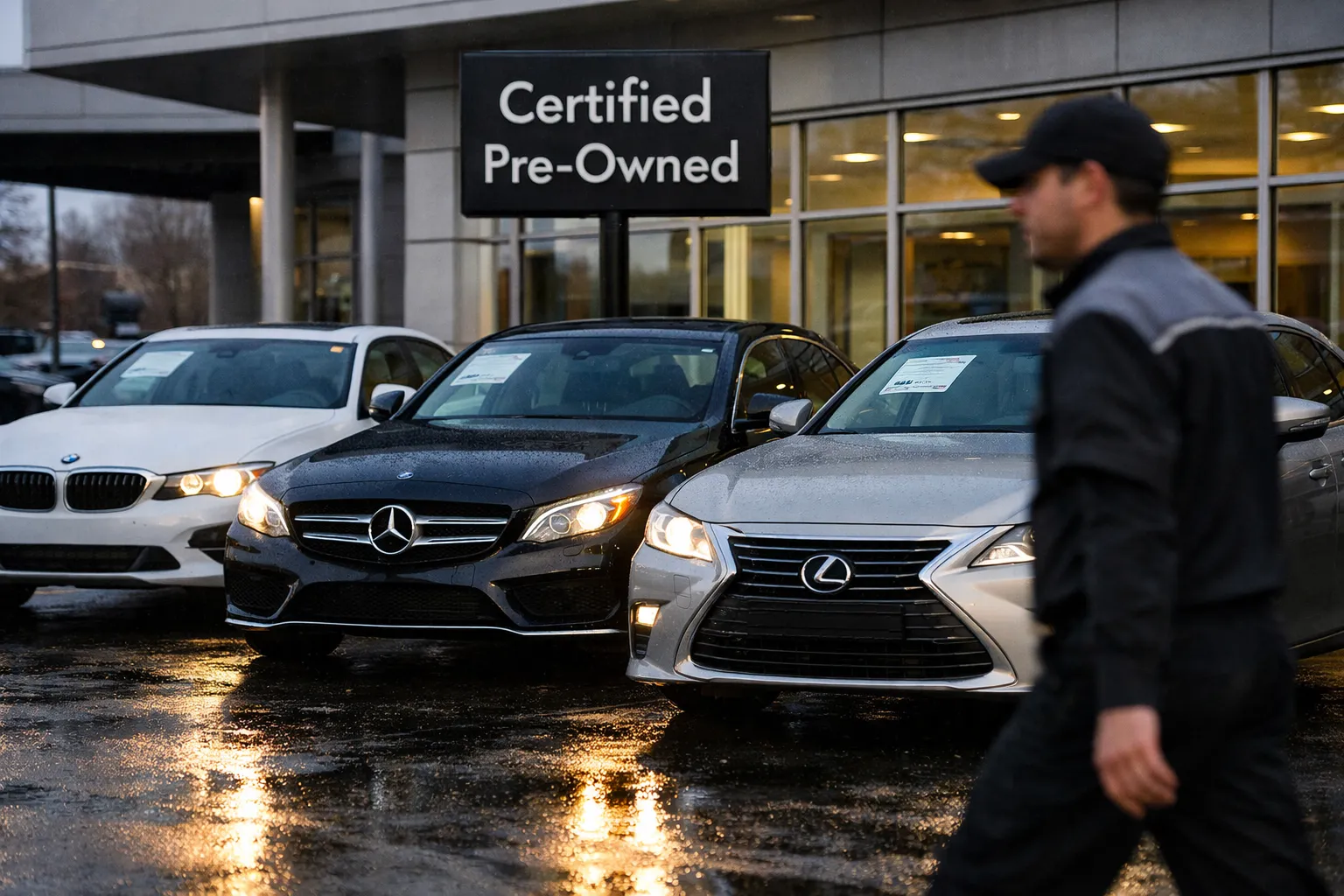
Overview
Certified pre‑owned (CPO) remains one of the clearest ways to reduce risk when buying a late‑model luxury used car. Between March and June 2026 the core question is unchanged—does the CPO badge justify the premium?—but the evidence buyers must weigh has shifted. This update examines what changed in the first half of 2026 for BMW, Mercedes‑Benz and Lexus CPO programs, how new vehicle technology (notably software and electrified powertrains) reshapes inspection and warranty value, and what buyers should do differently today.
Background: why mid‑2026 matters
Two market forces drove the need for an update. First, a deeper pool of EVs and hybrids is reaching CPO age—three‑ to five‑year examples of plug‑in and battery‑electric variants are now common on dealer lots. Second, OEM aftersales practices have continued shifting toward software maintenance (over‑the‑air and dealer updates), subscription‑tied features, and component‑level refurbishments that affect what “certified” covers in practice. These trends change what buyers should look for in inspection reports, warranties and pricing.
Data and evidence: what's different in 2026
- EV/hybrid checks are now a standard buyer ask. More luxury CPO listings in mid‑2026 show battery health or capacity checks in the inspection notes. For buyers this is essential: battery capacity, state‑of‑health (SOH) printouts and documented thermal‑management repairs materially affect resale value and operating range.
- Software and telematics matter more. Mercedes and BMW increasingly include vehicle software status as part of their certification flow—examples on dealer listings show "module recode" or "latest OTA update applied." Lexus continues to emphasize mechanical and service‑history hygiene, but its newer models also receive software checks as standard.
- Pricing premiums compressed in many markets. As supply of near‑new luxury cars increased in 2025–26, the average CPO premium versus comparable non‑CPO inventory narrowed in metro markets we reviewed. Premiums remain model‑specific—high‑demand SUVs and electrified variants still command a gap—but the typical broad brand premium has shrunk versus early‑2020 pandemic levels.
- Transferability and subscriptions are a frequent friction point. Buyers report encountering non‑transferable telematics functions or the need to reactivate connected‑services subscriptions after purchase. That can produce surprise monthly costs or feature loss (navigation live updates, concierge services) unless clarified at sale.
Inspection scope: breadth vs. depth in 2026
- Lexus: Still conservative on acceptance thresholds. Lexus CPO listings in 2026 more commonly include a printed inspection packet showing service history, hybrid/battery diagnostics for RX and NX hybrids, and clear reconditioning line items. Lexus dealers tend to exclude vehicles with irregular service records.
- BMW: Continues to focus on driveline, electronics and maintenance compliance. In 2026 BMW’s CPO process increasingly documents software/ECU updates and fault‑code resets performed before sale. Expect a heavier emphasis on maintenance history—BMW accepts vehicles with visual wear more often, but will typically recondition electronics and driveline items to factory standards.
- Mercedes‑Benz: The brand’s CPO process places added emphasis on software integrity and functional system validation. Listings and dealer notes now more routinely list completed software updates, telematics account transfers and module reflashes. For highly optioned S‑Class and E‑Class models, Mercedes' CPO reconditioning may include costlier electronic module replacements.
Warranty and transferability: what to confirm now
Warranties remain the primary rationale for paying a CPO premium, but the landscape has two new realities in 2026:
- Battery and electric drive coverage: For EVs and plug‑ins, buyers must confirm whether the CPO extension covers battery capacity loss or only defects. Some programs extend a specific high‑voltage battery warranty or offer a separate battery health guarantee; others cover battery only under original factory terms.
- Connected‑services and subscriptions: Factory warranties rarely cover the ongoing cost of subscription services. Ask whether features tied to a subscription (real‑time traffic, concierge, remote unlock) will continue post‑sale or whether reactivation fees apply.
Practical steps: insist on the printed CPO warranty booklet at signing, verify the VIN‑specific start date for the extension, and confirm the dealer will handle telematics/connected‑services transfer with the OEM. For out‑of‑state resales, ask how easily the warranty transfers and whether a regional registration requirement exists.
Pricing premiums and depreciation: what's worth the extra cost?
Two 2026 dynamics matter:
- Supply normalization: with near‑new luxury inventory higher than in 2021–23, broad CPO premiums are less automatic. Compare listings by VIN and model year—don’t assume CPO always commands a fixed percentage premium.
- Model‑ and powertrain‑specific risk: complex, high‑tech models (plug‑in hybrids, EVs, top S‑Class trims) still justify larger premiums because out‑of‑warranty failures are costly. For traditionally reliable, mechanically simple models (for example, some Lexus ES/GS/older RX variants) the incremental value of CPO may be smaller.
Rule of thumb for June 2026: calculate the premium against expected repair exposure for the next 12–36 months. If the premium is less than a conservative expected repair cost for likely failure points (battery warranty gap, transmission, major electronics), CPO is usually worth it.
Dealer behavior and transparency in mid‑2026
Dealers still vary widely in how they present and price CPO vehicles. Recent dealer listings show three repeat behaviors:
- Detailed inspection packets on Lexus lots: Lexus dealers more often post inspection summaries and carry fixed CPO pricing with fewer “prep” upsells.
- Value‑add bundling at BMW dealers: BMW stores frequently offer maintenance packages, concierge transfer assistance and optional extended warranties alongside the CPO, which can be layered into financing.
- Software/service bundles at Mercedes dealers: Mercedes dealers sometimes bundle recent module updates or paid telematics transfers as part of the sale—useful, but they can be used to justify higher asking prices.
Buyers should demand a VIN‑level inspection report, itemized reconditioning receipts, and a clear statement of who pays for any unresolved recalls or open service campaigns.
Multiple perspectives
Buyers: want clear, documented protection and predictable costs. Independent mechanics: warn buyers to verify hidden software or subscription costs that dealers may not highlight. OEMs: promote factory backing and franchised repair quality as a key differentiator. Market analysts: note that as EVs enter the CPO cycle the nature of reconditioning and the economics of certification will continue to evolve.
Implications for buyers
In June 2026 "certified" still matters, but in more nuanced ways than before. Key implications:
- For EVs and plug‑ins, battery diagnostics and explicit battery coverage are non‑negotiable.
- For tech‑heavy Mercedes and top‑trim BMWs, CPO adds value primarily by shifting expensive electronics and software risk back to the manufacturer.
- For many Lexus models, CPO remains a straightforward way to get a clean, well‑presented car with a modest premium—especially for hybrids with conservative service histories.
Practical June 2026 checklist
- Get the VIN and ask for the complete CPO inspection packet and reconditioning receipts.
- For EVs/plug‑ins ask for a battery SOH/capacity printout and written battery warranty terms.
- Confirm which connected services transfer and whether reactivation fees or subscriptions apply.
- Verify software update history and whether recent OTA or dealer reflashes were applied.
- Compare the CPO price to identical non‑CPO listings and calculate whether the premium is less than a conservative estimate of future repair exposure.
- Check online reviews and forum threads for local dealer claim‑handling reputation—warranty labor delays are commonly discussed by owners and can be a real after‑purchase cost.
Outlook: what to watch for in the rest of 2026
Expect three continuing trends: (1) more explicit battery and high‑voltage system protocols in CPO checklists; (2) greater documentation of software and telematics status in certification paperwork; and (3) continued compression of broad CPO premiums as supply balances. Legislators and consumer advocates may press for clearer disclosure rules about subscription features and warranty transferability—buyers should watch mailing lists and trade press for any rule changes affecting CPO transparency.
Bottom line
Through June 2026, CPO status remains a useful tool but buyers must dig deeper than the badge. Lexus still tends to deliver conservative acceptance and clear presentation; BMW balances performance expectations with thorough mechanical and software checks; Mercedes puts software and system integrity front and center. For EVs and highly‑optioned, electronics‑heavy models the CPO warranty can be decisive—ask for battery diagnostics, software update history and explicit subscription transfer rules before you sign.
How do I verify an EV battery's state‑of‑health before buying CPO?
Ask the dealer for a VIN‑specific battery diagnostic printout showing current capacity or state‑of‑health and the test date. If the manufacturer performs a dedicated battery check as part of certification, get that documentation in writing and confirm any battery warranty extension terms.
Will my connected services and subscriptions transfer with a CPO purchase?
Not always. Some connected features require account reactivation or new subscriptions after ownership transfer. Ask the dealer to confirm which services will remain active, who pays any reactivation fees, and whether the CPO price includes transfer assistance.
Is CPO worth it for a five‑year‑old Lexus hybrid?
Often the value is smaller than for an electronically complex Mercedes or BMW because Lexus hybrids have lower documented repair risk. Compare the CPO premium to expected repair exposure and consider a third‑party short‑term warranty if the premium exceeds likely costs.
Can I negotiate CPO add‑ons and service plans?
Yes. Dealers regularly treat maintenance plans, prepaid service and extended warranties as negotiable. Ask for an itemized price, compare with standalone third‑party options and consider rolling add‑ons into financing only after confirming total cost.