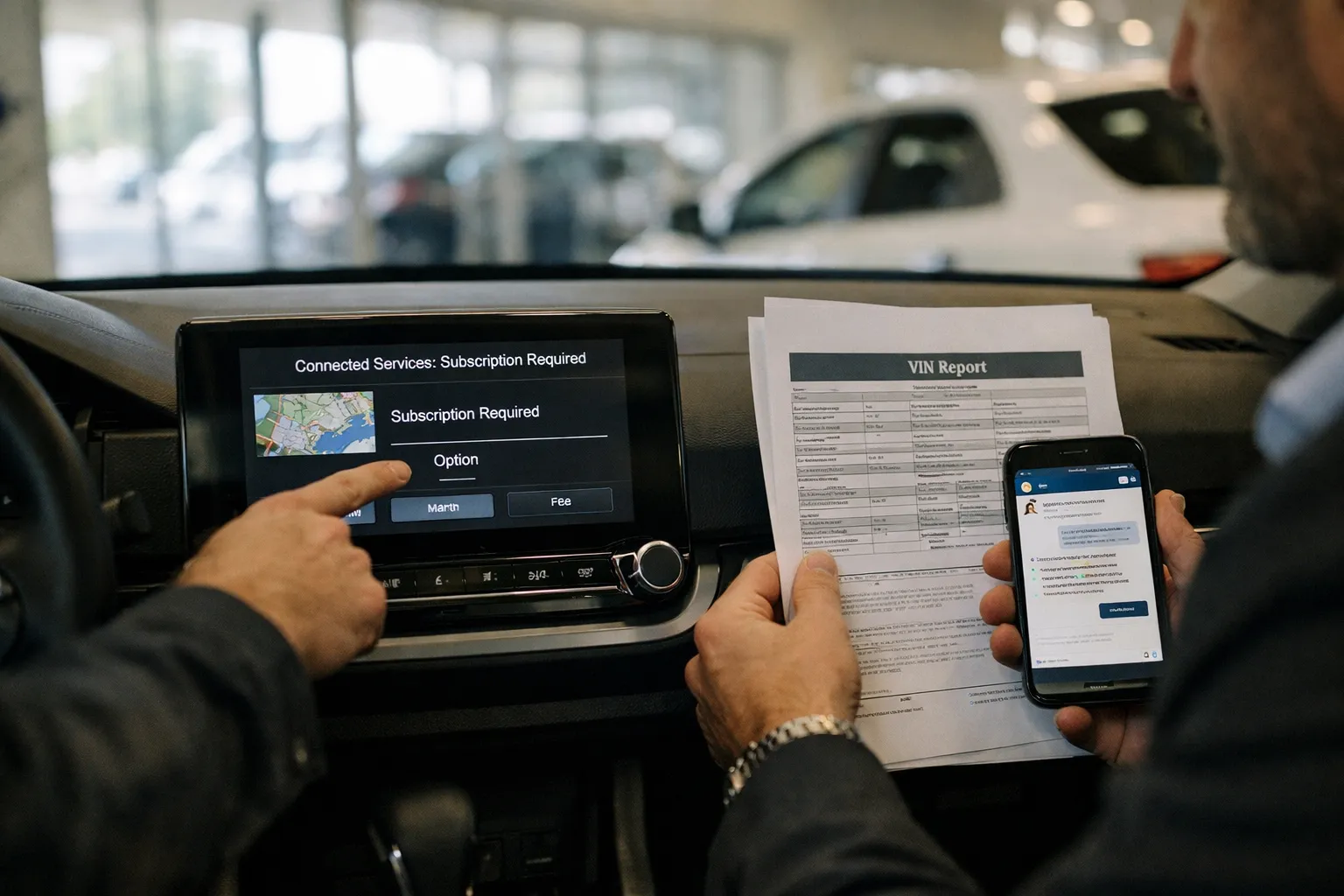
Automakers increasingly move features—navigation, connected apps, remote services, and advanced driver aids—behind ongoing subscription plans. By 2026 many buyers encounter vehicles where attractive functions are cloud-locked or tied to the seller’s account. For car-buying enthusiasts who want the most value for their money, subscriptionized features complicate the purchase math and the inspection checklist.
This guide walks you step-by-step through buying a car that includes factory subscription features: how to spot them in listings, verify whether a feature is active and transferable, negotiate price adjustments, protect your privacy and data, and calculate the total cost of ownership over the time you expect to keep the car.
Why subscriptions matter when buying a car
Subscription features change the economics and experience of ownership:
- Cost: Some subscriptions are a few dollars per month (basic connected services); others exceed $100–$200 monthly for advanced assistance or safety features.
- Transferability: Not all services transfer automatically to a new owner; some are linked to the original buyer’s account and require an OEM account transfer or reactivation.
- Functionality: Sellers may factory-reset vehicles before sale, which can disable cloud-billed features until re-activated.
- Resale value: A vehicle with transferable, prepaid subscriptions or permanently unlocked features is worth more than the same car that loses functions when ownership changes.
Step 1 — Before you shop: research which features are subscriptionized
Start by making a checklist of features you value and whether they are commonly subscription-based:
- Connected navigation and live traffic
- Remote services (remote start, lock/unlock, vehicle locator)
- Over-the-air software updates or performance unlocks
- Advanced driver assistance suites (hands‑on and hands‑off semi-autonomous driving)
- In-car Wi‑Fi and streaming services
- Enhanced security and stolen-vehicle recovery
Use OEM websites and owner forums to confirm which models and model years moved each capability behind a paywall. Popular examples in the market include subscription gateways for advanced driver aids and connected services—knowing the trend helps you ask the right questions.
Step 2 — Spot subscription clues in listings
Ads and listings sometimes hint that a feature requires a subscription. Look for terms like “connected services,” “requires account,” “subscription required,” “connectivity plan,” or “features transferable with account only.”
When a listing is vague, assume the feature might be subscription-locked and ask the seller directly. Examples of questions to ask in the listing or pre-screen call:
- “Are any factory features tied to the seller’s account or require a subscription?”
- “Is the vehicle’s telematics account active, and will those services transfer with the sale?”
- “Are there any prepaid subscriptions on the vehicle, and if so, for how long?”
Step 3 — Verification: use the VIN, OEM, and demo checks
Do not rely solely on seller word-of-mouth. Verify by VIN and by contacting the manufacturer:
- VIN lookup: Ask the seller for the VIN and use it to check the vehicle’s equipment list (dealer service departments and many third-party VIN decoders show factory options).
- Contact OEM support: Call the manufacturer or use official owner portals. Provide the VIN and ask: “Which connected features are factory‑enabled, and which need an active subscription? Are those subscriptions transferable to a new owner?”
- Request proof: Ask the seller for written proof of any prepaid subscription (email receipt, account screenshot) and for a demonstration that features work in-person during a test drive.
- Dealer records: If buying from a dealer, request that the dealer confirms in writing the status of subscriptions and their policy for transferring or pre-paying them.
What to see in a live demonstration
- Ask the seller to show each feature active on the vehicle (navigation live traffic, remote start via app, ADAS mode, Wi‑Fi hotspot connected to a phone).
- Confirm the vehicle is not logged into the seller’s personal account (a factory-reset should be performed and the seller’s account removed).
- Request screenshots or printouts of account pages showing prepaid months or transferability when applicable.
Step 4 — Transferability and account cleanup
Different manufacturers handle account transfers differently. Some features transfer with a VIN-based activation and the automaker can reassign service to a new owner; other services remain tied to an original account and are not transferable.
Ask the OEM support person these concrete questions when you call:
- “For this VIN, what services require the original owner’s account to be removed before the service can activate under a new owner?”
- “Can the OEM reassign prepaid service to a new VIN owner, and what documents are required?”
- “Is there any functionality that permanently requires the original account (e.g., app profiles or remote keys)?”
Require the seller/dealer to perform a factory reset and supply proof the account was disassociated before you pay. If the seller refuses, factor that into your negotiation (see Step 6).
Step 5 — Privacy and data hygiene
Connected cars store telematics, paired phone data, payment tokens, and profiles. Before completing the purchase, insist on these steps:
- Factory reset the infotainment system and mobile apps in your presence.
- Have the seller sign a statement that their accounts are removed and provide screenshots or confirmation emails.
- If buying from a dealer, ask for documentation that the dealer cleared the vehicle’s previous owner account through the OEM portal.
Keeping these record items protects you from unexpected charges and prevents former owners from accessing telematics logs.
Step 6 — Negotiating price with subscription math
When a feature requires a subscription you plan to keep, calculate the present cost and use it to negotiate a price reduction or to ask the seller to pre-pay a certain number of months.
How to calculate:
- Estimate the subscription monthly cost (call OEM or check official pricing).
- Multiply monthly cost by the number of months you would realistically keep the car (e.g., 36 months).
- Discount future payments to present value if you want more precision (optional for enthusiasts).
Example: If an advanced ADAS package costs $25/month and you plan to keep the car 3 years, add $25 × 36 = $900 to your projected ownership cost. Use this number to ask the seller to reduce the asking price by approximately that amount (or by a portion if you’re willing to pay part of the future fees).
Negotiation options:
- Ask seller/dealer to include a specific number of prepaid months (e.g., 12–24 months) at sale.
- Request a price reduction equal to the net present value of the subscription you must purchase.
- Ask for a permanent unlock (one-time purchase) to be included, if feasible, or request the seller to purchase the unlock at closing and provide proof.
Step 7 — Contract language and proof
When you agree terms, add explicit language to the purchase contract or sales invoice that documents subscription status. Sample clauses to request:
- “Seller confirms the following subscription services are active and transferable: [list] — proof attached.”
- “Seller will remove owner account from vehicle and provide OEM confirmation number prior to title transfer.”
- “Seller agrees to prepay X months of [service name] or provide a price reduction of $Y.”
For dealer purchases, insist on a printed invoice showing any credited value for subscriptions or prepayments.
Red flags and when to walk away
- Seller refuses to provide the VIN for verification.
- Seller cannot show the feature working during a test drive.
- Seller refuses to factory reset or remove their account.
- OEM support says the desired service is non-transferable and cannot be reactivated without the original owner.
- Price reduction or prepayment requests are refused and the subscription cost materially affects your ownership budget.
Practical examples and trade-offs
Example A — Remote services only: A compact SUV’s remote start and vehicle finder are behind a $6/month connected-services plan. If you value those features but the seller won’t transfer a prepaid plan, paying the monthly fee yourself costs $216 over three years. If the dealer offers a $200 reduction instead of prepaid months, that is approximately break-even.
Example B — Advanced driving assistance: A midsize luxury sedan lists hands‑free driving and lane-change automation as subscription options—the OEM prices these features at several tens of dollars per month or an optional one-time purchase for a higher upfront sum. If you plan to keep the car long-term and use the feature often, negotiating a price reduction to cover 24–36 months of subscription or asking the dealer to include a permanent unlock is reasonable.
Checklist before you sign
- Have you obtained the VIN and confirmed factory options and which features require a subscription?
- Did you contact the OEM and verify transferability and account-cleanup steps?
- Did the seller demonstrate the features in-person and provide proof of any prepaid subscription?
- Is the factory reset completed and documented (screenshots, OEM confirmation)?
- Is contractual language included to reflect subscription transfers, prepayments, or price adjustments?
Final recommendations for enthusiasts
1) Treat subscriptionized features like recurring fees for any other product. Count them into your total ownership cost before you make an offer.
2) When possible, favor vehicles with permanently unlocked features or documented prepaid subscriptions—those sell easier and preserve resale value.
3) Keep records of account transfers and OEM confirmations in case of future disputes.
4) If you’re unsure about a seller’s claims, insist on a short contingency period in the contract that allows you to verify subscription transferability with the OEM before closing.
Subscription models are part of how cars will be sold more widely in 2026 and beyond. For buyers who do their homework—VIN checks, OEM calls, contractual protections—the subscription era doesn’t have to be a trap. It can be negotiated into the overall deal so you know exactly what you’re buying and what you’ll pay over time.