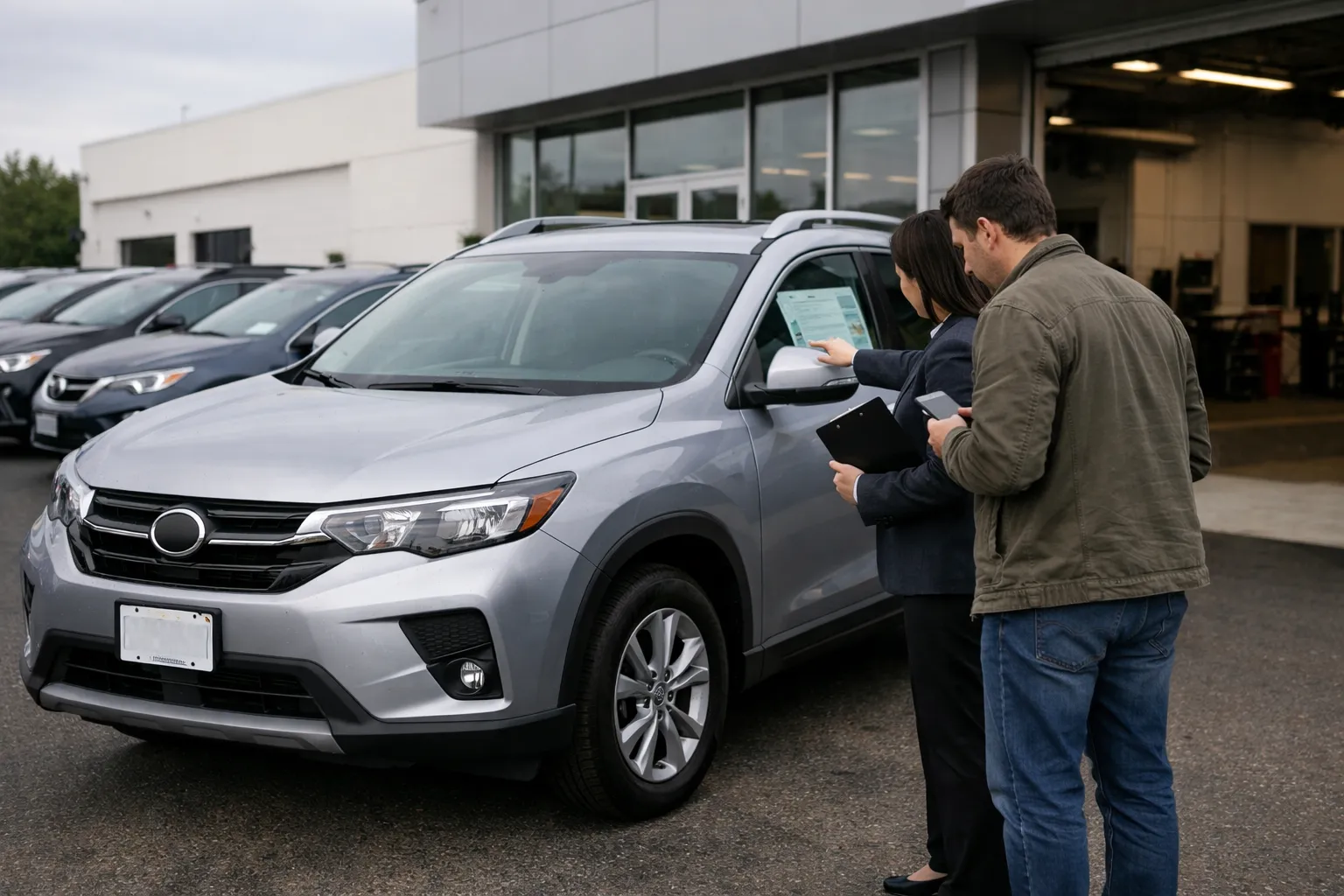
Introduction
What you'll learn: how to find, inspect, verify and negotiate for dealer demos and loaner cars in November 2026. This update adds timely guidance for EV demos, software/subscription issues, and current market behavior. Who this is for: car-buying enthusiasts who want near-new condition at a lower price without surprises. Why it matters: between normalizing inventories and manufacturers managing demo programs more tightly, the right diligence now can save thousands and avoid late surprises from software locks, battery health problems, or warranty start-date confusion.
Prerequisites / Context
Short background you should know before you start:
- Market context: New-vehicle inventory largely normalized through 2026, though availability still varies by region and by model. Popular EVs and constrained luxury models often show smaller demo discounts than mainstream ICE models.
- Demo vs loaner: Demos (used for test drives, sales events, display) and loaners (service-car loans) are typically dealer-owned; warranty effects depend on when first registration occurred. Increasingly, demos may also have telematics or subscription-based features—these affect ownership value.
- Tools you need: VIN lookup (manufacturer site, Carfax/AutoCheck), smartphone for photos and battery/health apps (for EVs), preapproved financing, and a plan for an independent pre-purchase inspection (PPI) when needed.
Step 1 — Research and target selection
- Scan inventory broadly. Use dealer sites, manufacturer CPO pages and third-party aggregators (Cars.com, Autotrader, CarGurus). Filter for "demo," "dealer-owned," "loaner" and note date posted and listed mileage.
- Watch category differences. In 2026, EV demo inventory has grown as brands accelerate retail test-fleet turnover; however, high-demand EVs often carry small or no discounts. Internal-combustion and mainstream crossovers still show the largest demo markdowns in many markets.
- Compare apples to apples. Build comparables for the same trim, pack, paint and options. Pull recent retail sales rather than just asking prices—transaction data (Kelley Blue Book, Edmunds, Cox Automotive summaries) can show realistic discount ranges for your market.
- Set a realistic discount target. Use a range rather than a single number and adjust by model demand: mainstream ICE demos often yield larger discounts (historically 5–15% off MSRP); in-demand EVs may only see 2–8% or cosmetic/perk-based concessions.
- Pre-approve financing. Captive finance promotions sometimes extend to demos; still, bring bank/credit-union preapproval so you can tell the dealer you know your out-the-door cost alternatives.
Step 2 — On the lot: inspection checklist
Bring a phone, flashlight and a notepad. Take VIN photos and document mileage. For EVs bring an app or request a battery health readout.
Exterior & tires
- Walk the vehicle at arm's length. Look for inconsistent paint, small repairs, and panel gaps. Multiple small repairs could indicate repeated light damage.
- Check tires for even wear and date codes; loaners used on long service runs can have higher-than-expected highway miles and uneven wear.
- For EVs inspect the charge inlet and seams around the charge port for corrosion or repair evidence.
Interior & electronics
- Check driver seat bolsters, steering wheel gloss and pedal wear—short trips and lots of test drives accelerate these signs.
- Test every electronic feature, including infotainment, voice assistants, driver-assist systems, climate controls and USB ports. For EVs, verify that charging timers, vehicle-to-grid or bi-directional charging (if equipped) function.
- Look for service stickers or dealer notes that indicate frequent loaner turnover.
Underhood, underbody & EV-specific checks
- Under the hood: look for fluid leaks, aftermarket parts or modified components. For hybrids, inspect coolant and inverter connections.
- Underbody: check for heavy scrapes, new welds, or patched areas that suggest structural repairs.
- EV battery and drivetrain: request a battery state-of-health (SOH) or capacity report if the brand or dealer can provide one. Ask when the battery was last balanced or if the car has had any major battery service.
Odometer & VIN
- Record odometer and VIN; demos commonly range from a few hundred miles to low five-figures depending on program age and loaner volume.
- Run a history report (Carfax/AutoCheck). Look for "owned by dealer," "company car" or repeated short-term registrations. If history is sparse or blank, ask why—complete logs are a positive signal.
Step 3 — Test drive: what to focus on
Plan 15–30 minutes including highway and local streets; for EVs, include a short charge session if possible.
- Listen for unusual noises at startup, during acceleration, and on turns.
- Evaluate brakes for consistent feel and regenerative braking behavior in EVs—confirm settings operate as advertised.
- Check driver-assist features under real conditions. Systems that intermittently disengage can indicate calibration or sensor issues.
- For EVs, watch the estimated range and efficiency over a few miles; verify charge port operation and that the vehicle accepts both AC and (if applicable) DC fast charging.
Step 4 — Paperwork: verify the full history
Before committing, confirm the documented chain of events and the legal implications.
- Title and registration status: Verify the car is dealer-owned and that the title is clean. Avoid rebuilt, salvage, or flood titles unless you have clear repair documentation and expertise.
- Usage log: Ask for the demo/loaner log. A credible log shows dates and contexts (test drive, service loan). Blank or evasive logs are a red flag.
- Warranty start and service: Find the date of first registration or first retail sale—warranty clocks sometimes start on the first dealer registration. Use the manufacturer VIN lookup tool to confirm remaining factory coverage.
- Software, subscriptions and telematics: Ask whether any paid subscriptions (e.g., connected navigation, advanced driver-assist packs) are active, transferable, or data-tied to a dealer account. Some manufacturers lock features behind subscriptions or require transfer fees.
- CPO eligibility: Confirm manufacturer's CPO rules for demos in your brand; some require a maximum mileage or a specific inspection window to be eligible.
Step 5 — Pricing and negotiation strategy
Use verifiable data to bargain. Keep emotion out of it.
- Lead with market comps. Present recent transactions for the same trim/options. If your target is an EV in heavy demand, emphasize limited discount expectations and consider asking for accessories or free charging credits instead of price cuts.
- Anchor to mileage and condition. Propose discounts tied to recorded miles and observed wear. Example framework: low-mile demos (0–3k) — modest discounts; mid-mileage (3–10k) — larger discounts; high-mileage demos/loaners — proportionally larger markdowns. Adjust by model demand and regional supply.
- Ask for dealer-paid items. If price flexibility is limited, negotiate for documented items: first scheduled service, a full tank or charger/home EVSE credit, documented PPI, or waived fees.
- Leverage financing selectively. Only reveal outside preapproval late in talks to prevent dealers from offsetting discounts with higher finance spreads.
- Remain ready to walk. There are many demos across dealers; patience preserves negotiating leverage.
Step 6 — Warranty, CPO and post-purchase choices
Understand how buying a demo affects coverage and long-term value.
- Factory warranty: Confirm remaining months/miles using the manufacturer VIN tool. For EVs, confirm battery warranty specifics (capacity threshold and term).
- CPO conversion: Compare the cost of CPO re-certification to the price discount. CPO can add transferable warranty and sometimes reduced-rate financing, but it often costs thousands—ensure net benefit.
- Software and subscription transfers: Get written confirmation of which software features are included, which require ongoing fees, and whether subscription accounts will be transferred or must be purchased by the new owner.
- Extended warranty decisions: If buying an extended plan, compare manufacturer-backed vs reputable third-party products for coverage, exclusions and claim ease.
Common mistakes to avoid
- Assuming a demo has the same resale value as a never-driven new car; mileage and usage matter.
- Not checking software/subscription status—some features could be inaccessible unless you pay monthly/annual fees.
- Failing to verify warranty start date—some dealer registrations start the warranty clock earlier than the sale date.
- Skipping a PPI on higher-mileage demos or any vehicle that shows inconsistent wear.
- Accepting verbal promises—insist everything be written into the sales contract.
Pro tips
- For EVs, request an on-record battery SOH report or screenshot of onboard battery diagnostics—brands increasingly offer this tool for buyers.
- Ask the dealer to perform the next OTA update and have the vehicle reset to factory accounts before signing—this prevents transfer hassles and ensures features work at delivery.
- When negotiating, separate the sale price from financing, trade-in and add-ons to keep comparisons clean and avoid hidden markups.
- If you plan to buy CPO, time the purchase: some manufacturers allow CPO conversion only within a window after first retail registration—confirm that window first.
- Consider timing: end-of-quarter dealer quotas and slower model cycles often yield better demo deals, but the best EV deals are still constrained by demand rather than timing alone.
When to bring in a pro: independent inspection
For vehicles with more than roughly 7,000–10,000 miles, any inconsistent wear, or EV battery concerns, pay for a pre-purchase inspection. A thorough PPI typically runs $100–300 depending on region and will inspect powertrain, suspension, electronics, and (for EVs) battery and charging systems. For suspected frame damage, insist on a shop that can provide a frame/structural report.
Updated hypothetical example
Scenario: a brand-new 2026 compact EV demo with 6,300 miles, MSRP $38,000 and listed at $35,500. You verify a clean title, a documented loaner log showing service loans only, and a battery SOH at 97% capacity. The vehicle is not CPO-eligible because the manufacturer requires sub-5k miles for immediate CPO certification. Your negotiation approach: cite recent demo comps, ask for $33,500 (reflecting mileage and lost CPO eligibility), and request dealer-paid first scheduled service and a home-charger credit if they won't move on price. If dealer refuses price movement but offers a $500 charger credit and first service, weigh that against your target—sometimes a small accessory credit plus documented warranty is the best practical outcome.
Final checklist before signing
- VIN on vehicle, window sticker and all paperwork matches exactly.
- Title is clear and shows dealer ownership if applicable.
- Mileage and usage disclosures written on the contract.
- Warranty start date and any remaining factory/CPO terms are documented.
- All verbal promises (service credits, accessories, software updates) are written into the contract.
- Software and subscription transfer terms documented; OTA update completed if requested.
Bottom line
Dealer demos and loaner cars continue to represent excellent value for buyers willing to do their homework. In November 2026 the big changes to watch are: increased demo volume of EVs, expanding use of software/subscription features that may not automatically transfer, and manufacturers policing high-mileage or deep-discount demo sales on in-demand models. Use market data, inspect carefully (with EV-specific checks), verify software/subscription and warranty status, and put every promise in writing. With those steps you can secure near-new value without unpleasant surprises.
FAQ
Do demos always come with the full factory warranty?
Not always. The factory warranty is tied to the date of first registration or first retail delivery. Ask the dealer and check the manufacturer's VIN lookup to confirm remaining coverage in months and miles. Also ask whether any warranty work has already been performed and if that affects coverage.
How do I check battery health for an EV demo?
Request a battery state-of-health (SOH) or capacity report from the dealer; many manufacturers or dealers can pull this via diagnostic tools. If unavailable, ask for the most recent charging and service logs, and consider a PPI from an EV-capable shop that can run a battery diagnostic.
What should I do about software features that might be subscription-based?
Ask for a list of active subscriptions or connected services and get written confirmation about transferability or termination. If a feature is tied to a subscription the dealer won't transfer, negotiate price or ask for compensation equal to the remaining subscription value or an alternative concession.
Can a dealer mark a car as a demo to avoid CPO rules?
Manufacturers define CPO eligibility; some limit CPO to vehicles below specific mileage or within a registration window. Ask the brand's CPO policy and request written confirmation whether the car qualifies. If a dealer resists, escalate to the brand's regional representative.
Is an independent PPI still worth it for low-mile demos?
If the demo has under about 3,000 miles and you verified clean history and dealer documentation, a PPI is optional for many buyers. But for higher-mileage demos, loaners, or any vehicle with inconsistent wear, a PPI is inexpensive insurance against costly problems later.