Introduction
Advanced driver-assistance systems (ADAS) are now core features on a large share of late-model used cars. In August 2026, these systems—lane-keeping, adaptive cruise, automatic emergency braking (AEB), blind-spot monitoring and driver-assist subscriptions—deliver measurable safety and convenience, but also create inspection, verification and ownership questions that didn’t exist a decade ago. This updated guide tells car-buying enthusiasts exactly what to check, what to ask, how much to budget and when to walk away so you can buy confidently today.
Prerequisites & context: what has changed by August 2026
Two industry trends have shifted the stakes since mid‑2024:
- Broader ADAS penetration — Most mainstream brands include one or more ADAS features on many trim levels of model years 2018–2026; even economy compact cars commonly have AEB and lane‑departure warnings.
- Software and subscription complexity — Over‑the‑air (OTA) updates, region-locked features and subscription-based hands‑free services have become routine on some models. Ownership now often requires checking cloud accounts and software versions in addition to hardware.
Regulatory and consumer scrutiny of ADAS is higher, and independent calibration shops and dealer service centers now often publish calibration certificates. That makes it easier for buyers to demand documentation—but you still need to know what to look for.
Step-by-step buying checklist for ADAS-equipped used cars (Updated Aug 2026)
1. Start with disclosure, documentation and VIN checks
- Request full service records and ask specifically for any windshield replacements, front-end repairs, sensor replacements or ADAS calibrations. Look for calibration certificates that show the shop name, date, vehicle mileage and pre/post offsets.
- Run a VIN-based vehicle history search and inspect photos for front/rear impact, windshield repair, or bumper replacement. Even minor bumper repairs can require radar recalibration.
- Check recall and consumer complaint databases (NHTSA VIN lookup and manufacturer portals). For vehicles with OTA-capable ADAS, confirm whether any required software updates were applied; ask for a service printout showing update history where available.
- For subscription services (hands-free driving, live navigation features, telematics), ask: does the feature transfer on sale? If not, get confirmation in writing and estimate the subscription cost.
Why: documentation is the single most reliable predictor of ADAS health. A physical or digital calibration report is stronger evidence than a clean exterior.
2. Visual inspection — sensors, mounts and glass (what to look for)
- Windshield camera area: inspect for cracks, non‑OEM glass, mismatched adhesives or incorrect mounting clips. OEM glass often has small part numbers or camera-mounting marks near the rearview mirror—note these part numbers for verification.
- Front bumper and grille: look for paint overspray, uneven panel gaps, or missing radome covers. Radars are sensitive to grill alignment and plastic thickness.
- Side mirrors and rear bumper: check for loose trim, cracked ultrasonic sensors or aftermarket replacements.
- Underbody and harness area: where visible, scan for spliced wiring—non-factory repairs sometimes indicate sensor or ECU work that requires OEM diagnostics.
Why: visual clues often expose repairs that can compromise calibration or introduce sensor faults even when the vehicle looks cosmetically sound.
3. On-the-road tests — deliberate, safe verification
- Bring a passenger to watch and note system behavior and indicator lights while you drive on a combination of highway and urban roads.
- Adaptive Cruise Control (ACC): engage on a clear stretch. The system should accelerate, decelerate and resume smoothly; feel for abrupt braking or hesitation and listen for front-end noises.
- Automatic Emergency Braking (AEB): verify forward-collision alerts in close traffic—not by forcing an emergency, but by observing warnings in normal close-follow situations.
- Lane-keeping/center: test on a highway with consistent lane markings. Look for frequent disengagements or strong corrective steering that may indicate miscalibration.
- Blind-spot and rear-cross traffic: have an assistant walk or drive at a safe distance to trigger sensors, or perform controlled parking-lot tests for parking sensors and rear alerts.
Why: many ADAS faults only reveal themselves under dynamic conditions; short static checks (e.g., turning the wheel) won’t expose all problems.
4. Read the cluster, infotainment and account status
- Clear any transient messages by turning the vehicle on and reading all system messages. Persistent warnings (“Camera Blocked,” “Radar Fault,” “ADAS Unavailable”) are red flags.
- Check the infotainment system for blocked features, pending updates, or required OEM account logins. If the vehicle uses an owner account for features, ask the seller to remove their account and demonstrate that features can be activated by a new owner.
- Ask the seller or dealer to show the software/firmware version for major ADAS modules if accessible; note model-year‑specific known software fixes and ask whether they’ve been applied.
Why: ADAS availability is increasingly a software question as much as hardware. A working camera is useless if the control module is on an old, buggy firmware release.
5. Diagnostic scanning — what to run and when to escalate
- Begin with a full OBD2 scan using a quality, up‑to‑date scanner. Look for stored and pending ADAS diagnostic trouble codes (DTCs) and take screenshots or printouts.
- If you detect ADAS DTCs or you want high confidence, have a dealer or independent ADAS shop run OEM-level diagnostics. Dealer tools can read module serials, calibration timestamps, and flags that consumer tools often cannot.
- Be wary of low‑cost Bluetooth scanners that will not access ADAS ECUs—they can miss critical faults or calibration flags.
Why: ADAS systems often log issues that do not trigger a dashboard alert. OEM scans reveal module-level health and calibration status.
6. Confirm calibration history and request a pre-purchase ADAS inspection
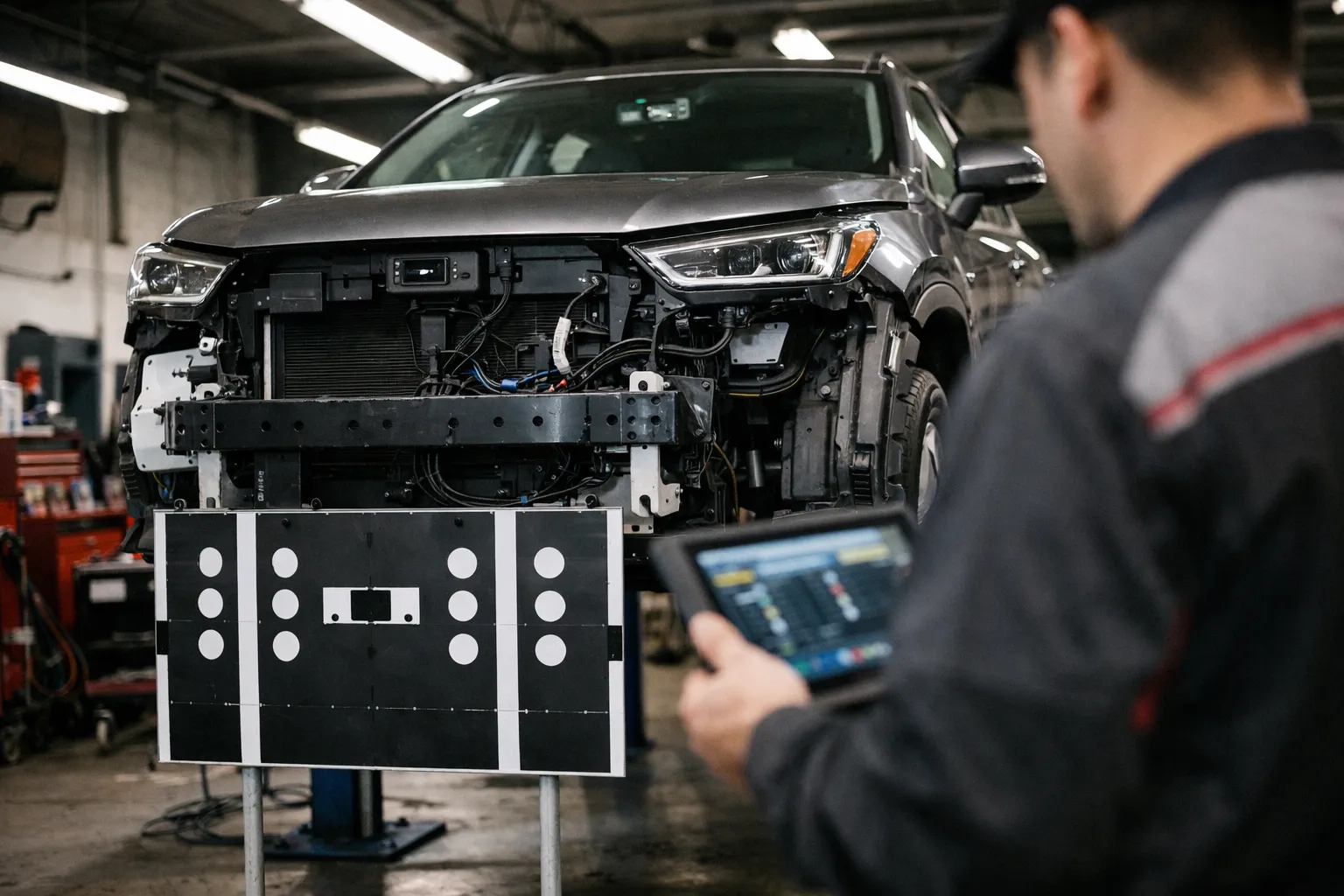
- If the VIN shows windshield or front‑end work, insist on proof of calibration. Ask for a written certificate or diagnostic report that records pre‑ and post‑calibration results and shows the shop’s calibration rig or OEM tool used.
- Schedule a focused ADAS pre-purchase inspection with a shop that uses OEM‑level tools or accredited calibration rigs (brands to look for: Hella Gutmann, Bosch ADAS rigs, Autel ADAS platform). Expect an inspection fee; typical August 2026 inspection-only fees for a focused ADAS check often range from $150–$400, depending on region and the depth of diagnostics.
- If calibration is required, get a written estimate. Static calibrations often cost less than full dynamic recalibrations; expect a full recalibration to range from roughly $200–$1,000 depending on vehicle complexity and whether multiple sensors/ECUs are involved.
Why: shops now commonly issue digital calibration reports. Treat that report like a maintenance record and require it or an inspection contingency in the sales contract.
Updated cost expectations and financial planning (Aug 2026)
Costs still vary widely by OEM, vehicle segment and whether OEM parts are used. Use these updated ranges as planning figures (prices vary by region):
- Windshield replacement + camera recalibration: $300–$1,200 (economy cars at the low end; luxury ADAS cameras and OEM glass toward the top).
- Radar sensor replacement: $400–$1,800 for parts; total with labor and recalibration $700–$2,500 on some premium models.
- Calibration services: $200–$1,200 depending on static vs dynamic and number of sensors.
- ECU/module replacement or dealer-only software reflashes: $500–$3,000 in high-end cases.
Tip: factor a 1–3% higher depreciation or maintenance reserve for ADAS complexity when calculating total cost of ownership for models in the 2018–2023 range that may require mid‑life sensor or software service.
Negotiation tips and contract language (new best practices)
- Require written proof of calibration for any windshield or front-end repair. If the seller cannot provide it, insist on a fresh post-sale calibration by a qualified shop at the seller’s expense or a price reduction that covers the estimated calibration cost.
- Include a clause in the purchase agreement: “Seller warrants ADAS components (front camera, radar, ultrasonic sensors, related ECUs) are fully operational and free of active DTCs at time of sale, and will provide calibration/diagnostic reports upon request.”
- For dealer or CPO buys, confirm whether ADAS features are covered under the CPO warranty and get the scope in writing (software, sensors, recalibration labor, subscription transfers).
- If a feature depends on an OEM account, require the seller to demonstrate account transfer or to provide activation codes/credits in writing.
When to walk away (updated red flags)
- Persistent ADAS warnings or logged faults that the seller refuses to diagnose or repair.
- Evidence of significant front-end collision repairs with no calibration history or inconsistent repair documentation.
- Subscription-locked features that the seller cannot transfer or deactivate, preventing activation by the new owner.
Post-purchase steps
- Within a few weeks of purchase, run a full ADAS diagnostic and calibration verification. If the dealer performed calibrations, request the digital calibration report and store it with other maintenance records.
- Register OEM connected services to your account, confirm OTA update settings, and disable previous owner accounts. Some manufacturers require a dealer to disassociate previous accounts — handle this promptly.
- Keep all receipts and calibration certificates. They increase resale value and provide proof of correct maintenance.
Common mistakes buyers still make
- Relying solely on dashboard messages—many ADAS faults are logged but not surfaced to the driver immediately.
- Assuming aftermarket windshields or bumpers are harmless—non‑OEM glass or incorrect radome materials can change sensor performance.
- Skipping OEM-level diagnostics—consumer OBD2 scans miss module-level flags and calibration timestamps.
- Ignoring software/account issues—feature access or safety improvements can hinge on up-to-date firmware and correct account ownership.
Pro tips (advanced buyer tactics)
- Ask for a dealer or independent shop to provide a pre-sale OEM scan printout. A current snapshot showing “no ADAS DTCs” is powerful leverage in negotiation.
- When possible, buy CPO vehicles with explicit ADAS coverage—the extra cost can be offset by included ADAS warranty and a documented calibration process.
- For high-value purchases, consider commissioning a full ADAS calibration verification that includes recorded pre/post offsets and sensor serial numbers; this is standard on newer calibration rigs and increasingly available.
- Check insurance offers—some insurers now provide discounts for verified functioning AEB and lane-keeping systems. Ask for documentation to secure a rate reduction.
Tools and resources (what to look for in 2026)
- NHTSA VIN lookup and recall search — start here for open recalls and crash records.
- Manufacturer service portals — for OTA update history and owner-account management instructions.
- ADAS calibration shops and published calibration certificates — ask local dealers for recommended vendors that use OEM‑level rigs.
- Model-specific owner forums and recent owner threads — useful for known firmware quirks and expected repair costs, but verify claims with documentary evidence.
Bottom line
By August 2026, buying a used car with ADAS requires the same care you would give major mechanical systems—but with an emphasis on documentation, diagnostics and software/account checks. Demand calibration certificates, insist on OEM-level diagnostics when in doubt, factor potential ADAS service costs into your price calculations, and make feature-transferability part of the sale. A modest investment in a focused ADAS inspection or a dealer-provided scan can prevent expensive surprises and protect safety—and the time you spend verifying these systems is the difference between a confident purchase and an expensive regret.
FAQ
Can I trust a dashboard message that says “ADAS ready” or “No faults”?
Not always. Dashboard messages provide a high‑level status but may not show logged DTCs or calibration flags. Always request an OEM-level diagnostic scan when relying on ADAS status for purchase decisions.
Do ADAS features usually transfer with ownership?
Hardware-based features (AEB, blind-spot sensors) transfer with the vehicle. Software-based or subscription features (hands-free driving, live telematics) may require account transfer or a paid activation. Confirm transfer rules with the manufacturer and include that in the sale paperwork.
How often do ADAS sensors need recalibration?
Sensors require recalibration after windshield replacement, front-end or bumper repairs, sensor replacement, or if the vehicle experiences suspension/steering repairs that change geometry. There’s no routine calendar interval—calibration is event driven.
Is it safe to buy a used car that had a windshield replacement if it was recalibrated?
Yes—if recalibration was performed correctly and there is a documented calibration report. Verify the report shows a successful post-calibration result and that the shop used OEM procedures or manufacturer-approved equipment.
Can I save money by using an independent shop for ADAS work?
Independent ADAS shops can be cost-effective and high-quality if they use OEM‑approved calibration rigs and tools. Ask for proof of the specific equipment used and for sample calibration reports before committing.