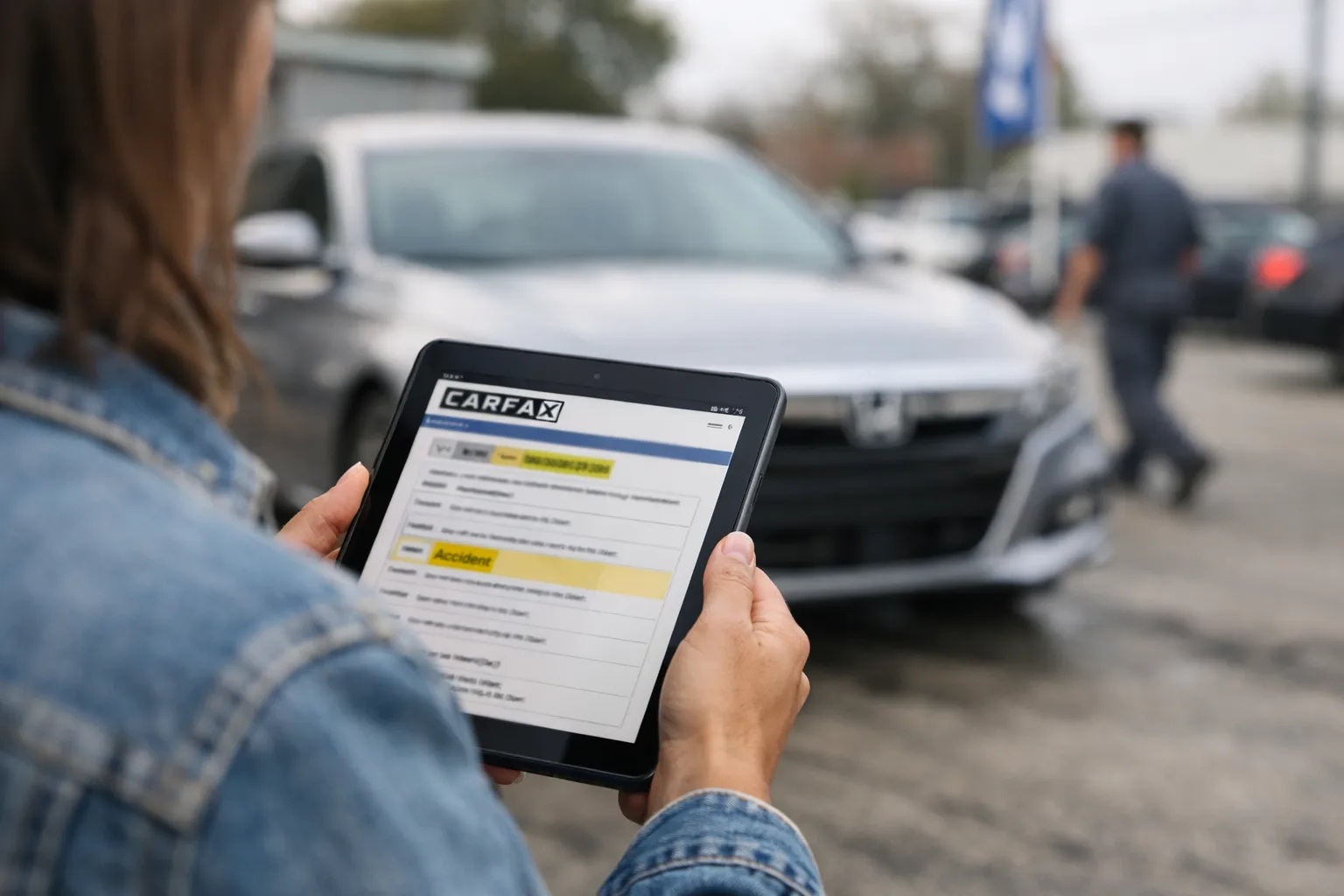
Vehicle history reports remain a core step for used‑car buyers. CARFAX is still the most recognizable brand in that space in August 2026, but its value—and its limits—have shifted as more EVs, telematics data, and electronic title systems enter the market. This updated review explains exactly what CARFAX provides today, recent developments that matter to buyers, real‑world use cases, pricing, alternatives, and a tight checklist you can use at the next test drive.
Overview: What are we reviewing? Key specs at a glance
- Product: CARFAX Vehicle History Report (VIN‑based aggregation).
- Core data sources: state title/DMV records, auction and dealer feeds, insurance/claims reports, repair shops and dealer service reports (where reported), and NHTSA recall feeds.
- Typical contents: title brands (salvage, rebuilt, flood), owner count, reported odometer entries, recorded accidents/claims, service records when available, open recalls, and sometimes a market‑value trend snapshot.
- Pricing (Aug 2026 list): single VIN report $39.99; common multi‑report packs (promotions vary) and dealer/subscription options are sold separately—always confirm on carfax.com before purchase.
Background: Who makes this and who it's for
CARFAX (ICAR, Inc.) remains a dominant private aggregator of VIN‑linked records. Its product targets consumers, independent buyers, and dealers who need a readable, single‑document summary of a vehicle’s reported history. The service’s brand recognition means dealers still widely display CARFAX reports to reassure buyers, but buyers and independent inspectors treat the report as the start of inquiry—not the final word.
What CARFAX provides in 2026 — and what's changed recently
Core mechanics haven’t changed: CARFAX aggregates records tied to a VIN from public and private sources. What has evolved since 2024:
- Greater integration with dealer and national service networks. CARFAX now ingests more dealer service feeds and national quick‑service chains than in prior years, increasing the frequency of service entries for newer cars bought/serviced at large chains.
- Better auction transparency—but not complete coverage. CARFAX has expanded auction data partnerships, so many wholesale movements and auction titles appear faster. Still, small independent auctions and some wholesale lanes can remain invisible.
- EV challenges remain. CARFAX can report recorded battery replacements or warranty repairs when the service or dealer reports them, but it does not perform battery health diagnostics or access most manufacturers’ telematics/BMS snapshots unless the OEM or dealer feeds those records.
- More efficient title feeds from some states. Several states upgraded electronic title and DMV reporting between 2022–2026, improving timeliness of title brands and lien data; coverage gap remains state‑by‑state.
Features analysis: Deep dive into capabilities
- Title brands and salvage reporting: CARFAX reliably surfaces state‑recorded title brands (salvage, rebuilt, flood) when DMV feeds are available. NMVTIS entries (national salvage/junk reporting) are also reflected when present, making CARFAX effective at flagging major title flags.
- Accident and insurance claims: reports include accidents that generated an insurance or police record in CARFAX’s sources. Minor collisions or repairs paid out‑of‑pocket without claims will be missing.
- Service history: now more comprehensive for cars serviced at national dealer networks and chains; local independent shop records still appear only if those shops forward entries to CARFAX.
- Recalls and safety notices: CARFAX displays NHTSA recall data and commonly links to manufacturer campaigns; it does not replace an OEM dealer diagnostic for unresolved or superseded recalls.
- Market trends and valuation: CARFAX provides estimated value trends, but these are directional. For firm pricing use Cody/KBB/Edmunds/Cox Automotive valuations in parallel.
Pros and Cons — specific, evidence‑based assessment
Pros
- Consolidates multiple official records into one readable report—efficient for screening several cars quickly.
- Expanded dealer/service feed coverage means more service notes for cars maintained at national chains.
- Widely used by dealers and buyers—having a CARFAX can speed negotiations because it’s a common, trusted reference.
Cons
- Still relies on upstream reporting. Private repairs, many bodyshop fixes, and routine maintenance paid in cash frequently don’t appear.
- Limited direct access to EV battery management system (BMS) telemetry. CARFAX cannot measure remaining battery kWh or state of health unless a service record reports a battery test or replacement.
- Coverage varies by state and vendor agreements. Some title/DMV updates can lag or be incomplete for specific jurisdictions.
- Costs can add up for buyers shopping many VINs; compare with free options (NICB VINCheck, NMVTIS lookups) and lower‑cost vendors.
Pricing and value (August 2026)
CARFAX sells single VIN reports and multi‑report packages directly at carfax.com. Typical list prices as of August 2026 are: single report $39.99; multi‑report packs and dealer/subscription plans vary and are often discounted during promotions. Dealers commonly provide free CARFAX reports with listings—so check before buying a report yourself.
Value proposition: CARFAX is worth the price as an early filter for higher‑value vehicles and dealer inventory where it often contains useful service and title feeds. For extensive shopping (multiple private‑party cars) consider combining a free NMVTIS/NICB check with targeted CARFAX purchases for vehicles that pass the initial screen.
How CARFAX compares with practical alternatives
- AutoCheck (Experian): often cited for auction and wholesale movement detection and a proprietary vehicle score. Use it alongside CARFAX when a vehicle has an ambiguous history—discrepancies can reveal gaps that merit follow‑up.
- NMVTIS and NICB VINCheck (free): NMVTIS provides government‑collected title/salvage/junk information; NICB’s VINCheck flags reported thefts and total losses. These are high‑value, low‑cost starting points.
- VinAudit / VinCheckPro (lower‑cost paid): budget paid reports (often sub‑$10) that draw on NMVTIS and commercial feeds. They can be helpful for screening a large lot of VINs quickly but typically have smaller service‑history footprints than CARFAX.
How useful is CARFAX for different buyer scenarios?
- Private‑party buyers: Good as an early filter for title brands and odometer anomalies. Expect the biggest gaps here because private sellers often don’t generate the public records CARFAX needs.
- Dealer inventory shoppers: Most useful—dealer cars often have richer CARFAX entries because dealers, auction houses and service departments report more frequently.
- Used‑EV buyers: CARFAX helps flag reported battery replacements and warranty work but does not substitute for battery capacity testing or manufacturer vehicle health reports (see checklist below).
- Classic/collector cars: CARFAX is less useful for provenance; specialist documentation, auction catalogs, and marque registries remain essential.
Practical test‑drive checklist: what to confirm beyond the CARFAX
- Verify the VIN on the vehicle, title and CARFAX—watch for transcription errors and mismatched trim or engine codes.
- Match odometer readings on the dash to the latest entries in service records and to CARFAX entries where present.
- Request original service invoices and photo evidence for any reported accident repairs; insist on invoice numbers and shop contact info so you can validate with the service provider.
- Get a pre‑purchase inspection (PPI) from a trusted independent shop. For structural/repair concerns insist the PPI includes frame, suspension, and alignment checks and photos of any prior repairs.
- For EVs: obtain the OEM battery health report or a dealer diagnostic showing remaining battery capacity (kWh) and state‑of‑health. If unavailable, pay for an independent battery capacity test or BMS readout—don’t rely solely on CARFAX entries.
- Run a free NMVTIS/NICB VIN check in addition to CARFAX to capture any federal/state salvage or theft entries that might not appear on every commercial report.
Tips to minimize surprises
- Use CARFAX as a filter—buy the report when a listing clears your initial check and you’re ready to move forward.
- Run both CARFAX and at least one alternative (AutoCheck or a NMVTIS provider) for high‑value cars; differing records usually indicate a need for paper invoices or DMV verification.
- Ask dealers for the raw invoices behind reported service items (invoice number, shop name, date). Verify a random invoice by calling the shop.
- If a CARFAX shows “minor damage” or ambiguous entries, insist on a PPI that documents the condition and includes photos of the undercarriage and structural points.
Alternatives to consider
- AutoCheck (Experian) — useful for auction/wholesale movement and a complementary view to CARFAX.
- NMVTIS / NICB VINCheck — free government and non‑profit checks for salvage/total‑loss and theft records.
- VinAudit and other low‑cost NMVTIS resellers — economical for bulk VIN screening.
Verdict
CARFAX in August 2026 remains essential as an early, readable aggregator of VIN‑linked records—especially for dealer vehicles and cars serviced in national networks. Its brand recognition and expanded dealer/service integrations increase its practical value. But it still cannot report what isn’t reported: private repairs, many bodyshop fixes, and most EV BMS telemetry remain blind spots. For high‑value purchases and EVs, combine a CARFAX with NMVTIS/NICB checks, a second commercial report when needed, and a targeted independent PPI (including OEM or third‑party EV battery diagnostics). Buy the CARFAX for screening and conversation—then spend on inspection to get the transaction right.
FAQs
Does a CARFAX guarantee a car is accident‑free?
No. CARFAX reports accidents and damage only when they appear in CARFAX’s data sources (police, insurance, dealer or shop reports). Unreported collisions, private repairs, or cosmetic fixes that never generated a claim or official record will not appear.
Can CARFAX tell me an EV’s remaining battery capacity?
No. CARFAX will show reported battery replacements or warranty repairs if they were recorded by a reporting source, but it cannot measure remaining kWh or state‑of‑health. For that, request an OEM battery health printout or pay for a battery capacity/BMS readout from a dealer or specialist.
What free checks should I run before buying a CARFAX report?
Start with NMVTIS (national salvage/title info) and NICB VINCheck (theft and reported total losses). These free checks surface many red flags; if the vehicle passes, purchase a CARFAX for a fuller service and title picture, or use a low‑cost VIN audit for bulk screening.
Is it worth paying for both CARFAX and AutoCheck?
Often yes for higher‑risk or higher‑value buys. Each aggregator draws different feeds; discrepancies often highlight records that need documentation or a DMV/title lookup. Use both when title brands, auction history, or odometer anomalies are in question.