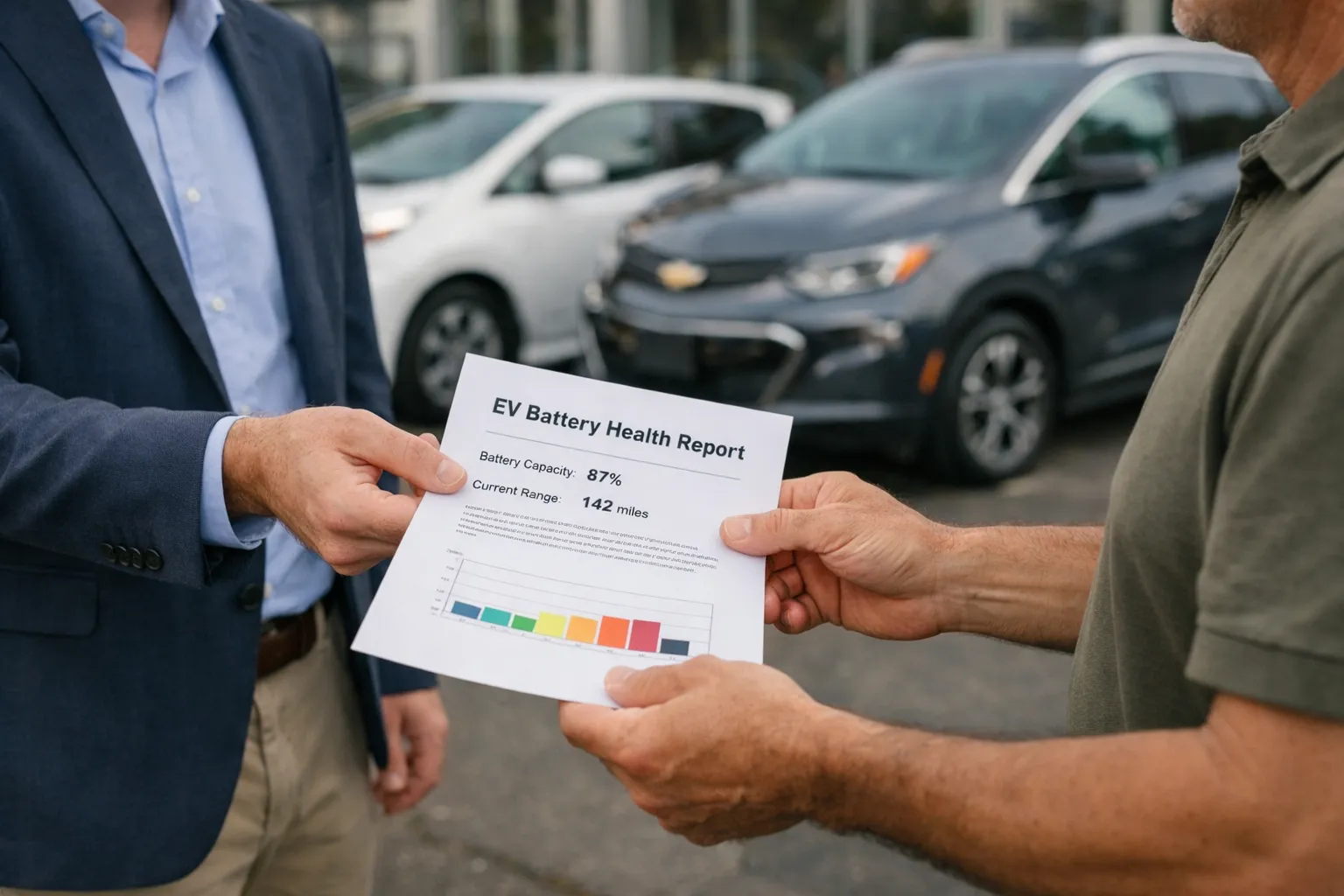
California regulators have adopted a new rule that requires dealers to disclose detailed battery-condition and software-update information when selling used electric vehicles (EVs). The measure, aimed at improving buyer transparency and reducing post‑sale disputes, will begin taking effect for dealer listings and point‑of‑sale paperwork in January 2027.
What dealers must disclose
Under the new rule, franchised and independent dealers selling used EVs in California must provide buyers with a standardized report that includes:
- Battery state-of-health (SOH) expressed as a percentage of original capacity or, where unavailable, an estimated remaining usable range;
- Date and version number of the last over‑the‑air (OTA) or dealer-installed software update that affects battery management or range optimization;
- Whether the vehicle’s battery has been replaced or repaired and the date of that work;
- Remaining manufacturer battery warranty coverage and transferability status;
- Any open recalls or service actions relating to the high-voltage battery or battery management system.
Why the rule matters to buyers
Battery condition is the dominant factor in a used EV’s value and daily usability. Unlike internal‑combustion engines, EV batteries degrade in measurable ways that directly affect range, charging speed and long‑term ownership costs. The new disclosure standard gives buyers a clear, comparable data point when shopping across dealers.
For buyers, the rule offers three immediate benefits:
- Faster assessments at the lot: A printed or digital SOH report reduces the need for time‑consuming diagnostic scans before making an offer.
- More accurate price comparisons: Buyers can compare battery health across similar models and model years rather than relying only on odometer and cosmetic condition.
- Reduced post‑sale disputes: With contract‑level disclosures, buyers have a clearer legal basis if a dealer misrepresented battery condition.
How the reports will be produced
The rule allows battery reports to come from manufacturer telematics portals, OEM diagnostic tools accessed by dealerships, or third‑party diagnostic services that meet a certification standard set by the California Department of Motor Vehicles. Dealers selling EVs without access to a manufacturer portal will need to obtain an independent diagnostic check before sale and disclose the results.
Impact on pricing and inventory
Industry analysts and dealers expect the rule to compress price spreads on used EVs with unknown battery condition and to increase premiums for high‑SOH cars. Dealers who already certify batteries as part of their certified pre‑owned (CPO) programs stand to gain a competitive edge.
Smaller independent dealers could face higher compliance costs if they must purchase diagnostic tools or pay for third‑party testing. Some dealers say that could lead to short‑term reductions in used‑EV inventory, particularly for older models whose battery health is more variable.
Dealer compliance and enforcement
Dealers that fail to provide the required report risk administrative fines and consumer restitution orders. The DMV will perform random audits of used‑EV sales paperwork and may require dealers to retain diagnostic data for a minimum of three years. Consumer protection groups pushed for the retention requirement to make post‑sale investigations possible.
Industry reaction
Manufacturer dealer groups have voiced mixed reactions. Some franchised dealer networks say the rule formalizes best practices they already follow, while independent dealers warn the compliance burden could disadvantage smaller operations. Several national online marketplaces have signaled plans to add battery‑health fields to their listing templates ahead of the January deadline.
Consumer advocates welcomed the change. "Buyers deserve clear, verifiable information about the single most important wear item in an EV," said an attorney with a statewide consumer group. "Standardized disclosure levels the playing field and protects people from surprise repair bills."
How buyers should use the new disclosures
For car‑buying enthusiasts and prospective EV owners, the new rule changes the inspection checklist:
- Ask for the SOH report before test‑driving. If a dealer resists, treat that as a red flag.
- Compare SOH across comparable listings rather than relying solely on model year or mileage.
- Verify remaining battery warranty dates and understand transferability limits; some manufacturer warranties may not transfer or may require dealer registration.
- Consider a third‑party battery test if you plan a long‑term ownership and the vehicle is out of warranty.
What to watch next
California's move is likely to influence other states and may prompt federal-level guidance on EV disclosure standards in the medium term. Watch for major online marketplaces and auto finance partners to update their processes: lenders are already interested in battery SOH as a factor in residual values and loan terms.
For now, buyers in California can expect more transparency at the dealership counter. Dealers that prepare in advance—updating listing templates, securing access to diagnostic tools and training sales staff—will make the transition smoother and may gain trust from a growing pool of EV shoppers.