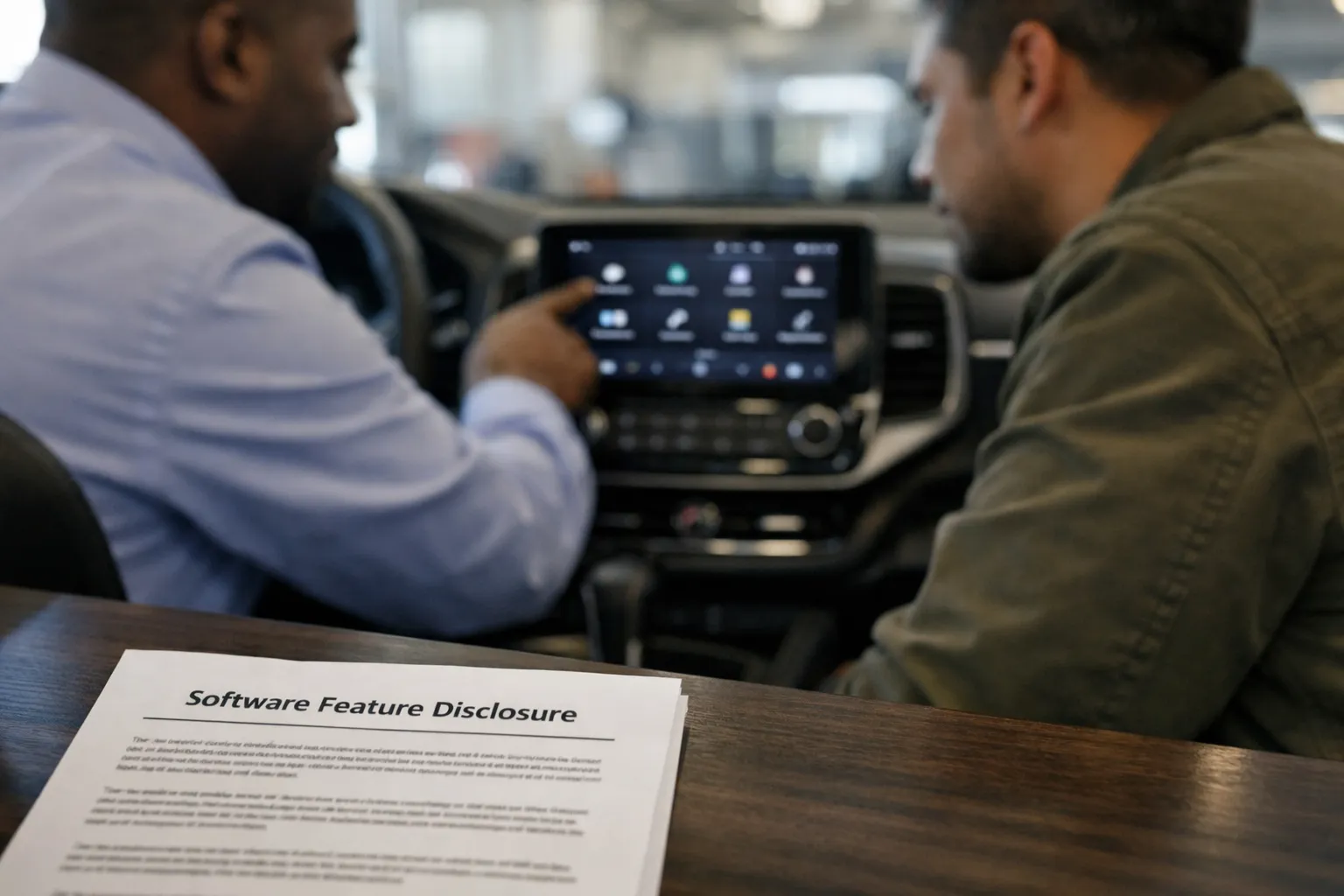
California’s new disclosure requirement for dealer sales, which took effect in November 2026, compels franchised and independent dealers to list any factory‑installed features that are controlled by software subscriptions or “digital keys.” The rule targets a growing source of buyer confusion—features that appear on a car at purchase but are disabled, limited or monetized by automaker software controls—and aims to make transferability clear for both new and used vehicles.
What the rule covers
Under the regulation, dealers must provide a conspicuous, itemized disclosure at the point of sale that identifies:
- Features on the vehicle that require an active manufacturer subscription, one‑time activation fee, or cloud authentication to function (navigation with live maps, advanced driver‑assistance functions, media streaming, “comfort” features such as heated seats that can be locked behind software, etc.).
- Whether those features are transferable to a new owner, and if transfer requires additional fees or dealer/OEM action.
- Any scheduled deactivation or sunset dates known to the dealer (for example, temporary trial periods that expire after a fixed number of months).
Dealers must also retain documentation showing they confirmed the subscription status and transfer rules with the OEM or the vehicle’s electronic records before completing the sale.
Why the rule matters to buyers
Buyers have reported cases in recent years where cars advertised as “fully loaded” arrived with features disabled or locked behind subscriptions—sometimes only discoverable after purchase. Because many modern features are enabled or controlled by over‑the‑air software, a vehicle’s on‑screen menu no longer guarantees a transferable hardware capability.
For shoppers this changes the calculus in several ways:
- Price vs. capability: A listed option may not equal long‑term capability. Buyers should insist on disclosure showing whether features are included permanently or offered as time‑limited trials.
- Resale and trade‑in value: Non‑transferable software features can depress resale values. Buyers who plan to sell or trade within a few years need to know whether the next owner will inherit subscriptions.
- Out‑of‑state purchases: California’s rule applies to sales within the state; buyers elsewhere should ask for the same disclosure and read OEM terms if buying used from outside California.
How dealers and OEMs are responding
Dealer groups had voiced concerns during the rulemaking about compliance costs and the complexity of tracing software entitlements across multiple manufacturers. Several large franchise groups told Car Buying Guide they are updating point‑of‑sale workflows and training staff to query OEM portals before listing vehicles.
Automakers that already use subscription monetization for features—BMW, Mercedes‑Benz, Volvo, GM and others—have moved to publish clearer subscription transfer policies on owner portals in recent months. Some OEMs allow one‑time transfers on change of ownership, while others restrict subscriptions to the original purchaser’s account unless a transfer fee is paid.
Industry attorneys say the practical effect will be to force faster harmonization between OEM account systems and dealer inventory tools. “Dealers have relied on model‑level option packs to describe cars for decades,” said an industry consultant. “With software entitlements, the unit‑level account details matter, and the new rule makes that information part of the sale.”
What buyers should do now
- Ask for the disclosure: If buying in California, insist on the new point‑of‑sale disclosure. Outside California, request the same information in writing.
- Verify transferability: Ask whether the OEM’s subscription terms permit automatic transfer on title change, require a separate account, or demand a fee.
- Request screenshots: For used cars, ask the dealer to show account status screens proving an active subscription or trial, and the expiration date if applicable.
- Factor costs into offers: If a feature you want is non‑transferable, include the cost of subscription or retrofit in your negotiations.
- Check for alternatives: Some functions can be permanently unlocked by OEMs (paid or free) or replaced with aftermarket hardware where practical—confirm warranty and safety implications first.
Potential ripple effects
Observers expect several likely outcomes from California’s move:
- More state legislatures may consider similar disclosure requirements—consumer groups are already lobbying statehouses in the Northeast and Midwest to follow California’s lead.
- Automakers and dealers will accelerate integration of subscription status into vehicle‑history and listing platforms, improving transparency for online shoppers.
- Secondary‑market pricing may adjust as valuation services incorporate software‑lock status into condition scores and comps.
For buyers, the immediate takeaway is clear: the days when a trim badge or option list guaranteed long‑term functionality are ending. Whether you’re buying new or used, demand documentation and factor software entitlements into your decision—especially for models where OEMs have made key safety or convenience features a subscription product.
Car Buying Guide will be monitoring implementation and reporting on enforcement actions, dealer compliance benchmarks and how OEMs adapt account and transfer policies over the coming months.