
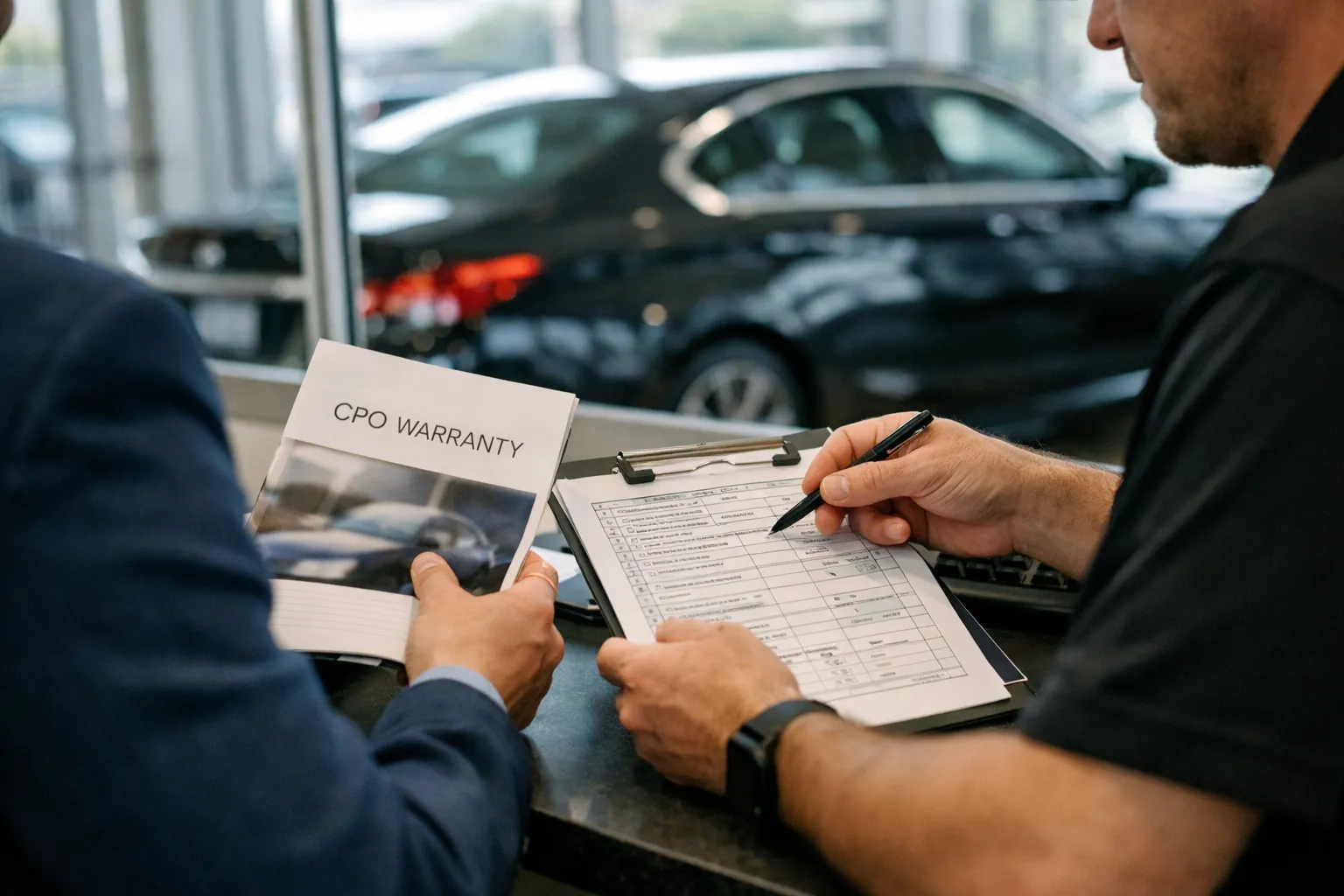
What you’ll learn: how to audit a Certified Pre‑Owned (CPO) warranty in June 2026 so you can tell substantive coverage from marketing copy. This guide is for car‑buying enthusiasts — owners of combustion, hybrid and an increasing share of EVs — who demand precise, actionable steps: how to verify coverage, what costs may still land at the service bay, and how to quantify the warranty’s impact on resale value.
Why this matters now: By mid‑2026, CPO programs have evolved beyond paper guarantees. Battery health, over‑the‑air (OTA) software updates, subscription‑tied features and the cost of ADAS calibrations now materially affect repair exposure. Dealers frequently charge administrative, diagnostic or per‑component deductibles that erode the sticker premium. A careful audit separates genuine protection from a premium paid for a badge.
Prerequisites / Context: what you should know before you start
- CPO is still not standardized. Manufacturer programs, captive finance‑arm plans and dealer‑run “certified” inventories co‑exist. Coverage language, authorized repair channels and deductibles vary by brand, model year and powertrain.
- Software and batteries are decisive. OTA updates, telematics-enabled diagnostics and battery state‑of‑health (SOH) data are now routine determinants of both reliability and the scope of warranty rights.
- Service experience is part of the coverage. How a program handles pre‑authorization, parts sourcing and calibration workflows materially impacts downtime and out‑of‑pocket costs.
Have these ready: the VIN; the full CPO contract (not the brochure); the vehicle’s original in‑service date; full service records; and the buyer’s order listing any CPO fees or add‑ons. Bring a phone to photograph documents and record names/time stamps during phone verifications.
Step 1: Confirm factory CPO versus dealer “certified”
- Obtain the official manufacturer CPO certificate tied to the VIN. Look for manufacturer letterhead, an enrollment or warranty number, and explicit VIN linkage — not just dealer stationery.
- Verify independently with a second franchise dealer. Call or email a different dealer of the same brand and ask service to confirm the VIN’s CPO enrollment and listed coverage dates. Note the representative’s name and time stamp.
- Read the administrator disclosure. Factory CPOs typically reference the manufacturer or captive administrator; dealer programs often name a separate third‑party administrator with different claims processes.
Why it matters: Factory programs usually promise nationwide claim portability and standardized handling. Dealer‑run certifications can be valuable but often carry more variable terms and narrower repair pathways.
Step 2: Anchor the warranty clock — in‑service date and stacking rules
- Get the original in‑service date in writing. Ask for the certificate or a system printout showing when the vehicle’s original warranty began.
- Confirm when CPO coverage actually starts and how it stacks. Does the CPO begin at sale, at original in‑service, or only after factory warranty expiry? Have the dealer point to the exact clause in the booklet.
- Calculate remaining coverage in months and miles using the VIN’s in‑service date and odometer. Don’t rely on sales scripting. If the math is unclear, request a written amortization table from the administrator.
Example: Two identical SUVs offered in June 2026 can differ by a year of coverage if one entered service in 2022 and the other in 2023 — a difference that affects expected repair exposure and resale pricing.
Step 3: Decode “bumper‑to‑bumper,” electronics and software clauses
- Determine contract type: exclusionary vs inclusionary. Exclusionary contracts (everything covered except listed exclusions) are stronger. Don’t let brochure language override the contract text.
- Search for explicit software, infotainment and telematics language. Locate clauses that mention “software,” “reprogramming,” “OTA,” “cloud services,” “subscription restoration” and “module corruption.” If those terms are absent, assume software remediation or subscription restores may be excluded.
- Check ADAS, sensor and calibration language. Confirm coverage for radar, lidar (if fitted), cameras, ultrasonic sensors and whether post‑repair calibrations (camera alignment, radar recalibration, wheel alignment) are included or billed separately.
Why it matters: On modern luxury cars, the expensive claims are often electronic modules, display assemblies, air suspension compressors and ADAS sensors — and repairs almost always require software reprogramming or calibration that may carry separate fees.
Step 4: EV‑specific checks — battery health, charging history and entitlements
- Request a recent battery state‑of‑health (SOH) or capacity report. For BEVs and PHEVs, insist on an OEM‑generated SOH printout or a technician‑signed diagnostic report showing capacity and degradation percentage. If none exists, ask why and make that part of your price negotiation.
- Ask for charging and thermal‑management history. Request any documented fast‑charging events, thermal‑management repairs, or service entries affecting the battery pack or associated pumps/sensors. Repeated thermal‑management faults are a red flag.
- Confirm transferability of subscription features and entitlements. Many modern EVs tie navigation, premium map updates, enhanced driver aids or concierge services to an account. Ensure features advertised as part of CPO will be active for the new owner or transferable without punitive fees.
Practical tip: Battery replacements on premium EVs frequently exceed five figures; battery health is the principal warranty exposure for EV buyers. If the dealer cannot produce a clear SOH report, treat that as a negotiating lever or walk away.
Step 5: Separate warranty from maintenance, wear items and minor adjustments
- Locate the wear‑item exclusion list. Verify whether brake pads, tires, filters, wiper blades, bulbs and 12V batteries are excluded. On many programs, 12V batteries have their own shorter coverage window.
- Clarify “seepage” versus “leak” definitions. Contracts commonly exclude seepage or cosmetic staining; ask the dealer to point to the exact language to understand how claims will be adjudicated.
- Understand “adjustments” and nuisance repairs. Items like trim rattle, minor alignment or static noise may be excluded. If ownership experience is paramount, tally likely excluded small‑claims costs into your negotiation.
Step 6: Audit deductibles, diagnostic fees, authorizations and rental coverage
- Confirm how deductibles apply. Is the deductible per visit, per repair order, or per component? A per‑component deductible can multiply quickly on multi‑module jobs.
- Check diagnostic fee rules. Learn whether diagnostic time is covered only when a warrantable failure is found, or whether the dealer can bill diagnostics if no fault is reproduced.
- Understand pre‑authorization timelines and escalation. Ask how long approvals typically take for high‑cost parts and who authorizes calibration labor.
- Verify towing, loaner and rental limits. Are daily caps and maximum days specified? Is downtime reimbursement automatic or discretionary?
Why it matters: A broad contract can still leave you paying repeated deductibles, diagnostic charges or rental fees that erode the CPO premium.
Step 7: Transferability, cancellations and resale mechanics
- Confirm transferability and transfer fees. A transferable factory CPO is a visible asset at resale. Ask for the exact steps and any fees required to effect a transfer.
- Verify whether coverage is VIN‑tied or owner‑tied. Some entitlements require the new owner to register the vehicle online or present proof of sale within a set period to activate certain features.
- Review pro‑rata refund and cancellation terms. If you buy an extended plan or decide to cancel, can you obtain a pro‑rata refund, and what administrative fees apply?
Step 8: Pressure‑test inspection and reconditioning evidence
- Request the completed inspection checklist with technician notes. Look for detailed line items and technician signatures, not just a stamped “inspected” statement.
- Ask for reconditioning invoices or redacted work orders. Confirm what was replaced, why, and whether tires or brakes were replaced with OEM‑equivalent parts. For AWD and performance cars, verify tire match and factory specifications.
- Perform your own sensory quality check during delivery. Drive at highway speeds to check wind noise and ADAS behavior; note interior electronics reboots, HVAC performance and sunroof noise. Photograph any issues and get seller acknowledgments in writing.
Why it matters: Inspection rigor varies by dealer. The paper trail is your protection against later disputes and a bargaining tool if the checklist appears cursory.
Step 9: Match the CPO warranty to the car’s risk profile and price it
- Identify high‑risk systems for that model and year: air suspension, turbochargers, high‑voltage inverters and charging hardware (for EVs), infotainment generation and ADAS sensor count.
- Check service history for repeat complaints. Multiple entries for the same issue, repeated battery maintenance or recurring ADAS calibrations are red flags even on certified cars.
- Gather comparables and quantify the premium. Document at least three non‑CPO and CPO comps; compare total cost of ownership including deductibles, likely diagnostics and rental exposure.
- Negotiate with specific asks. Request cash credits to offset documented cost differences (for example, a credit equal to the anticipated cost of two calibrations or a prepaid maintenance credit to cover excluded wear items).
Note: A well‑priced CPO remains a compelling value for complex luxury or EV models; conversely, a weak contract with recurring fees can make the CPO premium poor value.
Common mistakes buyers make with CPO warranties in 2026
- Assuming “bumper‑to‑bumper” automatically includes software fixes, subscription restorations, or cloud services.
- Not verifying in‑service date — crucial for lease‑returns that sat unused before resale.
- Confusing prepaid maintenance plans with warranty scope; they address different costs.
- Overlooking diagnostic, calibration and downtime fee language — these smaller charges can compound.
- Failing to request battery SOH or a timestamped OTA update history for vehicles with remote update capability.
Pro tips for discerning buyers
- Always commission a PPI even for factory CPO cars. A brand‑aligned independent specialist or another franchise dealer can catch items the selling dealer missed.
- Prefer simpler trims if the contract is vague on advanced features. Fewer modules generally means fewer expensive claims and faster repairs.
- Talk to the service manager, not only sales. Service departments work with administrators and parts lead times; their answers reveal how the program functions in practice.
- Document delivery condition thoroughly. Photograph tread depth, interior blemishes and any warning indicators with timestamps; get seller commitments in writing.
- For EVs: insist on charger adapters and a charging history printout. Unapproved third‑party charging or aftermarket battery work can affect claims and future diagnostics.
- Ask about cybersecurity and data privacy clauses. With OTA and telematics involved, know who can access vehicle data during diagnosis and whether data use affects dispute resolution.
FAQ: CPO warranty questions buyers ask in June 2026
Does a CPO warranty typically include over‑the‑air (OTA) software fixes?
Not by default. Some manufacturers explicitly include software reprogramming and OTA fixes; others limit coverage to physical component replacement and exclude cloud or subscription restorations. Find the clause that cites “software,” “reprogramming,” or “OTA” and ask for examples of covered scenarios; if unclear, get a written confirmation from the warranty administrator.
How should I evaluate an EV’s battery under a CPO program?
Request a recent OEM SOH or capacity report and any battery‑related service history. Confirm whether the CPO covers full pack replacements, module repairs and thermal‑management components. If the dealer cannot provide a recent SOH report, treat that as a negotiating lever — battery condition is the single largest warranty risk for EV buyers.
Will servicing at an independent shop void CPO claims?
It depends on the program. Factory CPOs typically require warranty repairs to be performed at franchised dealers to preserve parts traceability and software access; some dealer or third‑party plans allow broader shop choice. Routine maintenance at independents is usually acceptable if you follow the manufacturer’s schedule and retain itemized records, but always check the contract first.
How much does CPO transferability affect resale value?
Transferability is a tangible asset. A transferable factory CPO increases buyer confidence and can support a higher private‑party sale price. Confirm transfer fees and the administrative steps — some programs require online registration or a fee to activate the transfer.
Is it better to buy a non‑CPO car and purchase an extended plan later?
Sometimes. If a manufacturer’s extended service contract is competitively priced and available post‑sale, a non‑CPO vehicle with a clean PPI plus an extended plan can match or beat an overpriced CPO. However, extended plans may not replicate CPO scope for EV battery health or ADAS calibrations, so compare contract terms side‑by‑side.
Bottom line: In June 2026, “certified” remains useful — but the definition now includes batteries, software ecosystems and calibration workflows that were marginal a decade ago. Read the contract, demand documentation (SOH, OTA history, inspection checklists), and price the CPO against the vehicle’s real risk profile. That diligence turns a CPO badge from a marketing flourish into measurable protection.