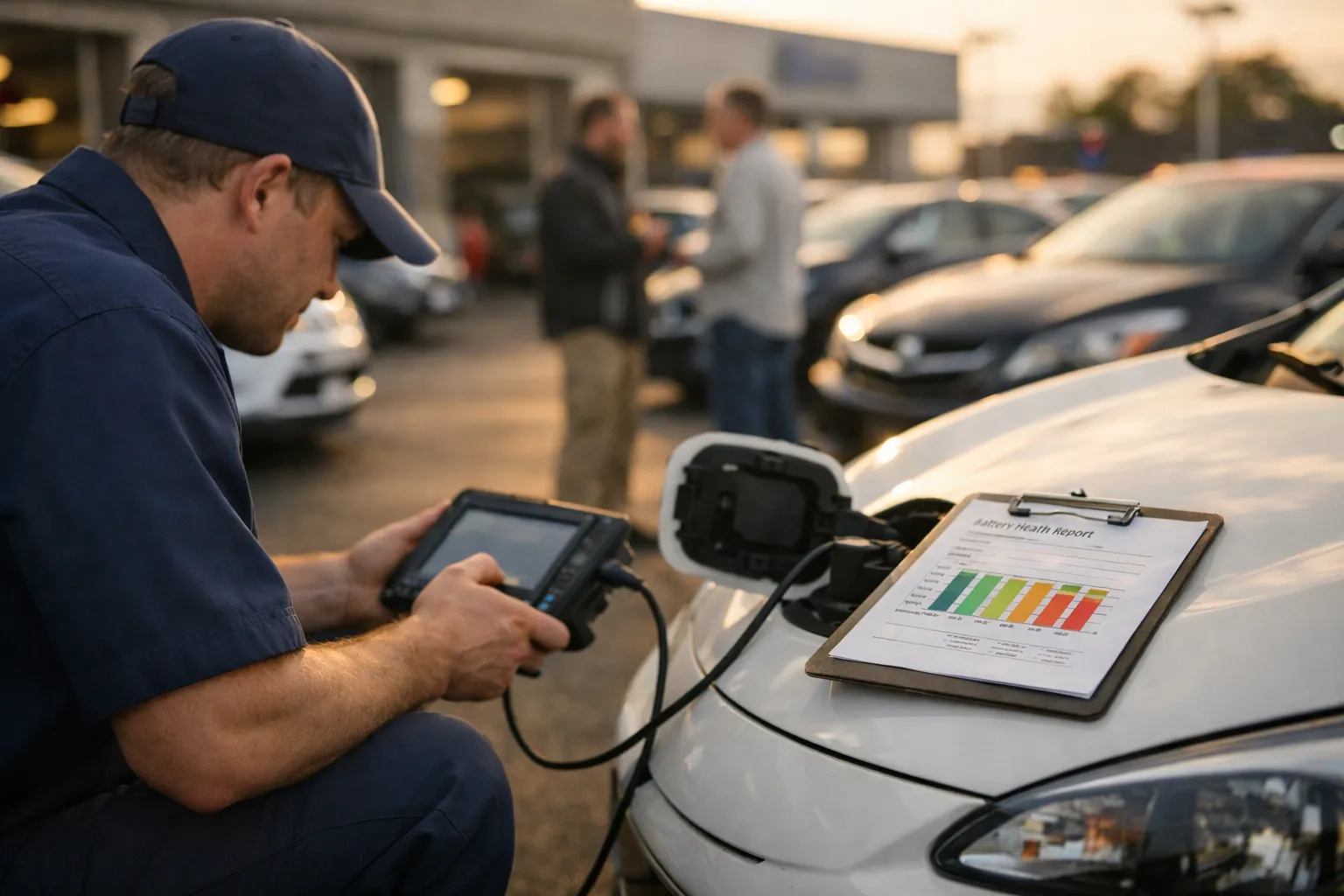
The used‑electric‑vehicle market is getting a new layer of transparency. A coalition of dealer associations, online remarketers and independent testing labs announced this week that it will begin issuing standardized battery‑health reports for retail used EV sales nationwide beginning in September 2026.
What the new reports will show
The reports are designed to give prospective buyers a concise, comparable snapshot of each vehicle’s battery condition. The standardized data package will include:
- State of Health (SOH) expressed as a percentage of original usable capacity
- Usable kilowatt‑hours (kWh) remaining and estimated real‑world range
- Cycle count or an equivalent metric estimating battery charge cycles
- Recorded battery temperatures and any thermal events flagged in vehicle telemetry
- Remaining manufacturer battery warranty and any past warranty repairs
- Details of prior battery replacements or refurbishments
Reports will be generated from a combination of on‑site diagnostic scans, anonymized OEM telematics where available, and third‑party laboratory capacity tests for cars undergoing certified pre‑owned (CPO) processing.
Why dealers and remarketers are moving now
Industry participants explain the initiative as a reaction to buyer uncertainty and litigation risk. Battery degradation is the single largest source of buyer hesitation toward used EVs: range loss and the prospect of an expensive battery replacement complicate pricing and financing.
By standardizing how battery condition is measured and presented, dealers aim to make valuations more defensible, reduce post‑sale disputes, and expand the buyer pool for older battery EVs that still have substantial usable capacity.
How this could affect pricing and financing
Standardized battery reports create a new data input for appraisers, insurers and lenders. A vehicle with a verified 90% SOH and clear warranty transferability may command a significantly higher trade or retail value than the same model reported only by odometer and cosmetic inspection.
Similarly, lenders may be more willing to finance longer terms for used EVs with documented battery health, and insurance underwriters could refine premiums for battery‑related losses.
What buyers should look for in a battery‑health report
Even with standardization, not all reports are equal. When shopping for a used EV, ask dealers to provide the full battery‑health packet and check the following:
- SOH percentage and the test method (on‑car diagnostic vs. lab capacity test).
- Usable kWh and the estimated range figure, along with the driving cycle used to estimate range.
- Evidence of previous battery work: replacements, module repairs, or software updates.
- Whether the manufacturer will honor battery warranty transfers and any required steps to preserve warranty.
- Date and time of the most recent report—battery condition can change with use and charging behavior.
Buyers should also consider commissioning an independent battery inspection if the car is older or has incomplete telematics; the new standard makes it easier for independent shops to compare results to dealer reports.
Limits of the new standard and open questions
Industry observers caution that standardized disclosure solves part of the problem but not all. A few caveats:
- SOH is a snapshot, not a long‑term guarantee. A poorly maintained battery can decline rapidly after testing.
- Not all vehicles have telematics or OEM cooperation; reports for legacy models will rely primarily on external diagnostics.
- There’s currently no single national verifier; the system relies on certified labs and dealer compliance, which raises enforcement questions.
Policy makers and consumer advocates are watching. Some state attorneys general have pressed for mandatory disclosure in the used‑EV market, and the coalition’s voluntary standard could either forestall regulation or serve as a baseline for future laws.
What this means for the used‑EV market
Analysts say the new reports could help normalize prices across regions and reduce the “unknown risk” premium buyers currently demand for used EVs. That could lower effective ownership costs and increase demand for 3‑ to 6‑year‑old electric models—vehicles that today make up an awkward middle ground between high‑priced CPOs and cheaper, uncertified private‑party sales.
For sellers, the tradeoff is operational: dealers and remarketers will bear testing costs and workflow changes to capture and present battery data. Early adopters expect that better data will pay off through faster inventory turns and higher resale values.
Practical timeline and next steps
The coalition plans a phased rollout beginning with pilots in California and Florida this summer, expanding nationally in September. Participating dealers will display a battery‑health badge on online listings and include the full report in every retail sale packet.
Buyers should start asking for battery‑health reports now. Even before the September rollout, some national remarketers and certified pre‑owned programs already publish partial battery data; bringing that information into a common format will make comparisons easier and help buyers negotiate with knowledge.
In short, the move toward standardized battery disclosures is a meaningful step for used‑EV transparency. It won’t eliminate all uncertainty, but it creates a concrete tool buyers can use to evaluate range risk, compare prices, and make smarter purchasing decisions.