Used‑EV buyers in 2026 face a market driven not just by mileage and trim but by the chemistry inside the battery pack and the legal and commercial protections that come with it. This analysis examines how lithium‑iron‑phosphate (LFP) versus nickel‑manganese‑cobalt (NMC) chemistries, warranty structures, replacement risk and supply trends are influencing resale values and buyer behavior. It ends with practical checks and negotiation levers buyers can use when evaluating a used EV.
Why battery chemistry now plays a defining role in used‑EV pricing
Two technical realities are reshaping the used‑EV market. First, LFP and NMC packs age and fail in different ways. LFP chemistry is cheaper, uses no nickel or cobalt, and typically offers higher cycle life with slower capacity fade; NMC tends to have higher energy density but can degrade faster and is more sensitive to full‑depth cycling and high temperatures. Second, manufacturing choices and supply‑chain pressures over the past three years have pushed a wider range of mainstream models into LFP for their lower‑cost standard‑range variants, increasing the share of LFP cars reaching the used market.
The practical result: two used cars identical on paper (same year, trim and mileage) can carry markedly different market values if one has an LFP pack and the other an NMC pack. Dealers and private sellers increasingly price that chemistry premium into listings because buyers are willing to pay more for a battery type with lower perceived long‑term risk.
Warranties, transferability and how they alter buyer calculus
Battery warranties remain one of the clearest economic protections for buyers. Most mainstream OEMs now offer battery warranties measured in years and miles—commonly 8–10 years or 100,000 miles—covering significant capacity loss or defects. For buyers of used EVs, two warranty issues matter most:
- Remaining term: A car with five years left on an 8‑year battery warranty commands a higher price than one with no warranty coverage.
- Transferability and scope: While many battery warranties attach to the vehicle and continue for subsequent owners for the warranty term, some coverage is limited or conditional. Buyers must check whether the warranty covers capacity below a specified state‑of‑health (SoH) threshold, full pack replacements versus module repairs, and whether any third‑party repairs void coverage.
Because warranty coverage reduces the downside risk of expensive pack repairs, certified pre‑owned (CPO) units or cars with long factory battery warranties retain stronger resale value. Conversely, models where the original warranty has expired—or where warranty terms are narrow—face steeper depreciation to reflect replacement risk.
Market dynamics: supply, chemistry shifts and regional factors
Several market trends interact to determine used‑EV prices in 2026:
- Supply of LFP‑equipped cars: The rapid expansion of LFP in lower‑priced models—adopted widely by Chinese brands and used selectively by Western OEMs for standard‑range trims—means more long‑lived LFP cars will populate the used market through the mid‑2020s. That rising supply reduces premiums over time but also increases buyer choice.
- Raw material economics: Elevated prices for nickel and cobalt in earlier years made NMC packs more expensive to produce; as that cost pressure persists, manufacturers will continue migrating lower‑cost segments to LFP, affecting future supply composition.
- Regional climate: Heat accelerates some forms of battery degradation. Buyers in warm states should pay particular attention to thermal management systems (active cooling) and historical charging patterns; NMC packs without robust thermal management can show accelerated fade in hot climates.
The net effect: in markets where LFP adoption is high, buyers increasingly value demonstrable pack health over model pedigree alone. In regions with extreme heat, cars with documented thermal management records or full service histories add value.
How battery condition translates to dollar value
Assessing a pack’s State‑of‑Health (SoH) is now part of valuation work. Sellers and dealers who provide BMS snapshots, full charge cycles, and recent diagnostic logs often achieve higher prices because buyers can quantify remaining capacity and estimate remaining useful life. In contrast, vehicles with unknown battery histories are discounted to reflect worst‑case replacement cost.
Battery replacement remains the single biggest line‑item risk on many used EVs. Replacement costs vary widely by manufacturer and pack size; a prudent buyer treats the possibility of a five‑figure replacement as a tail risk and prices offers accordingly. Where a vehicle has LFP chemistry and a robust warranty, that tail risk is substantially reduced and prices reflect it.
Practical evaluation checklist for used‑EV buyers
When shopping for a used EV in 2026, go beyond visual inspection and test‑drive. Focus on the battery:
- Confirm chemistry: Ask the seller for the cell chemistry. If they can’t provide it, check window stickers, VIN decoders, or manufacturer's spec sheets for the specific build and market.
- Request SoH and charge logs: Obtain a recent battery health report or BMS snapshot. Many dealers now include these for CPO listings; private sellers may provide charging app histories or inverter logs.
- Verify warranty terms and transferability: Check remaining duration and what triggers a claim (e.g., below a specified SoH). Contact the OEM if terms are unclear.
- Look for signs of thermal events or recalls: Ask for full service history. Check NHTSA/recall databases for pack‑related recalls and whether recall repairs were completed.
- Assess charging habits: Frequent DC fast‑charging and frequent 100% fills can accelerate some NMC packs; higher SoH with such histories suggests solid thermal management or favorable chemistry (e.g., LFP).
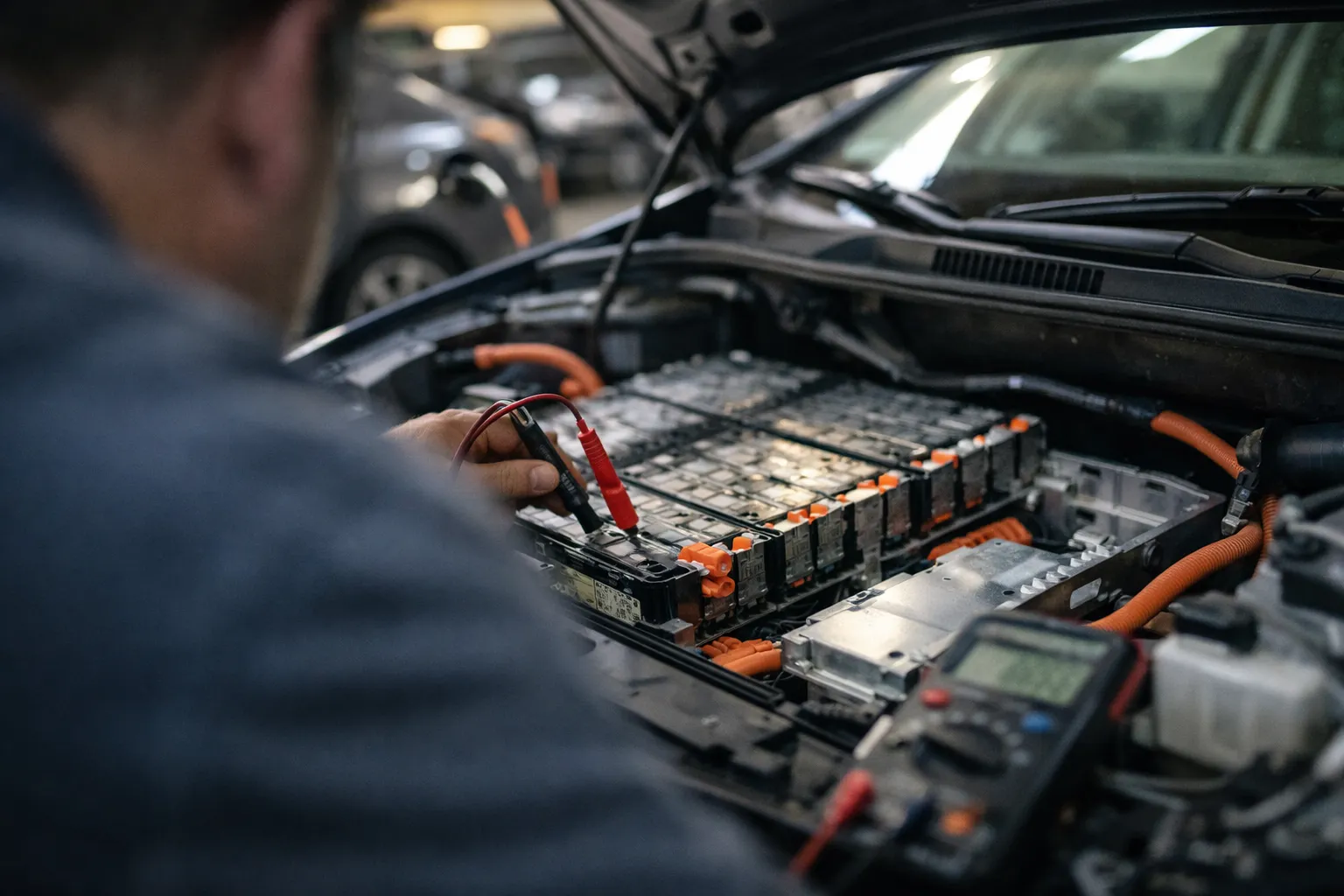
- Get independent diagnostics: Use an EV‑savvy technician or third‑party diagnostic on a tablet/OBD adapter to read SoH and voltage spread across modules, if available.
Negotiation levers and valuation approach
Buyers can use battery data as direct negotiation currency. If SoH is lower than comparable listings or warranty coverage is limited, ask for price reductions commensurate with estimated replacement or capacity loss. Conversely, if a seller provides a recent complete BMS log showing stable SoH and a significant remaining warranty, that car justifies a premium.
Other levers: request a short-term dealer warranty for battery coverage, ask for third‑party inspection credits, or structure price contingencies tied to a battery health threshold identified during inspection. For CPO vehicles, compare the implied warranty coverage to non‑CPO equivalents and demand pricing that reflects the difference.
Implications for long‑term ownership and resale
For buyers planning multi‑year ownership, chemistry matters less if the warranty covers the likely ownership period and the car’s thermal management is robust. For short‑term owners or lease buyers seeking rapid resale, choosing models with strong residuals—often LFP‑equipped standard‑range variants or NMC packs with excellent thermal management and warranty coverage—reduces resale uncertainty.
Finally, expect market signals to keep evolving. As more LFP cars enter the used pool and battery second‑life and recycling economics improve, the relative premium for LFP could moderate. But for the next several years, buyers will still benefit from treating battery chemistry and warranty posture as primary determinants of used‑EV value.
Bottom line
In 2026, battery chemistry and warranty status are central to used‑EV valuation. Buyers should prioritize verified State‑of‑Health data, remaining warranty coverage and clear evidence of how the car was charged and maintained. Equipped with those facts, you can convert technical battery details into concrete negotiation advantages and avoid the price surprises that have tripped up early used‑EV buyers.