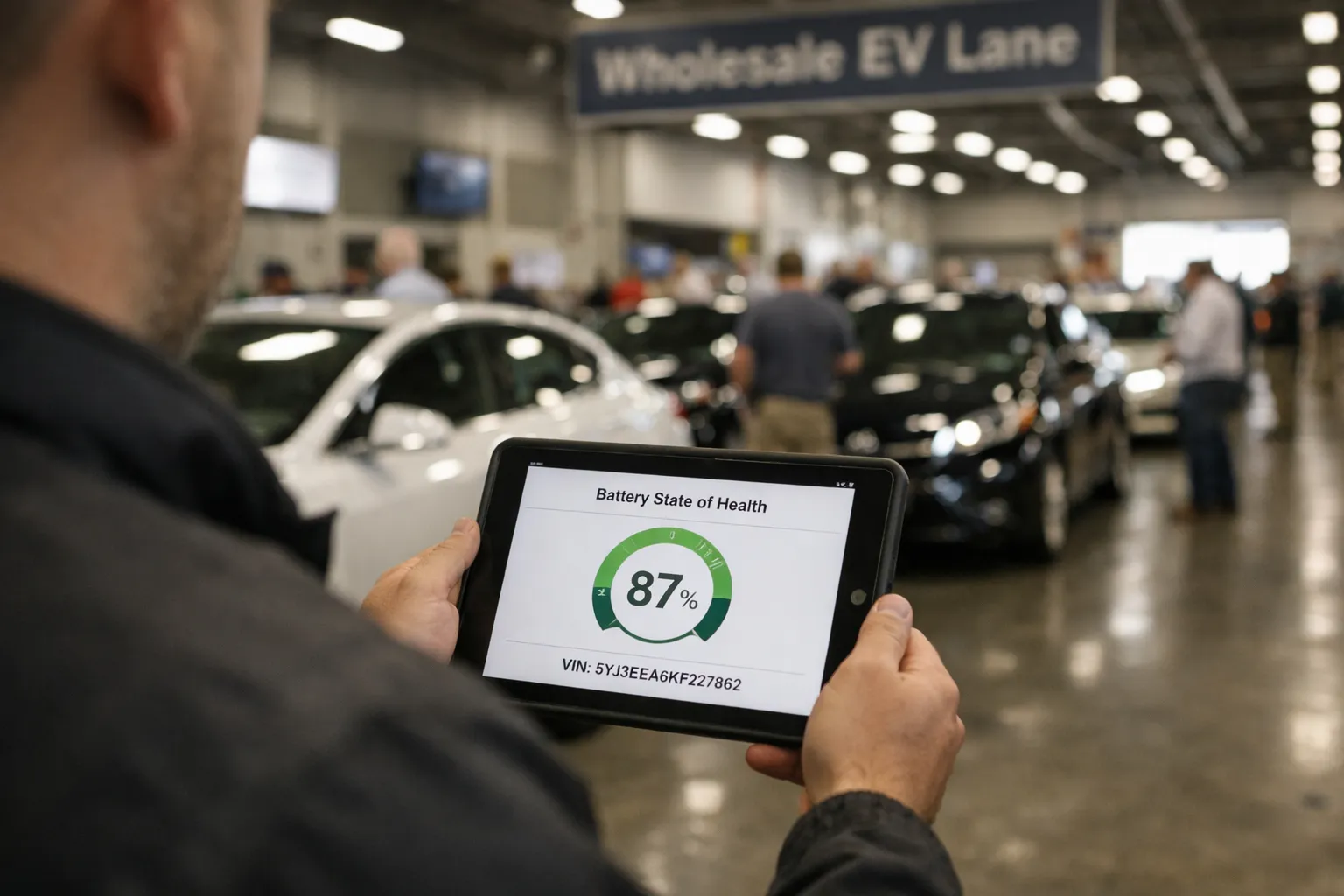
Who, what, when, where, why: Manheim and IAA — the two largest U.S. wholesale vehicle auction operators — announced in mid‑2026 a requirement that every electric vehicle sold through their platforms include a standardized, VIN‑linked battery state‑of‑health (SOH) certificate. Since the original July 2026 announcement, both firms have begun phased rollouts: each published its approved diagnostic‑vendor lists in July 2026 and started requiring certificates for selected lanes and online listings in late July and early August 2026. Full enforcement remains scheduled for December 31, 2026. The change aims to reduce information asymmetry around battery condition and speed transactions across wholesale channels.
Context: why this matters now
Used‑EV volume has continued to grow in 2026 as more 2018–2021 battery electric vehicles reach the end of initial leases and fleet cycles. For wholesale buyers — rental fleets, dealer groups and independent refurbishers — battery condition is the single largest variable in residual value and reconditioning cost. Before a standardized certificate, buyers relied on inconsistent OEM readouts, vendor‑specific tools or no metric at all. The auction houses’ push for a common SOH certificate is intended to create a comparable, auditable data point across makes and chemistries.
What the certificate looks like today (August 2026)
The format announced in July remains the baseline, and the operational specifications have been tightened during the rollout. Required elements now include:
- VIN‑linked SOH percentage — remaining capacity as a percentage of original pack capacity;
- Full‑equivalent cycles or cumulative energy throughput — a standardized unit to compare aging across pack sizes;
- Timestamped diagnostic log — record of thermal events, module replacements, BMS resets and diagnostic snapshots;
- Source provenance and signature — indication whether the readout is OEM‑generated or from an approved third‑party, plus a digital signature or hash to guard against tampering;
- Certificate issuance date and inspector ID — who ran the diagnostic and when, linked to the auction lot.
Manheim published its approved vendor list on July 15, 2026; IAA published its vendor list on July 27, 2026. Both lists prioritize vendors that support VIN‑linked exports and cryptographic signing or chain‑of‑custody logging.
OEM and vendor participation — where we are
Participation by automakers is mixed but improving. Several large OEMs expanded dealer‑level diagnostic access and agreed to export readouts compatible with the auction certificate format during July 2026 negotiations. At the same time, approved independent diagnostic providers are filling gaps for older models and salvage lanes; auctions expect third‑party reads to account for a material share of certificates through 2026.
Key practical point: a certificate generated by the OEM typically carries stronger provenance for warranty claims and is less likely to be questioned during a post‑sale dispute. Certificates from approved third‑party vendors are acceptable at auction, but buyers should confirm vendor enrollment on the auction’s published list before assuming parity.
Early market effects observed in August 2026
During the initial weeks of phased enforcement, dealers and fleet buyers reported clearer bid dispersion on lots with published SOH. Auction operations teams say listings that include a certificate move faster through digital lanes and generate fewer post‑sale disputes because the data is auditable and timestamped. Auction managers also report an uptick in consignors ordering certificates proactively to avoid lot‑level discounts for “no certificate.”
Note: full quantitative impact on pricing will be clearer after the December 31, 2026 enforcement deadline, but the short‑term effect is already visible: lots with 80%+ SOH are holding premium prices relative to uncertified peers, while uncertified or suspect‑signed lots carry larger discounts.
Risks and technical limits to watch
- Measurement variability: Different diagnostic algorithms and pack topologies can yield SOH estimates that differ by several percentage points. Watch for vendor calibration notes on the certificate.
- BMS tampering and data integrity: Auctions now require cryptographic signatures where OEMs and vendors support them, but not all legacy vehicles will have that protection. Buyers should prefer OEM‑signed certificates when warranty transferability is a concern.
- Warranty and transfer rules: The certificate itself does not create or transfer OEM warranty rights. Buyers must still verify OEM warranty transferability and any OEM‑required inspection steps for claims.
- Salvage and rebuilt packs: Certificates will flag module replacements in the diagnostic log, but assessing the quality of a repaired pack still requires expert review.
Practical steps for car‑buying enthusiasts (what to do now)
- Always request the auction’s VIN‑linked battery certificate and download the full diagnostic log before bidding or buying retail.
- Prioritize OEM‑signed certificates if you plan to rely on remaining warranty or want the strongest provenance for resale.
- Understand SOH in context: an 80% SOH on a 2019 compact EV is different economically than 80% on a 2021 luxury EV with a 200‑kWh pack. Compare estimated remaining range, not just percentage.
- If buying privately, pay for an independent SOH test from an auction‑approved vendor before closing; many approved vendors now offer mobile diagnostics tied to the standard certificate format.
- Ask for the vendor ID and certificate hash so you can check the certificate against the auction’s published record and detect post‑sale alterations.
Impact summary: who benefits and who should be cautious
Buyers benefit from clearer, auditable battery data that reduces asymmetric information and post‑sale disputes. Dealers and fleets will be better able to underwrite residuals and plan reconditioning. Sellers who proactively obtain certificates typically avoid steeper discounts. Caution remains necessary for vehicles without OEM‑signed certificates, for packs with complex module histories, and for buyers who intend to hold vehicles into long warranties without verifying transfer rules.
What to watch next
- December 31, 2026 — scheduled date for full enforcement across Manheim and IAA lanes.
- Q1 2027 — expected publication of aggregated pricing data by auction houses showing SOH‑linked price differentials.
- OEM participation updates — watch OEM technical bulletins for standardized export formats and warranty transfer rules tied to SOH certificates.
Frequently asked questions
Will the certificate guarantee I can make a warranty claim?
No. The certificate documents battery condition and diagnostic history but does not by itself transfer or guarantee OEM warranty rights. Verify the OEM’s published warranty transfer rules and any required inspection procedures before relying on the certificate for claims.
Can certificates be forged or manipulated?
Certificates that include vendor provenance and cryptographic signatures are much harder to alter; auctions now favor those formats. Legacy vehicles or vendors that can’t sign digitally are higher‑risk — in those cases insist on on‑site diagnostics or a fresh read from an approved vendor before purchase.
How should I interpret SOH percentage?
SOH is a relative measure of remaining pack capacity. Interpret it alongside pack size and expected use: 80% SOH on a 40‑kWh commuter EV means different remaining range and replacement economics than 80% on a 150‑kWh luxury pack. Look at full‑equivalent cycles and the diagnostic log for a fuller picture.
What if a vehicle has no certificate on the auction listing?
Uncertified lots should carry discounts to reflect the higher uncertainty. If you’re buying at retail, insist on an auction‑approved certificate before completing the sale or negotiate price to reflect the missing information.