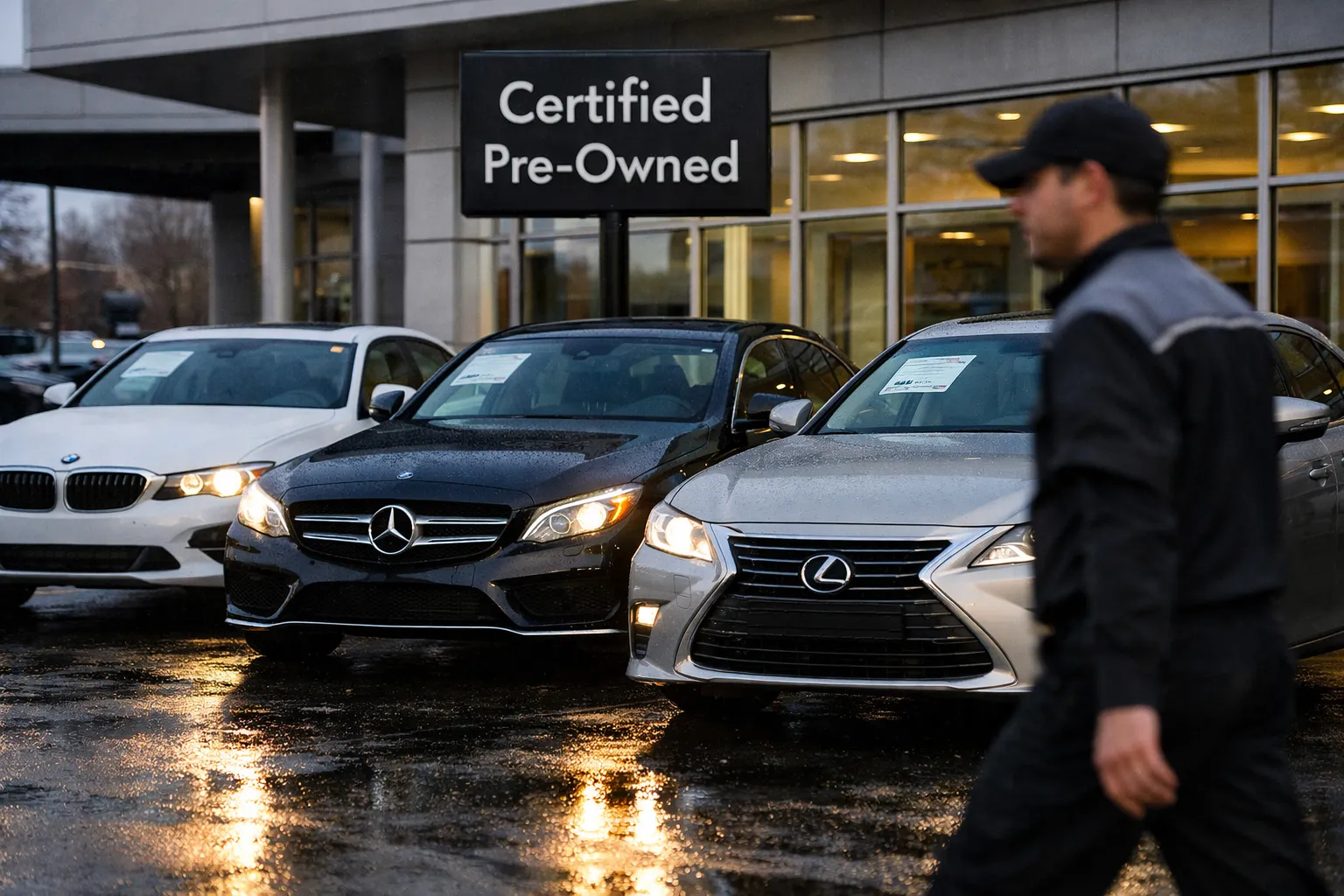
Overview
Certified pre‑owned (CPO) still reduces risk when buying a late‑model luxury used car, but between June and November 2026 the marketplace and manufacturer practices continued to evolve. This update focuses on concrete changes in the last five months for BMW, Mercedes‑Benz and Lexus CPO programs, highlights fresh buyer risks tied to batteries and software, and gives an updated, practical checklist for shoppers today.
Background: why late‑2026 matters
Two forces driving CPO change accelerated through 2026. First, the 3–6 year cohort of electrified luxury vehicles—battery‑electric models (BEVs) and plug‑in hybrids (PHEVs)—has grown large enough that dealers and OEMs are standardizing battery checks and making explicit policy choices about battery coverage. Second, the shift of vehicle features from hardware to software continued: over‑the‑air (OTA) updates, paid feature subscriptions, and modular electronic control units (ECUs) are now normal points of friction when ownership changes hands. That combination has changed inspection priorities, warranty language and the bargaining points for buyers.
Data and evidence: what's different by November 2026
- EVs and hybrids are an established share of CPO inventory. Multiple market trackers and dealer networks report that 2023–2024 model‑year electrified luxury cars are now common on CPO lots. That means battery health and thermal‑management history have gone from optional notes to core certification items in many markets.
- Battery diagnostics are standardized more widely, but thresholds vary. Dealers and OEM certified inspectors increasingly provide state‑of‑health (SOH) readouts or capacity percentage for the high‑voltage battery. In practice, many franchised lots treat a 70–80% SOH as the common acceptance band, though exact thresholds differ by brand and model.
- Software, feature flags and subscription transfers are a bigger deal. OTA update history and telematics-account transferability now appear in more CPO inspection packets. Buyers still report encountering post‑sale feature loss—navigation services, remote functions or advanced driver‑assist features—when subscriptions require reactivation or OEM account migration.
- Pricing premiums remain compressed overall, but are powertrain‑sensitive. After supply continued to normalize in 2026, broad brand‑level CPO premiums narrowed on average. However, BEV and PHEV variants or highly‑optioned trims with complex electronics still carry larger premiums where warranty risk is meaningful.
- Regulatory and consumer pressure increased disclosure. Consumer advocates and some state consumer‑protection offices pushed OEMs and dealers to clarify which connected services transfer to new owners and what fees, if any, apply. That pressure increased the frequency of documented telematics transfer steps in certification paperwork.
Inspection scope in November 2026: breadth and new depth
- Lexus: Lexus continues to emphasize conservative acceptance standards and clear paper trails. In late 2026 more Lexus CPO listings for RX and NX hybrids include printed battery diagnostics, itemized hybrid‑system reconditioning receipts and explicit notes when a vehicle is excluded for inconsistent service history. Lexus dealers typically favor documented service continuity over aggressive cosmetic acceptance.
- BMW: BMW's CPO process now more consistently includes VIN‑specific software status reports and battery SOH printouts on electrified models. BMW dealers are also more likely to list completed ECU recodes or updated driver‑assist calibrations in the inspection packet. BMW still accepts vehicles with visible wear more readily than Lexus, but it commonly documents and invoices any electronics or driveline reconditioning to factory standards.
- Mercedes‑Benz: Mercedes places the most emphasis on software integrity and full functional validation. In November 2026 Mercedes CPO packets often include telematics transfer steps, completed module reflashes and, for high‑trim S‑Class/EQ models, line items for module replacements when fault histories indicate risk. Mercedes franchised dealers have used software/service bundles as both a convenience and a pricing lever.
Warranty and transferability: new realities
Warranties remain the main rationale for paying a CPO premium, but buyers now face two distinct 2026 realities:
- Battery coverage clarity is essential. Some OEM CPO programs explicitly extend battery protection for a defined capacity‑loss threshold; others restate original factory battery warranty terms with no additional capacity guarantee. Ask for VIN‑specific battery warranty language and whether a capacity guarantee (for example, coverage if SOH falls below a named percentage) is part of the CPO contract.
- Connected services are rarely guaranteed for free. Factory CPO warranties rarely cover ongoing subscription costs. Even where franchised dealers assist with account migration, buyers may face reactivation fees or regional service limitations (e.g., maps/traffic services tied to specific markets). Get written confirmation of what transfers and who pays any fees.
Practical steps: insist on the printed, VIN‑specific CPO warranty booklet during signing, verify the extension start date for the CPO coverage, and request an explicit telematics transfer plan that names whether the OEM or dealer will complete account migration and at whose cost.
Pricing premiums and depreciation: what’s worth paying for now
Two dynamics determine whether the CPO premium is justified:
- Supply normalization: With near‑new luxury inventories higher than during the pandemic years, dealers are less able to demand broad, brand‑level CPO premiums. Always compare identical VIN listings (equipment, mileage, accident history) rather than relying on a fixed percentage.
- Powertrain and electronics risk: Electrified models and top‑trim, software‑heavy variants typically justify larger premiums because post‑warranty repairs are costly. For mechanically simple Lexus sedans and older non‑hybrid models, the incremental value of CPO is smaller.
Practical rule for November 2026: calculate the premium against a conservative estimate of likely out‑of‑warranty exposure for the next 12–36 months (battery capacity gap, major ECU, drivetrain repairs). If the premium is less than that estimate, CPO is generally economical.
Dealer behavior and transparency trends
Dealer presentation still varies, but three behaviors are now common:
- Lexus lots tend to post more complete inspection packets: Many Lexus dealers now provide a VIN‑level inspection summary and fixed CPO pricing with fewer add‑on prep charges.
- BMW dealers bundle service and transfer help: BMW stores frequently present optional prepaid maintenance and concierge telematics transfer assistance that can be financed into the sale.
- Mercedes dealers emphasize software/service bundles: Mercedes dealers regularly include recent module updates or telematics‑transfer assistance as part of the transaction; these are valuable but sometimes used to support higher asking prices.
Always request VIN‑level inspection reports, itemized reconditioning receipts and a written statement of responsibility for open recalls or outstanding service campaigns.
Multiple perspectives
Buyers: want transparent, documented protection and predictable costs at transfer. Independent mechanics: continue to advise second opinions on battery SOH and to verify that critical ECUs were fully reprogrammed rather than superficially reset. OEMs and dealers: promote factory backing and certified repair processes as the primary differentiator. Market analysts: say the economics of certification will continue shifting as more BEVs and PHEVs hit the 3–6 year window and as software maintenance costs become easier to quantify.
Implications for buyers
- For BEVs and PHEVs, insist on a VIN‑specific battery diagnostic printout and written battery warranty or capacity guarantee where available.
- For Mercedes and heavily‑optioned BMWs, the CPO warranty often shifts expensive electronics and software risk back to the manufacturer—this can be decisive if the vehicle is loaded with driver‑assist and comfort features.
- For many Lexus models, CPO remains an efficient route to a clean, conservatively maintained vehicle, especially hybrids with continuous service histories.
Updated checklist — what to get in writing before you buy
- VIN and full CPO inspection packet (itemized reconditioning receipts and fault‑code history).
- Battery SOH/capacity printout with test date and the exact battery warranty language tied to the VIN.
- Written statement of which connected services transfer, who will perform the transfer, and any reactivation fees.
- Software update history (OTA or dealer reflashes) and confirmation that calibrated sensors/ADAS were validated post‑update.
- Comparison of the CPO price to identical non‑CPO VINs and a calculation showing whether the premium is less than a conservative repair‑exposure estimate.
- Contact info for warranty claim escalation at the OEM level and an estimate of typical local turnaround time for warranty repairs from the selling dealer.
Outlook: what to watch for through 2027
Expect continued standardization of battery and high‑voltage system protocols in CPO checklists, broader documentation of software and telematics status in certification paperwork, and ongoing compression of broad CPO premiums as near‑new supply remains ample. Also watch regulatory activity: consumer advocates and state agencies are increasingly focused on the transparency of subscription transfers, and any formal guidance or rulemaking will directly affect CPO disclosures.
Bottom line
As of November 2026, CPO still matters—but buyers must evaluate the badge with more granular checks. Lexus offers conservative acceptance and clear documentation; BMW pairs traditional mechanical focus with growing software and battery transparency; Mercedes places software and telematics transferability at the center of certification. For BEVs, PHEVs and electronics‑heavy builds, CPO documentation—battery SOH, software update history and subscription transfer terms—can be the deciding factor.
How do I verify an EV battery's state‑of‑health before buying CPO?
Ask the seller for a VIN‑specific battery diagnostic printout showing current capacity or SOH and the test date. Confirm whether the CPO program includes an explicit capacity guarantee or only the original factory battery warranty. If the dealer offers only a generic statement, request the OEM’s written battery policy for that VIN.
Will my connected services and subscriptions transfer with a CPO purchase?
Not automatically. Some services require account migration, reactivation fees, or regional eligibility checks. Before signing, get a written list of which features will be active at delivery, who performs the transfer (dealer or OEM), and whether any fees apply.
Is CPO worth it for a five‑year‑old Lexus hybrid in late‑2026?
Often the incremental value is modest because many Lexus hybrids have lower documented electronic risk. Compare the CPO premium to a conservative estimate of likely repair exposure and consider a short‑term third‑party warranty if the premium exceeds expected costs.
Can I negotiate CPO add‑ons and service plans?
Yes. Dealers commonly treat maintenance plans, extended warranties and telematics assistance as negotiable. Ask for an itemized price, compare with third‑party alternatives, and avoid rolling high‑cost add‑ons into financing without calculating total interest costs.