As used-vehicle markets settle after pandemic-driven shocks and fleet liquidation cycles, meaningful price differences persist across U.S. regions. For motivated buyers — especially enthusiasts willing to travel or arrange shipping — regional arbitrage can translate into thousands of dollars saved. This article analyzes the mechanics behind those gaps in mid‑2026, identifies which cars most often deliver net savings, and provides a step‑by‑step financial test and practical tips to execute an out‑of‑state purchase safely.
Why regional price gaps still exist
Several structural forces create and sustain geographic spreads in used-car prices:
- Local demand and climate: Trucks and SUVs hold premium value in Sunbelt markets and rural areas; convertibles and certain luxury coupes often command more in warm‑weather metros.
- Fleet and rental disposal patterns: Regions with large rental-car operations or heavy corporate fleets tend to have regular supply inflows, depressing local prices for models those fleets favor.
- Regulatory and inspection regimes: States with strict emissions testing or rigorous safety inspections reduce the pool of eligible vehicles and affect resale values for non‑compliant models.
- Tax, registration and title costs: State sales tax, registration fees and title transfer practices vary widely and alter the final cost equation for cross‑border purchases.
- Dealer practices and competition: Areas with more used-car retail competition and online dealer aggregators typically show tighter pricing; less competitive markets have higher retail‑to‑wholesale spreads.
Which vehicles yield the best arbitrage opportunities
Not all cars are equally profitable to buy out of state. Patterns observed across markets point to these categories as most likely to deliver net savings after travel or shipping:
- Full-size trucks and certain SUVs: High local demand in some Sunbelt metros inflates prices there; the reverse is true in parts of the Midwest where supply is deeper.
- Popular midsize sedans and compact SUVs: High-volume models can show consistent, modest spreads that scale well when dealers or private sellers are price motivated.
- Luxury cars with dealer-certified programs: Certified Pre-Owned (CPO) premiums vary by region; in soft CPO markets buyers can uncover high-value units still under factory warranty.
When arbitrage is least likely to pay
- Older niche models, rare options, or cars in poor condition — shipping and inspection risk often erode any sticker discount.
- Vehicles subject to state-specific equipment rules (e.g., California emissions, advanced lighting standards) — converting or certifying a non‑compliant car is costly.
Calculating the true cost: a practical decision test
Do not stop at advertised price. Run this five-line economic test before pulling the trigger.
- Start with the advertised out‑of‑state price.
- Add shipping/travel costs: get at least two car‑shipping quotes and estimate travel, lodging, and meals if driving home.
- Add buyer fees: dealer documentation fees, out‑of‑state title transfer, emissions or safety prep, and any reconditioning requested by your inspector.
- Add state taxes and registration: determine how your home state taxes out‑of‑state purchases (some credit taxes paid elsewhere, others do not).
- Subtract any guarantee or warranty value you would get locally (local dealership return policies, extended warranties) and factor in inspection contingency.
If the resulting total is at least 5–8% below comparable local listings for the same vehicle, arbitrage is often worthwhile. Below that threshold, the time and risk usually outweigh modest savings.
Example calculation (hypothetical)
Example: A midsize SUV listed for $22,500 in State A where supply is deep. Comparable local listings in State B average $25,000.
- Shipping quote: $750
- Independent inspection (pre‑purchase): $150
- Out‑of‑state title fees and temporary tags: $200
- State B sales tax on the vehicle: $1,875 (7.5%) — note some states credit taxes paid elsewhere
Total landed cost = $22,500 + $750 + $150 + $200 + $1,875 = $25,475. In this scenario the landed cost exceeds the local average, so arbitrage fails. Swap in a $20,500 purchase price and the landed cost becomes $23,475 — a clear saving versus $25,000 local average.
Practical checks and risk controls
Even when the math looks good, due diligence prevents costly surprises. Prioritize the following:
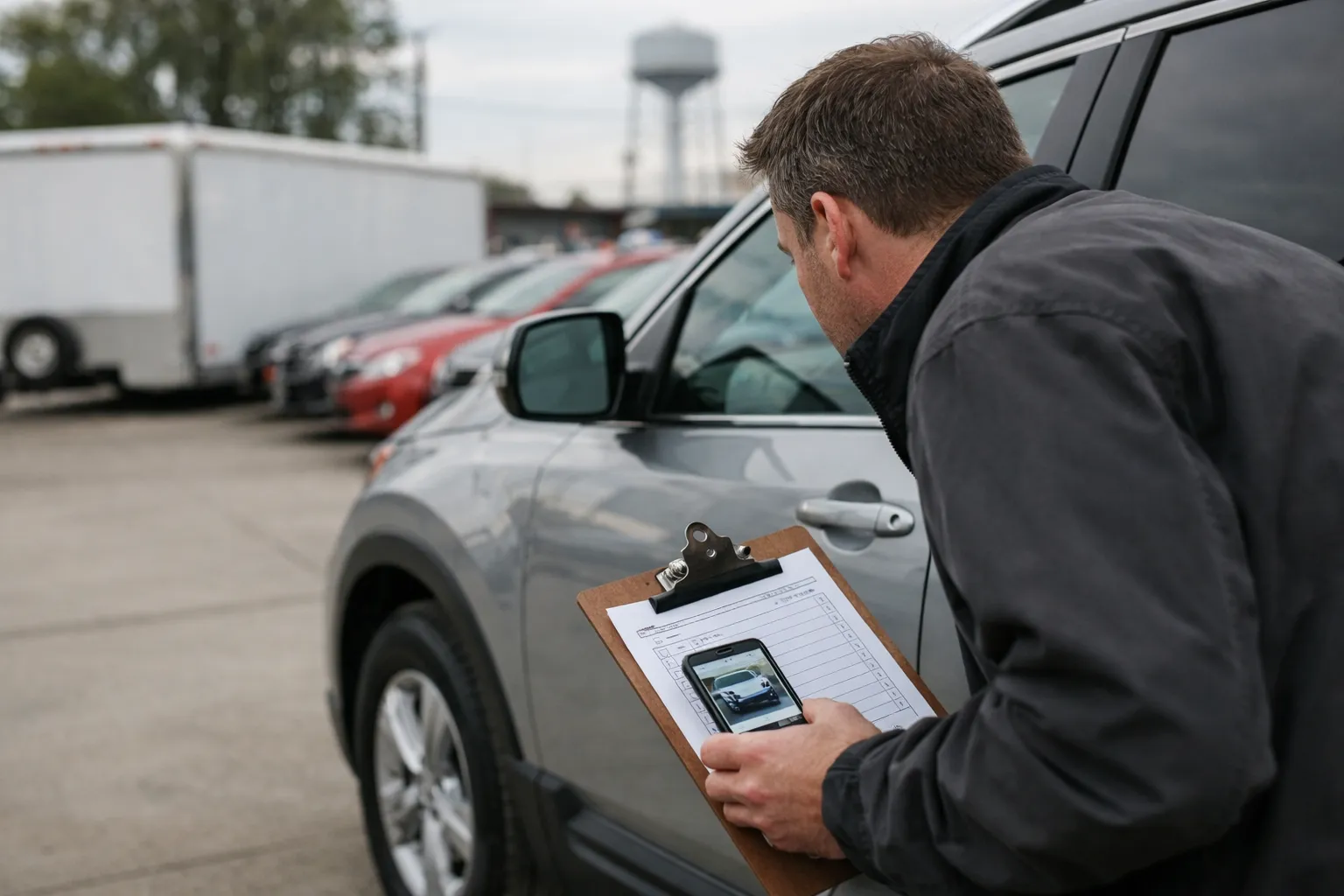
- Independent inspection: Always hire a local, third‑party mechanic or inspection service and secure a written report that can be a purchase contingency.
- Title and history clarity: Check the title status (clean, salvage, rebuilt), accident history, and any state odometer/brand flags; use vehicle history services and state title databases.
- Emissions and equipment compliance: Verify whether the vehicle complies with your state’s emissions and safety rules; factor conversion costs if it doesn’t.
- Payment and escrow: Use secure payment methods and consider escrow services for private transactions; avoid wiring large sums without verified escrow or dealer paper trail.
- Return and dispute remedies: For dealer purchases, confirm return windows and arbitration procedures; for private-party deals, know the limited legal recourse you’ll have if problems arise.
Timing and seasonal effects
Seasonality amplifies regional spreads. Sellers in snow‑belt markets discount convertibles and summer-focused vehicles in winter; conversely, trucks and AWD crossovers can fetch premiums in colder months. Calendar-aware buyers can target model classes at their weakest seasonal demand in the selling region.
Where to find the best arbitrage targets in 2026
Rather than a single “best city,” think in market pairs: regions with excess supply of a model versus regions with tight demand. Typical pairings that remain relevant in 2026:
- Midwest / Plains markets (higher supply) → Sunbelt metros (higher demand for trucks and SUVs)
- Tourist or resort markets in summer (convertibles more expensive) → cold inland markets in winter
- States with large corporate fleet disposition centers → smaller markets that lack fleet off‑loads
Use market indices (Manheim Used Vehicle Value Index, NADA, local listing aggregators) to spot where depreciation, days‑to‑sell, and price declines are most pronounced.
Negotiation and execution tips
- Ask for a time‑stamped photo and a VIN disclosure; verify recent maintenance receipts and the inspection report.
- Get written promises for anything the dealer says verbally (minor repairs, inclusion of recent inspection work).
- For private sellers, consider meeting at an inspection facility or arranging a portable inspection before final payment.
- When shipping, obtain insurance that covers agreed value and compare carrier loss/damage rates.
Bottom line
Regional arbitrage remains a viable strategy in 2026, but it’s no longer a guaranteed win. Buyers who succeed combine careful market scanning, realistic landed‑cost math, and disciplined risk controls: independent inspections, clear title verification, and conservative assumptions about taxes and compliance. When the numbers pass the five‑line test and inspection is clean, traveling or shipping a car can net savings that justify the effort — often by thousands of dollars.
For car‑buying enthusiasts, the opportunity is now more tactical than speculative: you won’t beat local prices by accident, but with the right vehicle class, market pair, and process, regional buying still rewards preparation.