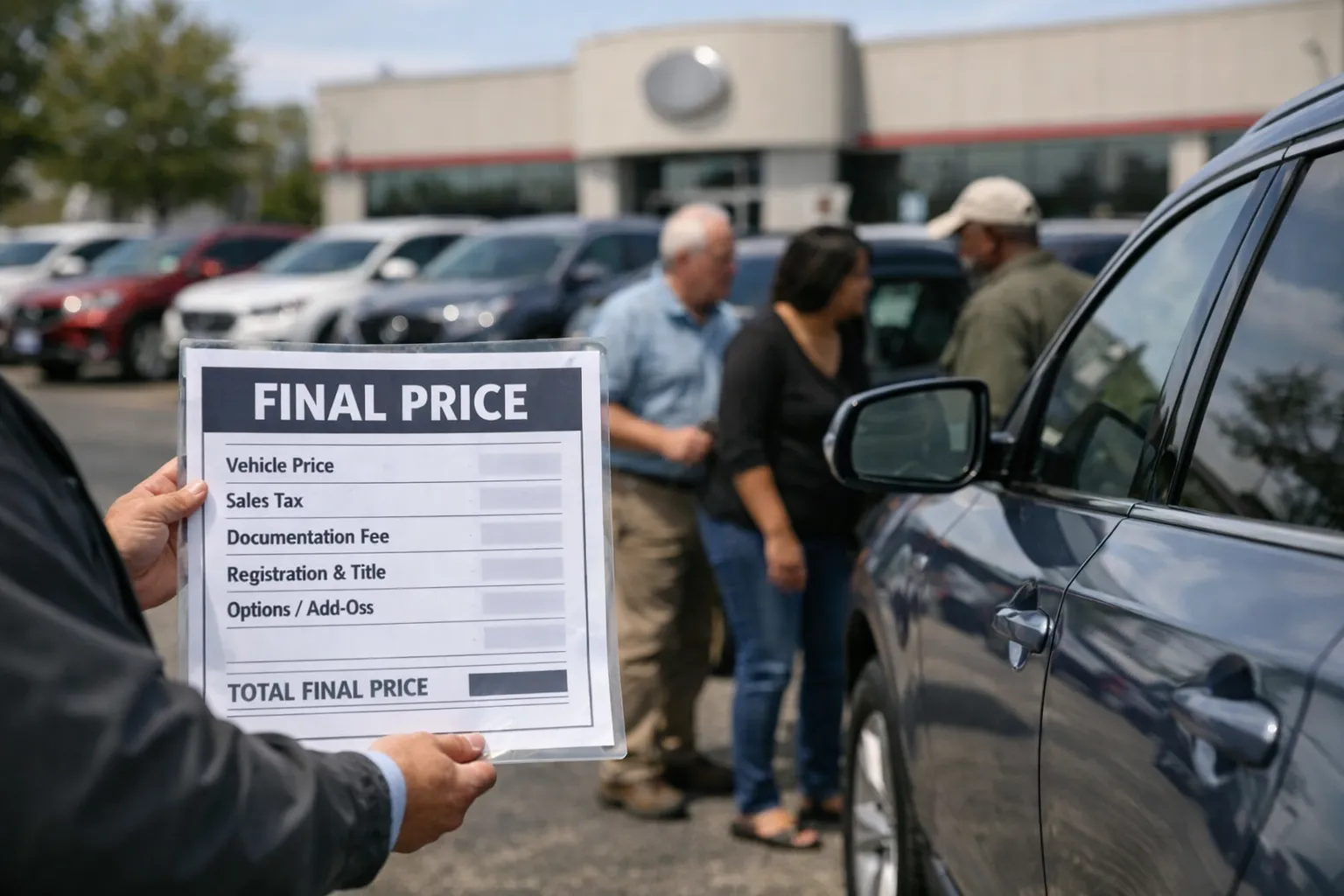
The National Automobile Dealers Association (NADA) and a coalition of large dealership groups announced a voluntary, nationwide standard for a "Final Price" window sticker on new and used vehicles, aiming to eliminate hidden fees and simplify price comparisons for buyers. The initiative, unveiled in a joint announcement Tuesday, sets an October 1, 2026 target for broad dealer enrollment and a one-year phase‑in for smaller independent stores.
What the "Final Price" sticker will show
Under the new standard, the window sticker—designed to sit alongside or replace the traditional Buyer’s Guide—will present a single, prominently displayed "Final Price" number that includes:
- Manufacturer suggested retail price (MSRP) or dealer asking price
- Dealer-installed accessories and optional packages explicitly identified and priced
- Documentation and administrative fees set out as a single line item
- Estimated sales tax by state and any local levies
- Pre-discount incentives and trade‑in allowances separately listed
- Estimated finance charges shown as an APR range with a clear "financing not included" flag if a loan is used
The standard also requires a plain‑language footnote explaining that the "Final Price" is the total the dealer will ask for at point of sale before trade or financing adjustments. The draft text released by NADA also calls for a standardized icon to indicate whether the price includes destination charge.
Why dealers and consumer groups backed it
Dealers have struggled with consumer mistrust tied to opaque fees—document fees, handling charges and discretionary markups have been persistent flashpoints. For buyers, these add-ons often mean the advertised price on a listing is materially different from the out‑the‑door number.
Proponents argue the new label will reduce haggling over unavoidable charges and level the playing field for online listings. "Standardized, visible pricing reduces buyer friction and helps simplify omnichannel retailing," the NADA announcement said.
Consumer advocacy groups welcomed the transparency push but stressed the need for enforcement. "Voluntary standards are a step forward," said an advocacy spokesperson, "but consumers will only benefit if the label consistently reflects the actual amount they pay at signing." Many advocates want state-level oversight or federal guidance to prevent reclassification of fees that would undermine the label's intent.
Early adoption and rollout
The agreement identifies a two-tier roll-out. Large dealer groups and franchised chains are encouraged to implement the sticker system beginning October 1, 2026. Independent and small dealers are given until October 1, 2027, to comply. NADA said it will publish a compliance checklist and sample sticker templates before the October start date.
Industry technology vendors have already moved to support the change. Several dealer-management-system (DMS) providers confirmed they are working on software updates to populate the sticker automatically from inventory and add-on records, aiming to minimize incremental workload on showroom staff.
What it means for buyers
For car-buying enthusiasts who comparison-shop across listings, the sticker could meaningfully cut the time needed to compare true prices across dealers and private sellers. Key practical impacts buyers should watch for:
- Fewer surprise fees: Dealers must disclose the most common add‑ons on the sticker. That should reduce "sticker shock" at signing.
- Cleaner online listings: Car-search sites and marketplaces are expected to adopt filters for "Final Price" once the standard is widely used.
- Financing clarity: The sticker will not pre-approve loans, but the APR range and finance-charge estimate give buyers a clearer starting point when negotiating credit terms.
- Trade‑in transparency: Trade allowances and how they affect the final price will be shown separately, helping buyers evaluate net cash flows.
Open questions and potential pitfalls
The voluntary nature of the standard leaves several enforcement questions unanswered. Dealers could, for instance, itemize new add-ons that previously were rolled into larger fees, preserving the out‑the‑door price but changing how it is presented. Without a binding legal requirement or audit mechanism, consumer groups worry about cosmetic compliance.
Another open issue is how the sticker will interact with state laws that cap or ban certain line items. States vary in how they regulate documentation fees and sales disclosures; harmonization will require coordination between the new industry standard and state regulators.
What Car Buying Guide recommends to buyers now
- Ask for a printed Final Price sticker or a screenshot of the dealer's window-sticker preview before visiting.
- Confirm which taxes and registration fees are included and which remain subject to change.
- Get all promises—such as included accessories or service packages—in writing and on the sticker.
- Compare the stickered Final Price across multiple dealers rather than just advertised list prices.
The "Final Price" sticker marks a rare industry-wide bid to simplify the car-buying checklist. If broadly adopted and delivered with meaningful oversight, it could reduce friction and better align advertised and paid prices. For buyers, the coming months will be a test: watch pilot dealers and ask for the sticker early in the shopping process to see whether the promised clarity translates into real savings at the signing table.