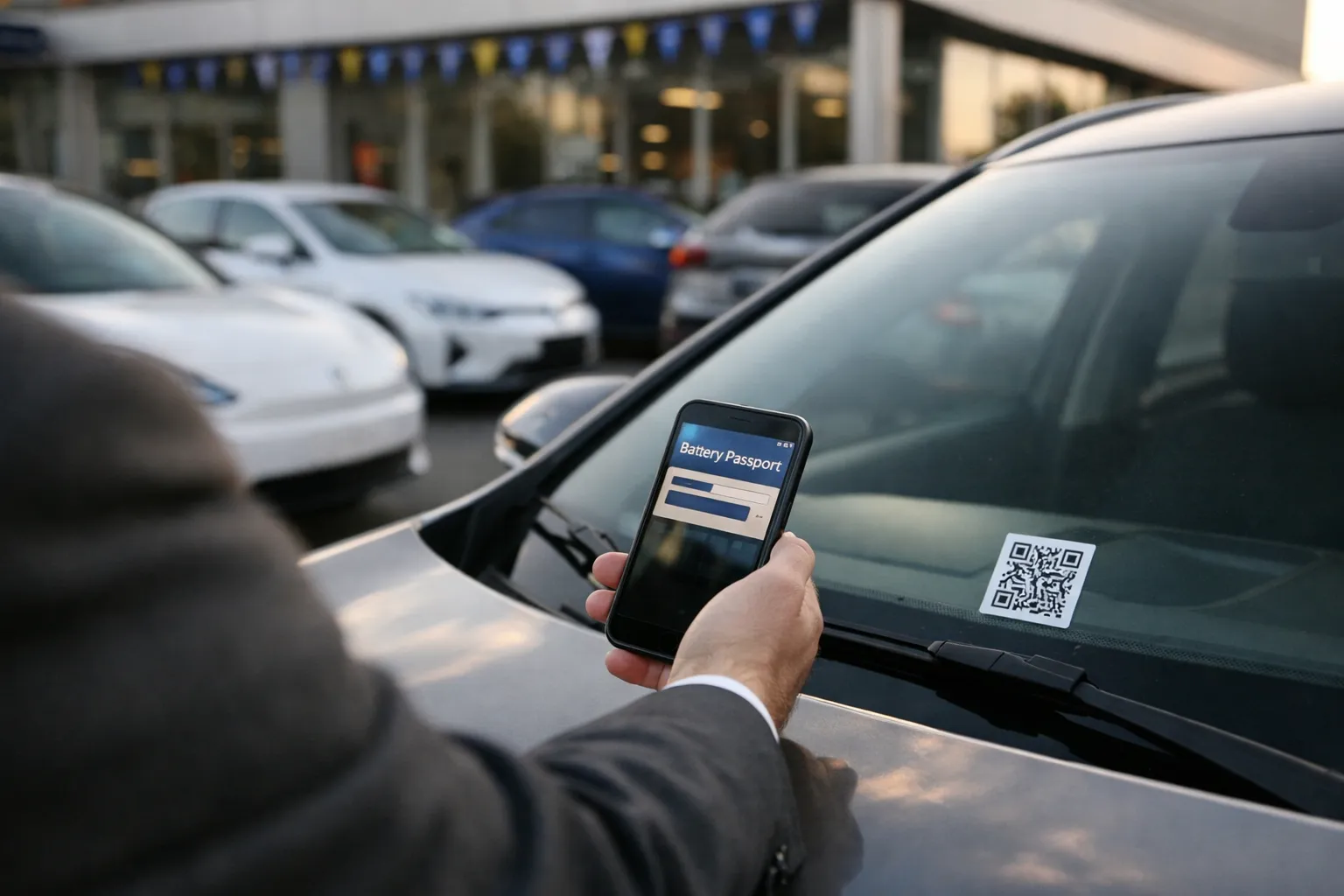
The European Union has moved to standardize how secondhand electric vehicles are sold across member states by requiring that used-EV listings include battery passport data and a set of basic battery-health metrics. The change is scheduled to take effect for consumer-facing online and dealer listings at the start of 2027 and is already prompting dealers, automotive marketplaces and lenders to adjust how they price and market used EVs.
What the new requirement means for buyers
Under the new rule, every used-EV listing offered to consumers in the EU must display a link or QR code to the vehicle’s EU battery passport entry plus three baseline battery-health indicators: remaining calculated capacity (as a percentage of original), recorded cycle count or equivalent usage metric, and whether the battery is covered by any transferable warranty. Sellers must also note whether the battery has been subject to major repairs or replacement and provide the date of the last battery-system diagnostic.
For buyers, the change addresses a long-running transparency gap. Until now, prospective owners often relied on individual dealer reports, OBD-II scans or seller claims to assess battery condition. The passport requirement will make standardized, manufacturer- and recycler-supplied provenance and condition data visible at the point of sale.
Why regulators acted
EU regulators have framed the move as a consumer-protection and sustainability measure. Battery health is arguably the single largest determinant of a used EV’s remaining useful value and long‑term ownership costs. Standardized data aims to reduce information asymmetry that can depress cross-border trade in used EVs and spur wasteful early battery scrapping.
Officials also point to ambitions in the EU’s Battery Regulation: the so-called “battery passport” program has been designed to track materials, production and lifecycle data. Extending passport visibility to secondhand sales completes that lifecycle chain and supports circular-economy goals by improving the reuse and remanufacturing market for EV batteries.
Industry reaction: mixed, but pragmatic
Dealer groups and online marketplaces acknowledge the extra work but say the requirement could ultimately boost consumer confidence. “A buyer is far more likely to choose a used EV when they can independently verify battery condition,” said a spokesperson for a pan‑European dealer association. Marketplaces are racing to integrate battery-passport links and adapt listing templates to display the mandated metrics.
Some smaller independent dealers warn about implementation burdens. Gathering and verifying passport links for older imported vehicles or cars repaired by third parties will require new checks and in some cases retroactive passport registration. Several European marketplaces and dealer software vendors are offering bulk‑upload tools and VIN-to-passport lookup services to speed compliance.
What this does to pricing and warranties
Analysts expect a near-term price dispersion increase: vehicles with passports showing high remaining capacity and transferable battery warranties should command premiums, while cars with incomplete or poor-quality data may see deeper discounts. The change also raises questions about warranty transfer rules—manufacturers will now face pressure to allow warranty transfer or provide clear documentation if coverage lapses on resale.
Insurers and lenders are already recalculating risk models. Battery-condition visibility reduces uncertainty about residual values, which can tighten financing spreads on used-EV loans and leases. Some lenders said they will offer conditioned pricing—better loan rates for cars with passport-verified battery health above a set threshold.
Cross-border sales and consumer protections
One of the intended effects is to unclog the intra-EU used-car market. Before the passport mandate, buyers in one country often hesitated to buy used EVs from another because of differing battery-service practices and opaque records. With passport data standardized, national differences in documentation still exist but are less of a barrier to cross-border transactions.
Consumer groups welcomed the transparency but cautioned that passports are a starting point, not a full solution. “A passport documents provenance and recorded diagnostics, but it won’t substitute for an independent pre-purchase inspection,” said a consumer-rights advocate. Buyers are still advised to request a walk-around verification, test drive and, where possible, a technician’s battery-scan readout.
Practical checklist for buyers in 2027
- Confirm the listing includes a battery‑passport link or QR code and verify VIN matches the passport.
- Check the passport’s remaining-capacity figure and whether a transferable warranty is listed.
- Ask for the latest battery-system diagnostic and compare it to the passport entry for consistency.
- Factor the passport-backed battery condition into negotiation: strong battery metrics can justify a premium, weak/absent data should reduce price.
- For cross-border purchases, confirm whether any battery warranty transfer requires dealer or manufacturer paperwork and whether local workshops can service the pack.
What to watch next
Implementation details will determine how quickly the market adjusts. Watch for two near-term indicators: how quickly major online marketplaces fully integrate passport display by region, and whether OEMs clarify warranty-transfer rules tied to passport entries. Also monitor secondary services such as certified battery-health audits and extended warranties built around passport data; these services could become standard add-ons.
For car-buying enthusiasts, the passport rollout promises a more data-driven used-EV market. The immediate work for sellers and platforms is nontrivial, but the outcome should be clearer valuations and less guesswork at the point of purchase—especially for cross-border buyers who previously had to take batteries largely on faith.