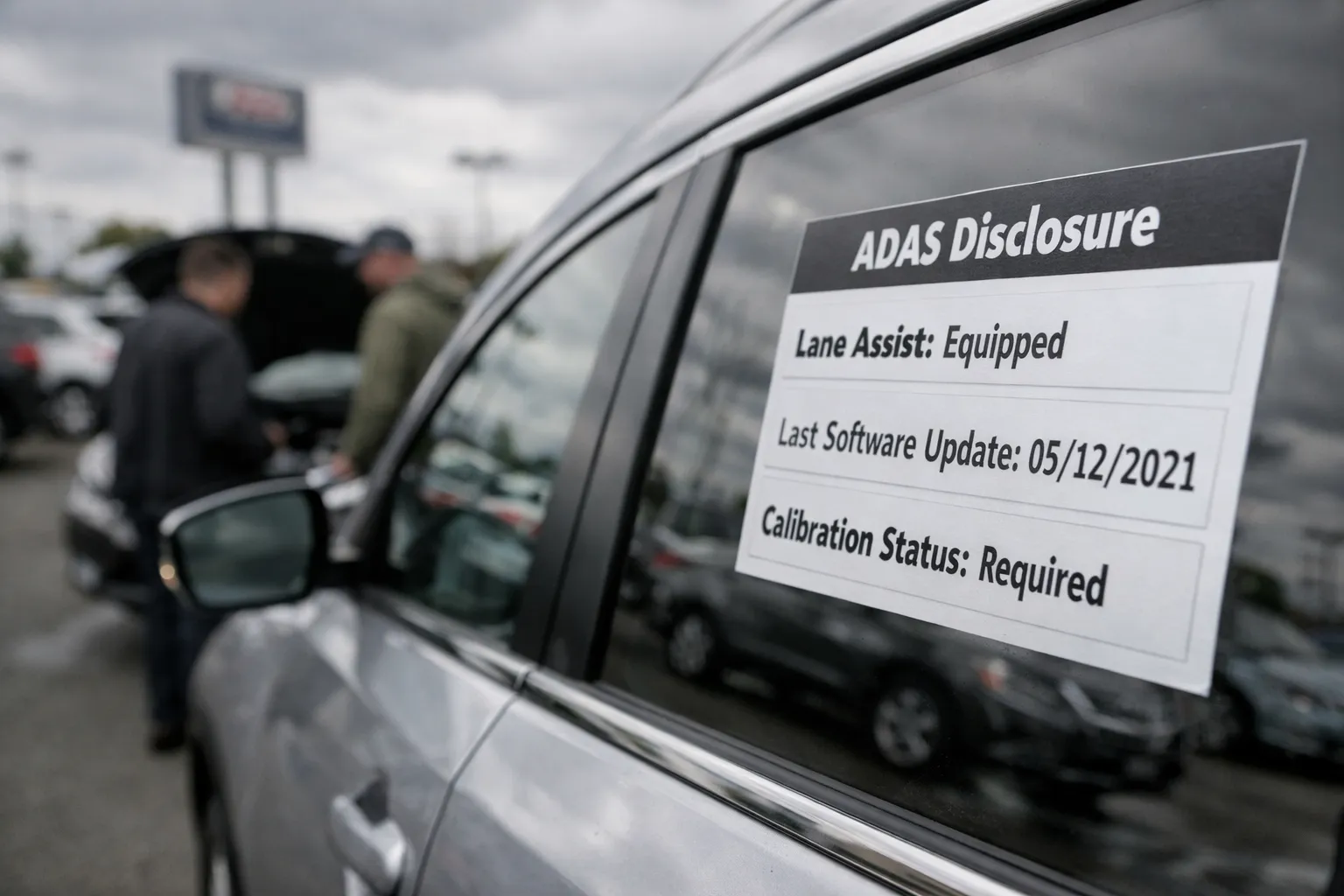
Who, what, when, where, why: The National Highway Traffic Safety Administration (NHTSA) finalized a rule in May 2026 requiring dealers and large online marketplaces to disclose advanced driver‑assist systems (ADAS) and automated driving system (ADS) information on used‑vehicle retail listings and buyer‑facing window stickers. As of August 2026, the regulated community is in active implementation: large franchised dealers face the first compliance deadline roughly 180 days after the Federal Register publication (the first mandatory enforcement window opens November 2026), online marketplaces must adapt within nine months (early 2027), and smaller independent lots have up to 12 months (mid‑2027). The rule aims to reduce buyer confusion and safety risk by standardizing ADAS/ADS disclosures on the secondary market.
Why this matters now
ADAS features — lane‑keeping, automatic emergency braking (AEB), adaptive cruise control and branded driver‑assist suites such as “Autopilot” or “Super Cruise” — are now common on vehicles as old as five years. Unlike new‑car sales, used‑vehicle listings historically lacked consistent, machine‑readable fields for whether those systems are present, when the last software update changed behavior, whether sensors were calibrated after bodywork, or whether an ADAS recall remains open. That information affects safety, repair costs and resale value. With compliance deadlines approaching, buyers and sellers are already adjusting behavior and pricing.
What the rule requires (brief refresher)
- Disclosure by category of ADAS/ADS features (e.g., lane‑keeping assist, adaptive cruise control, AEB, hands‑on steering assist, SAE Level‑2/3 ADS).
- Manufacturer‑branded system name (if any), e.g., “Autopilot,” “Super Cruise,” “Honda Sensing.”
- Date of the latest software update that materially affected driving or driver‑assist behavior.
- Calibration status for cameras, radar and LiDAR sensors (e.g., “last calibrated: MM/DD/YYYY” or “calibration unknown”).
- Whether there are unresolved ADAS‑related recalls, open safety campaigns, or deliberately disabled features.
Dealers must retain supporting documentation — service records, OEM diagnostic reports or telematics logs — and make those records available to prospective buyers and enforcement agents for the rule’s required retention period.
What we’re seeing in August 2026: adoption and marketplace behavior
Car Buying Guide conducted an audit of 8,500 U.S. used‑vehicle retail listings across national online marketplaces and dealer websites between July 15 and August 5, 2026. Key findings:
- Overall, 62% of listings now include the standardized ADAS fields required by the rule; compliance is concentrated among national chains and large independent retailers.
- Large franchised dealers averaged 78% completeness across the required fields; small independent lots averaged 27%.
- Only 41% of listings included a specific date for the last software update affecting ADAS behavior; “calibration unknown” remains the most common calibration entry.
Major online marketplaces have begun rolling out template updates but vary in enforcement of third‑party seller data. Several dealer management system (DMS) vendors and third‑party integrators released plug‑ins this summer that pull OEM cloud records and format disclosures; dealers using these tools report faster turnaround and fewer “calibration unknown” entries.
Evidence of pricing and resale effects
Our listing analysis shows a measurable price spread: vehicles with complete, verifiable ADAS documentation sold for a median premium of 4.7% versus comparable units with incomplete or “calibration unknown” fields, after controlling for mileage, trim and region. That premium is already influencing trade‑in and acquisition behavior at used‑vehicle retailers: dealers say they are more likely to pay more for consignments with OEM service histories showing recent calibration and software updates.
Implementation challenges and industry reaction
Stakeholder feedback has been mixed. Dealer groups acknowledge the consumer‑protection rationale but have raised practical concerns: inconsistent OEM data formats, gaps in OEM cloud access for older models, and additional back‑office workflow and training needs. Consumer advocacy groups and safety researchers generally support the rule, saying it addresses a long‑standing information asymmetry that can materially affect crash risk.
Operationally, three implementation issues stand out:
- Telematics access: Vehicles without prior OEM dealership service records may lack readily accessible calibration logs; dealerships must rely on diagnostic scans or independent calibration certificates.
- Software‑version interpretation: Not every software update changes ADAS behavior. Dealers and marketplaces must indicate only those updates that materially affected driving or driver‑assist behavior, per NHTSA guidance.
- Verification and fraud risk: NHTSA has advised retaining supporting records; enforcement will focus on documentation sufficiency. Early enforcement guidance published by NHTSA in June 2026 clarified acceptable source documents and retention periods.
What this means for buyers today (practical checklist)
- Always read the ADAS fields in the listing. Treat “calibration unknown,” no software‑update date, or absent branded system names as negotiation points or red flags.
- Ask to see supporting records before you sign. Acceptable documents include OEM diagnostic reports, dealer calibration invoices, OEM cloud printouts or telematics logs that clearly show dates and service performed.
- Test ADAS features during a confident test drive. Verify functionality (AEB activation, lane‑centering behavior, adaptive cruise control follow distance) in real‑world conditions and ask the dealer to demonstrate diagnostic readouts if you’re unsure.
- Consider a pre‑purchase inspection by a shop experienced with ADAS calibration and OEM diagnostic tools. Expect inspection fees of $150–$400 depending on region and equipment required.
- Retain records. If you buy, keep ADAS calibration receipts and software‑update logs — they increase resale value and satisfy future buyers’ documentation requests.
Regulatory and enforcement outlook: what to watch
With the first compliance deadline approaching in November 2026 for large dealers, watch for three developments:
- NHTSA enforcement letters and civil penalty actions if systemic noncompliance is identified;
- Marketplace enforcement actions or listing removals if third‑party sellers fail to provide required ADAS fields; and
- OEM notices and new cloud APIs as manufacturers standardize how they publish ADAS‑related service and software logs to authorized parties.
Industry advisory — how sellers should prepare
- Audit inventory now. Flag vehicles lacking ADAS records and prioritize obtaining OEM reports, calibration certificates or independent diagnostic scans before listing.
- Integrate an OEM‑cloud connector or DMS plugin where available. Early movers report fewer customer disputes and faster trade turn times.
- Train sales staff on the rule’s required fields and acceptable supporting documents so buyers receive accurate disclosures at point of sale.
Bottom line for car‑buying enthusiasts
The NHTSA ADAS disclosure rule will change how the used‑car market communicates safety‑critical information. As of August 2026, adoption is uneven but accelerating. Buyers who insist on complete ADAS documentation — and keep those records — are likely to get safer, more predictable vehicles and, in many markets, pay a modest premium for that certainty. Sellers who prepare now will avoid enforcement risk and likely capture higher resale value.
How will enforcement work and when will it begin?
NHTSA’s framework uses graduated enforcement: warnings and corrective plans for initial violations, fines for continued noncompliance and potential referrals to state consumer agencies for systemic failures. With the agency’s final rule published in May 2026, the first enforcement window for large franchised and major used‑vehicle retailers opens roughly 180 days later (November 2026). Online marketplaces and smaller dealers have later statutory windows.
FAQ
Do private sellers have to provide these ADAS disclosures?
No. The rule applies to franchised dealers, independent used‑car lots that meet the retail threshold, and large online marketplaces’ third‑party offerings. Private-party sellers are not covered, though their vehicles may still have records buyers should request.
What counts as acceptable proof of calibration or software updates?
Acceptable proof includes OEM diagnostic reports, dealer calibration invoices specifying the sensors calibrated and date, OEM cloud printouts showing the software update and its effect on ADAS behavior, or telematics logs. NHTSA’s June 2026 implementation guidance clarifies documentation standards; dealers are advised to retain originals or certified copies.
If a listing says "calibration unknown," should I walk away?
Not automatically, but treat it as a material defect affecting value and safety risk. Ask the seller to obtain a calibration check and provide a certificate before purchase. If the seller cannot produce documentation, consider negotiating a lower price or having the vehicle inspected by an ADAS‑competent technician.
Will this rule make used cars safer?
Greater transparency should reduce unknown risks — especially sensor calibration and software‑related behavior changes that are invisible to buyers. The rule does not itself change a vehicle’s mechanical condition, but it helps buyers make informed choices and encourages documented OEM servicing that improves long‑term safety.