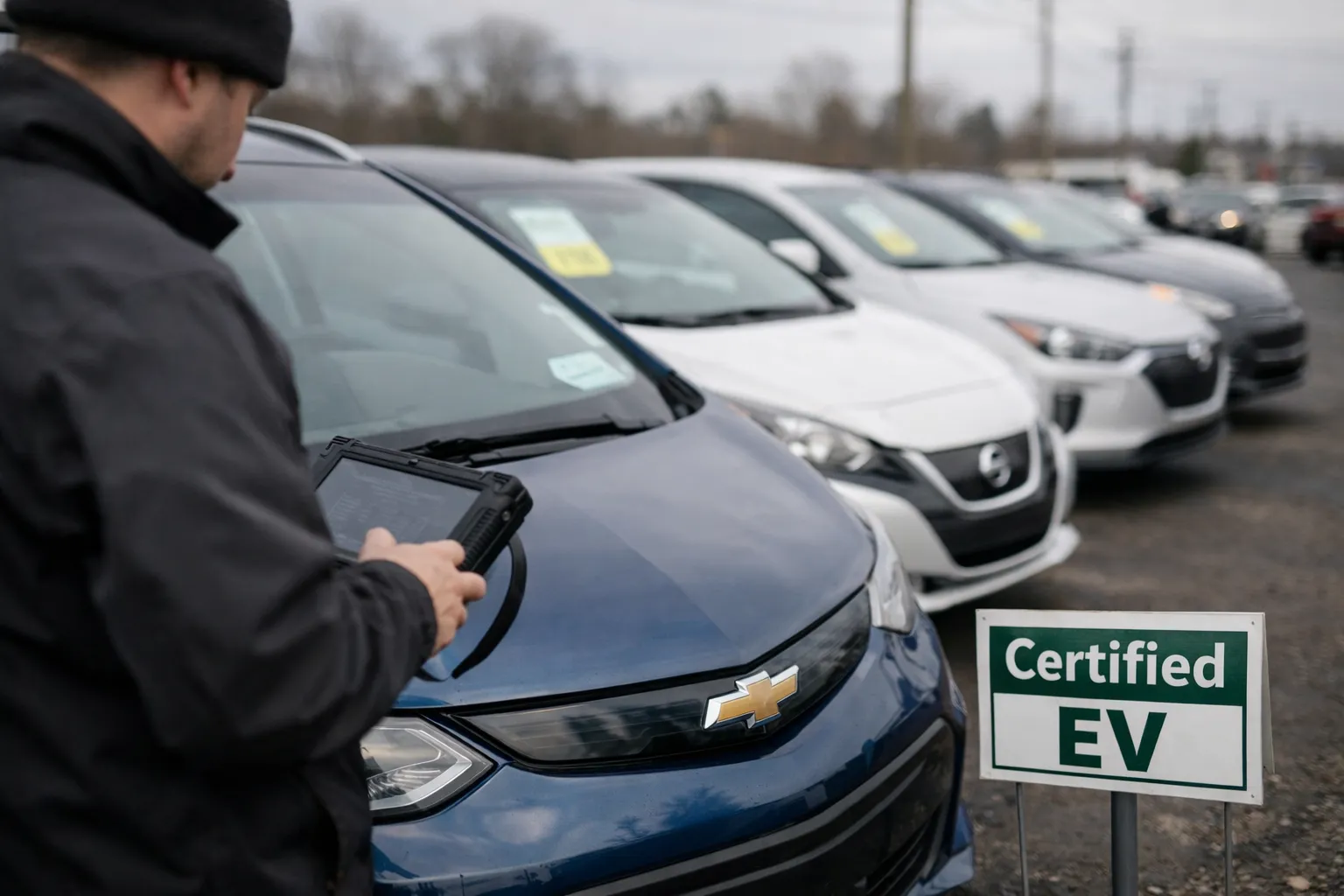
Who, what, when, where, why: As of November 2026, U.S. and European used‑EV markets are moving past the peak of the second major off‑lease wave that dominated the spring and summer of 2026. Off‑lease inflows—chiefly 2019–2022 leases returning at the end of 36–48 month terms—remained elevated through mid‑2026 but began trending down in Q3–Q4. The result: inventories are still higher than pre‑2024 levels, retail asking prices have mostly stopped falling, and the principal battleground for value now centers on verified battery state‑of‑health (SoH), warranty transferability and localized repair availability.
Context: why the timing still matters
The timing traces to lease cohorts written in 2019–2022. Those vehicles—Tesla Model 3/Y, Chevrolet Bolt EV/Bolt EUV, Nissan Leaf, Hyundai Kona Electric, early Kia Niro EVs and first‑wave Mustang Mach‑E and Volkswagen ID.4 leases—returned en masse between late 2024 and mid‑2026. That produced a supply shock in 2025–mid‑2026 that pushed many mainstream used‑EV asking prices 20–35% below 2022 peaks.
By November 2026 the market shows differentiation: higher‑quality, lower‑mileage and well‑documented vehicles are commanding premiums again, while undifferentiated listings without battery data continue to sit. This phase matters because it separates near‑term opportunistic buyers from longer‑term owners who must weigh battery life, repair paths and resale prospects.
Current market picture — supply, pricing and financing (Nov 2026)
- Supply easing but still elevated. Off‑lease volumes peaked in Q2 2026 and, according to aggregated auction and marketplace indicators, have declined through Q3–Q4. Inventory levels at major remarketers and franchised dealers are roughly 15–25% below their mid‑2026 highs but remain above typical 2019–2021 seasonal norms.
- Prices stabilizing, with model‑by‑model dispersion. Average used‑EV asking prices remain 20–35% under 2022 peaks for many mainstream models. However, since June 2026 some segments have recovered 3–10% as demand for lower‑priced electrics improved and certified programs absorbed higher‑risk units. Brand‑favored models with strong service networks (Tesla, Hyundai/Kia newer models) continue to hold value better.
- Financing has improved selectively. Lenders relaxed some of the tightest restrictions seen in early 2026 for vehicles with verified SoH and CPO coverage. Captive finance arms are again offering 60–72 month terms for certified units; subprime lenders still price older, uncertified EVs conservatively.
New developments since June 2026
- Remanufacturing scaled meaningfully. Through 2026 several OEMs and third‑party remanufacturers expanded module‑level repair and reman pack programs. Market participants report that module repairs and remanufactured packs now commonly reduce out‑of‑warranty costs by 30–60% compared with full OEM pack replacements, improving resale prospects for partially degraded cars.
- Broader adoption of standardized SoH summaries. Major auction houses, online retailers and many franchised dealer groups have adopted a common SoH summary template on listings that includes usable capacity percentage, recent maximum‑charge capacity, and a timestamped recent charge‑cycle count. That standardization has reduced information asymmetry and tightened spreads between certified and uncertified listings.
- State‑level incentive shifts increased buyer demand pockets. Several states (notably California and Colorado) expanded point‑of‑sale used‑EV rebates and streamlined income caps in 2026; those programs boosted demand at the lower end of the market for qualifying vehicles and helped move otherwise slower inventory.
- New third‑party battery insurance and warranty products. Insurers and warranty providers launched battery‑specific policies that cover capacity loss below a defined threshold for up to 3–5 years; those products are increasingly bundled into CPO offers and dealer guarantees.
What matters most for buyers now — updated priorities
Battery condition remains the decisive variable, but buyers now have more reliable tools and market mechanisms to assess and mitigate risk. Priorities for November 2026:
- Demand a standardized SoH summary. Ask for a seller‑provided SoH summary that shows current usable capacity (%), timestamped maximum charge, and recent charge‑cycle count. Listings without this template should be treated as higher risk.
- Prefer CPOs or dealer listings that include a battery policy. Certified units with explicit battery coverage or third‑party battery insurance trade at narrower spreads and simplify financing.
- Confirm warranty transferability and read OEM fine print. Many OEM battery warranties (commonly 8 years/100,000 miles for earlier models) remain in force, but transferability clauses and prorated remedies vary—get written confirmation.
- Check repair pathways locally. Verify availability and pricing for remanufactured modules or pack repacks in your region; turnaround time and parts availability have a direct effect on total cost of ownership.
- Factor telematics provenance into price. Vehicles with complete OEM telematics histories and documented low DC fast‑charge exposure command premiums; if telematics aren’t available, budget for an OEM diagnostic or an independent capacity scan.
Impact: who wins, who loses
Price‑sensitive private buyers and fleet purchasers continue to benefit from deeper selection and lower nominal entry prices, especially for models with solid reman repair paths. Dealers that adopted transparent SoH disclosures, battery guarantees and bundled warranty products have seen faster turns and smaller discounts. Sellers of early EVs without supporting data or repair options still face extended days‑to‑turn and price concessions.
Industry reactions and marketplace shifts
Major remarketing channels formalized EV condition labeling in 2026; online retailers emphasize SoH and warranty badges on listings; and some regional dealer groups have established partnerships with remanufacturers to offer same‑day module repairs at point of sale. Lenders and insurers are introducing underwriting models that incorporate SoH metrics to price loans and warranty products more accurately.
What's next — signals to watch
- Whether off‑lease volumes continue easing into 2027 as the 2019–2022 cohort clears the pipeline and 2022–2024 leases roll off more gradually.
- Further standardization of SoH reporting across marketplaces, which would shrink information asymmetry and compress premiums for certified units.
- Additional declines in module‑level repair costs and faster lead times as remanufacturing capacity expands—this would materially raise values for partially degraded cars.
- Policy changes at the federal or state level (clean‑vehicle credit eligibility or used‑EV incentives) that could shift demand pockets quickly.
Checklist for used‑EV shoppers — Nov 2026
- Require a standardized SoH summary and recent charge history; refuse opaque listings.
- Confirm OEM battery warranty status and transferability in writing.
- Prefer CPO units or dealer listings with explicit battery guarantees or third‑party battery insurance.
- Obtain a high‑voltage diagnostic or capacity scan if telematics are unavailable.
- Get local quotes for reman/module repair before finalizing price negotiations.
Frequently asked questions
Are off‑lease EVs still cheaper primarily because batteries are failing?
No. Prices fell initially because supply rose sharply in 2025–mid‑2026. Battery degradation varies widely by model, climate and use. The difference now is market transparency: vehicles with verified SoH and documented low fast‑charge exposure retain value; uncertified units carry higher discounts.
How much should I budget for battery repair or reman options in late 2026?
Prices vary by make and model, but module‑level repairs and remanufactured packs commonly run 30–60% less than full OEM pack replacements in 2026. Always get local quotes and timelines; availability and labor rates affect total cost of ownership and should factor into offers.
Does the federal used‑clean‑vehicle tax credit still matter for buyers?
Yes. Federal and state used‑EV incentives remain demand drivers for eligible buyers. Qualification rules—price caps, mileage ceilings and income limits—still restrict the program’s reach, so confirm eligibility before relying on the credit in your purchase budget.
What if the seller won't provide telematics or an SoH report?
Insist on an OEM diagnostic at a franchised dealer or an independent capacity scan before purchase. If neither is available, treat the vehicle as higher risk and adjust your offer accordingly or walk away—buying blind on battery health is a common source of post‑purchase cost and regret.
Bottom line: As of November 2026 the used‑EV market has moved from shock to sorting. Inventory pressures that drove sharp discounts earlier in the year are easing, certification and remanufacturing options are more widely available, and transparent SoH reporting has become a primary price differentiator. For buyers, that means more opportunity—but only if you insist on documented battery health, warranty clarity and known repair pathways before signing.