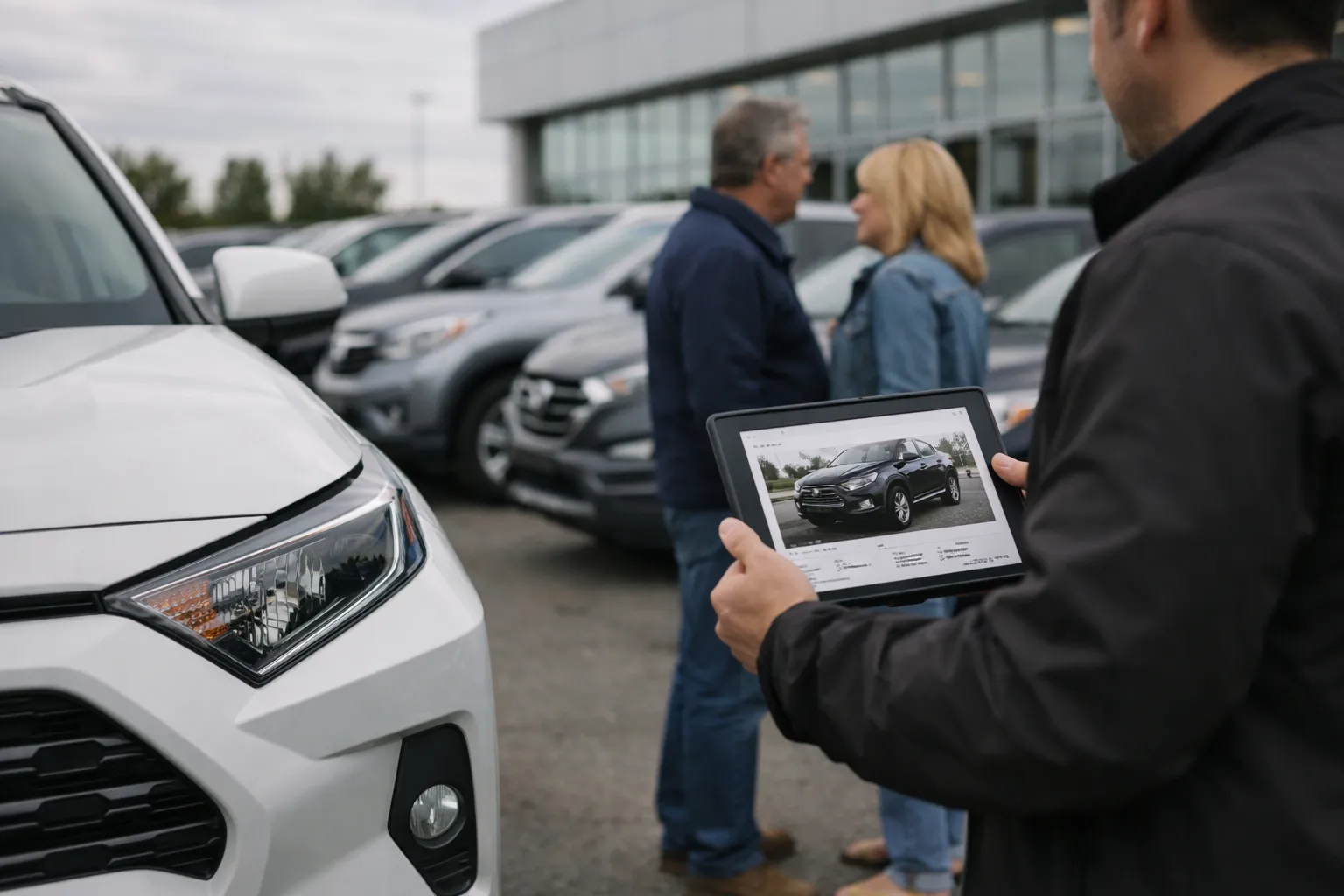
Buyers looking for a late‑model compact SUV face a common dilemma: pay a dealer premium for convenience, warranty and financing, or pursue a private‑party sale and bank on lower sticker prices but higher inspection and risk costs. Between 2024 and mid‑2026 the used market for 3–5‑year compact SUVs (vehicles like the Toyota RAV4, Honda CR‑V, Hyundai Tucson, Nissan Rogue and Ford Escape) settled from pandemic-era volatility into a new pattern: relatively abundant off‑lease supply, significant regional price divergence, and sharper model‑level differences than before. This analysis breaks down those dynamics, shows where real savings live, and gives practical guidance for buyers who want the best deal without sacrificing long‑term value.
Why 3–5‑year compact SUVs matter now
Compact SUVs are the single largest segment of retail used‑vehicle demand in the U.S.; they combine family practicality, acceptable ownership costs and strong resale values for many buyers. For cars aged 3–5 years, supply channels are dominated by three sources: dealer trade‑ins and rentals, lease returns, and private sellers. Changes in OEM leasing, fleet volumes and new‑car delivery schedules from 2022–2025 produced a wave of 3–5‑year vehicles returning to market during 2024–2026, but the distribution of those returns—certified pre‑owned (CPO) pipelines to franchised dealers versus direct wholesale to independent lots—has driven different pricing outcomes across channels and regions.
How dealer and private‑party prices diverge — the mechanics
- Gross price vs total cost. Dealers typically list higher gross prices, but those prices bundle reconditioning, title and paperwork, short‑term warranty or CPO certification, and access to finance. Private‑party listings start lower but shift costs to the buyer: inspections, immediate repairs, registration fees, and cash or third‑party financing hurdles.
- Financing and buyer pool. Many buyers need a loan; dealers package financing that can make a higher sticker acceptable through term and rate options. Private sellers rarely facilitate competitive financing, narrowing the buyer pool and keeping prices lower.
- Information asymmetry and signals. A dealer CPO sticker, recent service records and a professional inspection reduce perceived risk and support higher retail prices. Private sellers often provide less documentation, which suppresses offers even if mechanical condition is similar.
- Regional supply imbalances. Coastal metros and Sun Belt regions with higher population growth absorbed more lease returns into retail faster; inland and rural markets sometimes received a flood of wholesale units that depressed prices in local auctions and in private‑party stock.
What the 2024–2026 market shows for specific models
Across common compact SUV models the gap between private‑party and dealer prices varies by brand reputation, options content and service availability.
- Toyota RAV4 & Honda CR‑V. These models typically command the smallest private‑party discount versus dealer retail. Strong brand reputation and high demand keep private sellers asking close to dealer levels; the premium for dealer CPO on low‑mileage examples is often justified for buyers who value warranty transfer and dealer service.
- Hyundai Tucson & Kia Sportage. Historically more price‑competitive off‑lease, these have shown wider private‑party discounts—partly because certified programs are newer and less uniformly valued by non‑brand‑loyal buyers. Dealers will still press CPO price but private‑party bargains are more common.
- Ford Escape & Nissan Rogue. Pricing divergence here depends on equipment and powertrain. Turbocharged or AWD variants hold value better at dealers; base models without options often show pronounced private‑party discounts in markets saturated with trade‑ins.
Regional patterns buyers should know
Where you live remains one of the largest determinants of whether a private‑party purchase is genuinely cheaper after accounting for risk.
- High‑growth Sun Belt metros (e.g., Phoenix, Tampa, Atlanta). These areas processed more lease returns into retail faster; dealer inventory was replenished regularly, reducing the dealer premium. Private‑party discounts exist but are smaller because demand is strong.
- Midwest and Rust Belt (e.g., Detroit, Cleveland). Slower retail absorption and more wholesale supply pushed private‑party and independent dealer prices down further. Buyers who can travel regionally often find lower out‑of‑market private sales.
- Coastal and high‑value markets (e.g., Bay Area, NYC). Higher used‑car prices and greater demand for certified vehicles reduce the private‑party advantage; many buyers pay a premium for the dealer experience and warranty coverage.
Channel choice scenarios: when private‑party beats dealer
Private‑party is the better route if you match most of the following:
- You can pay cash or secure a competitive loan independently.
- You have reliable access to a trusted mechanic for pre‑purchase inspection.
- The vehicle has detailed service records and a clean title; local demand is soft.
- You are comfortable handling registration, taxes and any minor post‑purchase repairs.
In those cases, buyers commonly save several hundred to a few thousand dollars versus dealer retail on comparable models—savings that can outweigh the absence of a warranty, especially on brands known for reliability.
When dealers make more sense
Buy from a dealer when:
- You need dealer financing, a trade‑in, or a vehicle available immediately with a warranty.
- The vehicle carries an active CPO program with transferable coverage that materially reduces expected repair costs.
- You're buying in a market where private‑party listings are scarce or inconsistent.
Dealers also help mitigate asymmetric information through vehicle history reports, reconditioning and return policies (where offered). For buyers who prioritize certainty and time, these benefits can justify the premium.
How to compare prices correctly
- Normalize costs: Add likely reconditioning/inspection costs and the price of a short warranty to private‑party offers to compare to dealer retail. Factor local registration and transfer fees too.
- Check financing net cost: Compare the total cost of financed purchases (monthly payment × term + down payment) from both channels, not just sticker price.
- Adjust for time and reliability: Value your time for inspections, administrative paperwork and potential negotiation. If you anticipate immediate repairs, that erodes private‑party savings quickly.
- Use multiple valuation tools: Cross‑reference KBB, Edmunds, and auction indices to set a walk‑away price. Look at recent sold listings in your region, not just asking prices.
Practical checklist for 2026 compact‑SUV buyers
- Set your target models and acceptable options—demand varies by trim and powertrain more than by year in this segment.
- Inspect or commission an inspection; prioritize battery and AWD system condition on higher‑spec examples.
- Confirm title status, recall completion, and verify service records.
- Get pre‑approved financing if you’re considering private‑party purchases.
- When negotiating with dealers, ask for itemized reconditioning work and insist on a capped dealer fee.
- If buying private‑party, complete a bill of sale and use an escrow or bank transfer to avoid payment disputes; file the title promptly.
Bottom line
From 2024–2026 the private‑party channel remains the best place to shave dollars off the purchase price for many 3–5‑year compact SUVs—but only when buyers account for inspection, warranty and financing realities. Dealers will continue to command a measurable premium for convenience, CPO coverage and financing packages, and that premium is worth paying for buyers who value certainty and immediate drive‑away capability. The smartest buyers use both channels: start with dealer listings to benchmark retail and then hunt private‑party opportunities that meet or beat the all‑in dealer price after normalization. Regional market conditions and specific model desirability will determine which channel gives the biggest advantage.