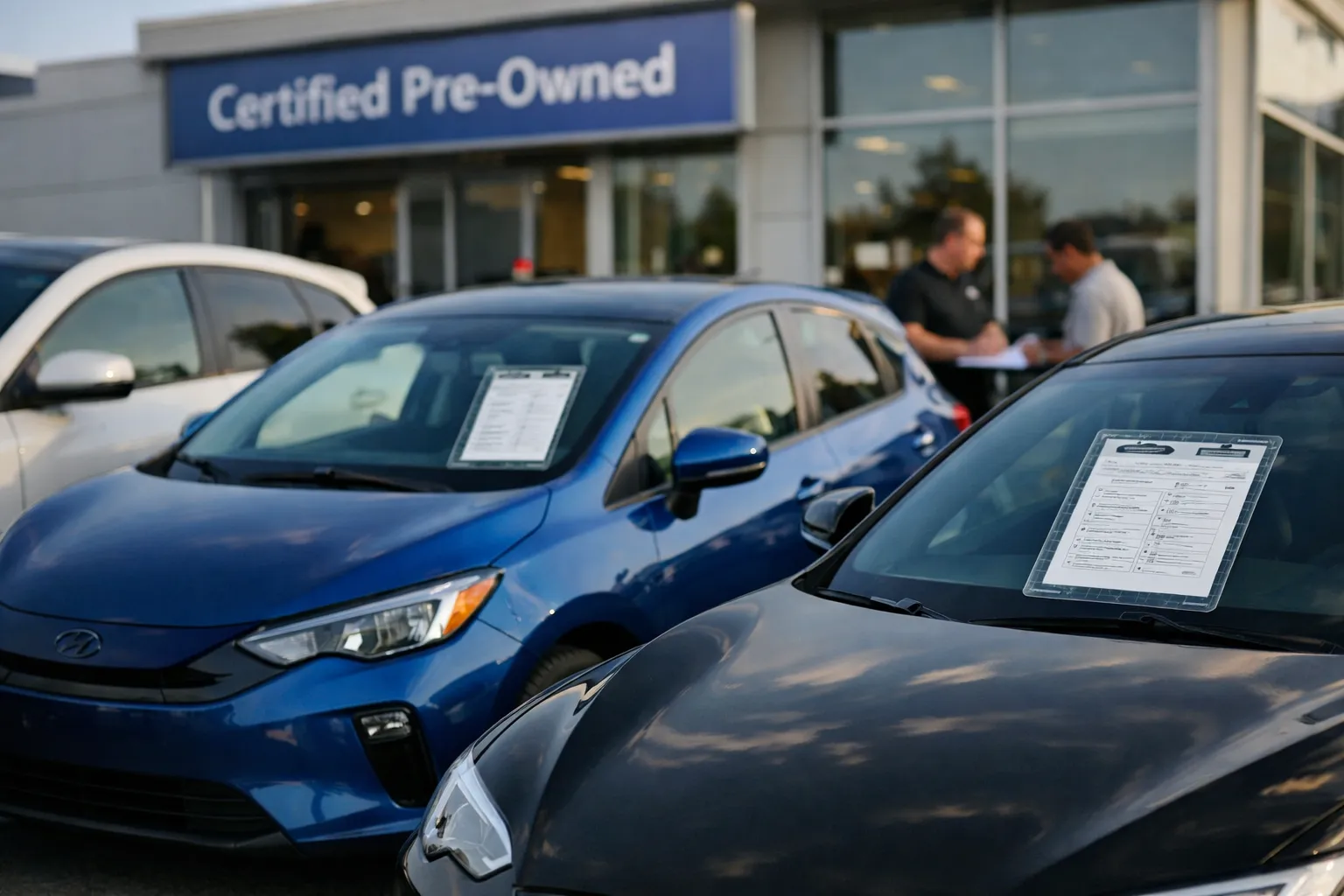
Executive summary: By 2026 certified pre‑owned (CPO) electric vehicles have evolved from a niche offering into a distinct segment of the used‑car market. That shift is driven not only by simple supply and demand, but by a cluster of factors specific to EVs: warranty transferability and length, availability of battery‑health data, OEM and dealer inspection protocols, and software/feature licensing or subscription issues. For buyers and enthusiasts, those factors change how value is assessed, how dealers price inventory, and what risks remain even after CPO validation.
How and why CPO EVs split from general used‑car stock
Traditional CPO programs have long relied on two pillars: a standardized inspection and a meaningful warranty or guarantee. For EVs, those pillars interact with EV‑specific technical and legal elements that create a product materially different from the average used ICE car.
- Battery and electric drive systems are capital‑intensive components whose remaining useful life is both highly consequential and difficult to estimate from a quick walkaround.
- Many EVs are continuously connected and receive over‑the‑air (OTA) updates; access to the vehicle’s telematics and software history can materially affect a buyer’s confidence.
- Warranties and battery guarantees vary by OEM and — crucially — by whether those warranties are transferable to a second owner and under what conditions.
Combine those factors with market realities — concentrated production cycles for many EV models, uneven regional charging networks and fluctuating consumer confidence — and CPO EVs begin to behave like a different asset class with distinct valuation drivers.
Warranty transferability and warranty scope: the core of value
Warranty terms are the single biggest differentiator between a general used EV and a CPO EV. Buyers value certainty: a transferable battery warranty that covers capacity loss beyond a set threshold or a multi‑year drivetrain guarantee reduces perceived downside risk.
Two features matter most:
- Transferability: Some OEM battery warranties explicitly transfer to subsequent owners; others void on resale or require dealer re‑registration. Where transfer is seamless, market confidence — and price — tends to follow.
- Scope and exclusions: Warranties that cover capacity degradation (for example, below a stated percentage of original capacity) address the key worry for used‑EV buyers. Warranties that exclude damage from improper fast‑charging, aftermarket battery work, or certain climate effects leave gaps.
For buyers, the practical implication is simple: verify not only the warranty's remaining term but also its transfer rules and the OEM process for future claims. Dealers who highlight clean, transferable warranty coverage can justify a premium; those who cannot are compelled to discount.
Battery health data and inspection protocols
Unlike engine compression or transmission leaks, battery health is a technical metric that depends on access to the vehicle's management system and often requires diagnostic tools. That asymmetry has pushed three developments that changed market dynamics:
- Dealership networks and authorized CPO programs increasingly include manufacturer‑level diagnostics in their inspection checklist, and document state‑of‑health (SoH) as part of the CPO packet.
- Independent test providers and third‑party labs now offer portable protocols — including short load tests and cell imbalance checks — that give buyers more evidence prior to purchase.
- Online marketplaces and listings that display verified battery reports reduce information asymmetry and compress price dispersion between sellers.
Where a CPO program publishes a documented battery‑health certification and the inspection includes battery capacity estimates, buyers are willing to pay for the certainty. Conversely, an absence of that documentation forces buyers to bid defensively and depresses prices.
Software, subscriptions and the ‘feature lock’ problem
EVs increasingly deliver value via software features that can be tied to accounts or subscriptions: advanced driver assistance packages, navigation services, or remote features. That creates a secondary layer of risk for used buyers:
- Some features are permanently enabled and remain with the car. Others remain tied to the original owner’s account and require transfer actions or new subscriptions.
- OEM policies on feature transferability vary and have concrete resale impact — a CPO model that guarantees feature transfers is worth more than one that requires the buyer to pay additional fees post‑purchase.
- Dealers who handle account transfers and re‑provisioning as part of their CPO workflow reduce friction; online platforms that leave the buyer to manage re‑provisioning push buyers to discount.
For buyers, always ask which features remain active and whether the CPO process includes account transition steps. The answer can shift the total cost of ownership meaningfully within the first year of ownership.
Dealer strategies and price formation
Dealers and OEM programs have adopted three broad approaches in 2026 that determine price formation for CPO EVs:
- Full OEM CPO (manufacturer‑backed): These programs emphasize factory inspection, warranty transfer and software/account re‑registration. They command the highest premiums because they mitigate the largest buyer risks.
- Dealer CPO (dealer‑certified): Individual dealer groups offer inspection and warranty packages that vary in depth. Where dealers additionally broker battery diagnostics or include temporary subscriptions, they capture a middle‑market premium.
- Budget/limited CPO: Low‑cost packages that provide a shorter warranty window or exclude battery coverage appeal to more price‑sensitive buyers but trade off perceived safety.
Across all three, presentation matters. Dealers who make diagnostics, warranty terms and software transfer policies visible at the listing level reduce buyer friction and often shorten time‑to‑sale. The transparency also compresses negotiation ranges: if a battery report and transferable warranty are in hand, buyers have less justification to push price sharply lower.
Financing, insurance and total cost of ownership
Lenders and insurers have adapted underwriting models to reflect the lower perceived risk of CPO EVs. In many cases:
- Loan terms for CPO EVs can approach new‑car finance rates because a documented warranty and inspection lower default risk for lenders.
- Insurance carriers increasingly price vehicles with documented battery health and OEM‑backed CPO coverage more favorably, especially where warranty covers expensive battery replacement scenarios.
For buyers, the benefit is practical: a higher headline price for a CPO EV can be offset by lower finance and insurance costs, as well as a smaller risk of a major, out‑of‑pocket repair.
What buyers should do: a checklist
When evaluating CPO EVs in 2026, treat the purchase as a bundle of documentation and assurances, not just a vehicle:
- Ask for the CPO inspection report and verify whether battery state‑of‑health is included; insist on seeing the specific diagnostics used.
- Confirm warranty transferability and note any steps you must take after purchase to preserve coverage.
- Clarify which software features are included, which require OEM account transfers, and whether the dealer will assist with re‑provisioning.
- Get clarity on a return or arbitration process if battery capacity is later found to be below stated thresholds.
- Factor financing and insurance quotes into the total price comparison — a higher CPO price can be offset by better rates and lower risk.
Where the market goes from here
Expectation of further standardization is reasonable. As more data becomes available — documented battery tests, standardized CPO inspection checklists, and clearer OEM policy for software transfers — the CPO EV segment should mature and potentially shrink the price gap with comparable new vehicles adjusted for depreciation. At the same time, buyers should expect continued heterogeneity: not all CPO programs are created equal and regional differences in charging infrastructure or climate will keep valuation differences in place.
For enthusiasts and serious buyers, the takeaway is straightforward: CPO status in 2026 is no longer a generic label. It represents an array of real, verifiable protections and data points that change asset risk and therefore price. Knowing which protections matter for your use case — long‑distance commuting, cold‑climate range confidence, or advanced‑feature access — will let you pick the CPO EV that delivers actual value rather than just a sticker.
Disclosure: This analysis synthesizes industry developments and buyer considerations specific to electric vehicles as of 2026 and focuses on factors observable in dealer programs and OEM policy. Readers should verify program specifics for individual makes and models before purchase.