Introduction
This updated August 2026 guide walks car‑buyers through buying a used vehicle from another state. It’s written for enthusiasts and repeat cross‑state buyers who want concrete, current advice: what to check remotely, how to protect payment, how electronic titles and EV issues affect the purchase, and the right documentation to register the vehicle at home without surprises. The process remains a multi‑step project; the differences in 2026 are more electronic paperwork, a larger used‑EV market, and new scam patterns — this article explains how to handle them.
Prerequisites and context
Before you start: know your state’s registration and tax rules, your budget including transport and inspection costs, and your tolerance for risk if you plan to buy without seeing the car in person. Two industry shifts matter most in 2026:
- Electronic titles and e‑liens: Many states now use electronic title systems. That speeds transfers but changes timing and who must coordinate a release (often the lienholder or dealer).
- Used EVs and hybrids: The used‑EV market has grown substantially. Buyers must add battery state‑of‑health checks and charging‑compatibility verification to the inspection list.
Step 1 — Research and target the right vehicle
- Define your priorities: reliability, fuel type (gas, hybrid, plug‑in, full EV), trim and must‑have options, and realistic pricing in the vehicle’s regional market.
- Use multiple listing sources: dealers’ sites, third‑party marketplaces (Autotrader, Cars.com), enthusiast venues (Bring a Trailer), and local classifieds. Set alerts and widen search radius incrementally.
- Filter early for paperwork transparency: listings that show clear title status, VIN, and multiple high‑resolution photos are higher quality leads.
Why: expanding geography increases odds of finding the right vehicle but adds measurable costs (inspection, shipping, travel). Build those costs into your offer.
Step 2 — Verify the vehicle identity and history remotely
- Get the VIN and run at least two checks: a paid vehicle history report (Carfax, AutoCheck) and a free check via NICB or state DMV where available. Look for title brands (salvage, flood, rebuilt), lengthy downtime, odometer inconsistencies, and insurance total loss records.
- For vehicles from states that issue electronic titles, confirm whether the seller has a paper title or if the title is held electronically by a lienholder — that affects timing for transfer and payment.
Why: history reports catch major red flags but are not exhaustive. If the seller resists providing the VIN, treat it as a significant warning sign.
Step 3 — Ask targeted questions and request specific media
- Request high‑resolution photos of the VIN plate, the title (front and back), the odometer, engine bay, and all four corners of the car. Save every image and message.
- Ask for a short walk‑around video that includes a cold start, a drive‑by of the instrument cluster, and an OBD‑II scan screen if possible. For EVs, request a battery state‑of‑health (SOH) snapshot from the car’s diagnostics or the seller’s charging app.
- Confirm exact mileage, service records for major items (timing belt, transmission service), and whether any remaining factory warranty or extended coverage transfers.
Why: remote evidence must be stronger than for local buys. An OBD‑II scan (or remote video of one) can reveal stored fault codes that photos won’t.
Step 4 — Arrange an independent pre‑purchase inspection (PPI)
Never close on a cross‑state purchase without a PPI. Options in 2026:
- Mobile inspection services that travel to the car (national and regional firms such as LemonSquad or local independent shops). They typically deliver written reports and photos within 24–72 hours.
- Local shop inspection requested by you; ask the seller to take the car there and confirm the shop is independent.
- For EVs, add a battery and charging‑system health check. Some inspectors now offer dedicated EV reports including estimated capacity, charging‑port condition, thermal‑management status, and software update history.
Why: inspections document mechanical and structural condition. If a seller refuses a professional inspection, consider that a reason to walk away.
Step 5 — Use escrow, conditional payment, and avoid reversible payment risks
- Escrow services (Escrow.com and similar) remain the safest route for private sales. Buyer deposits funds; escrow releases after title and vehicle delivery conditions are met.
- Avoid using payment methods that are effectively irreversible for large sums unless you have title in hand. Zelle and peer‑to‑peer apps are commonly abused by scammers because payments are immediate and often unrecoverable.
- If using a bank wire, confirm the seller’s identity by phone using independently sourced numbers (not the ones in the listing) and verify the physical presence of title or notarized instructions for ELT release before sending funds.
Why: scams have shifted to social‑engineering tactics around urgent payment. Escrow or dealer handling avoids the most common traps.
Step 6 — Title transfer, lien release, and electronic titles
- Confirm the title status and exactly how transfer is handled in the seller’s state (paper title vs. electronic). If the title is held electronically by a lienholder, get written payoff instructions and a timeline for electronic release.
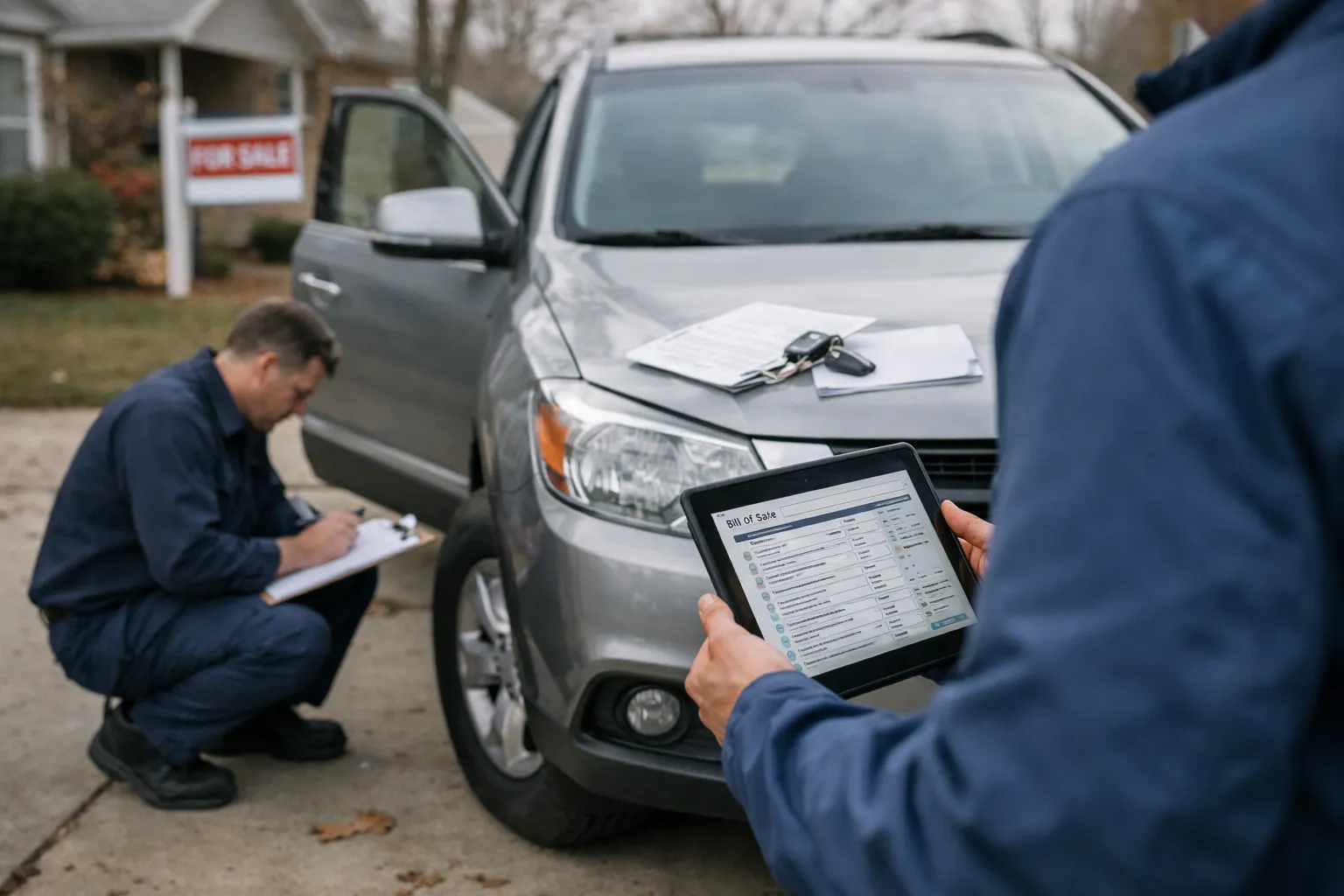
- Require a notarized bill of sale that includes VIN, sale price, odometer reading and the seller’s legal name and address. If your state requires a separate odometer disclosure form, ensure the seller completes it.
- If there is a listed lien, obtain proof of lien release or a written payoff arrangement conditioned on your payment through escrow.
Why: ELT speeds transactions but changes who signs and when. Misunderstanding electronic release timelines is a common cause of delayed registrations.
Step 7 — Emissions, VIN verification and registration timing
Check your state’s DMV rules before purchase. Important 2026 considerations:
- Some states accept recent out‑of‑state emissions tests; others require a local inspection upon registration. For EVs, emissions testing is generally not required, but states still may require safety or VIN verifications.
- VIN inspections and vehicle identification can be performed by DMV agents, law enforcement, or licensed inspectors. If your state requires an in‑person VIN check before registration, plan for that step in your timeline.
- Temporary operating permits: dealers routinely issue temporary tags; private sellers often cannot. If you plan to drive the car home, get written confirmation about who will provide a permit or arrange covered transport.
Step 8 — Shipping vs. driving home — costs, insurance, and carrier vetting
- Get at least three written quotes from transport brokers (Montway, Ship a Car Direct, uShip, etc.). Confirm door‑to‑door pickup, delivery window, and whether carriers are DOT‑registered with an MC number.
- Check carrier reviews on multiple platforms and verify the carrier’s insurance limits. Ask whether the transporter carries contingent cargo insurance or whether you must buy supplemental coverage.
- If driving the car home, verify temporary registration and insurance are valid for the drive. If the car is not roadworthy, use an open or enclosed carrier appropriate to the vehicle’s value and condition.
Why: transport is often the second‑largest cost in an out‑of‑state purchase. Written carrier terms and insurance limits reduce disputes at delivery.
Step 9 — Registering and paying sales/use tax in your state
When you bring the car home you will generally register it at your local DMV. Bring:
- Signed title or electronic title transfer confirmation, bill of sale, and any lien release documentation.
- Proof of insurance meeting your state’s minimums.
- Identification and residency documents.
- Money for registration fees and state sales or use tax — your state typically taxes the vehicle at registration based on purchase price or fair market value.
Tip: Some states offer a grace period for registration of new acquisitions; others require immediate action. Check DMV guidance online to avoid late fees and to know whether you need a VIN verification or emissions test before plates are issued.
Step 10 — After purchase: maintenance, warranties and consumer recourse
- Schedule a comprehensive inspection with your trusted mechanic within the first 500–1,000 miles. This uncovers deferred maintenance like brake wear, coolant leaks, or transmission issues.
- Transfer or register any remaining factory or extended warranty promptly — many require notification within a short window.
- If a dealer sold you the vehicle, review their written warranty and state lemon or dealer protection laws. For private‑party purchases, document any misrepresentation and consult your state attorney general or small claims court if necessary.
Sample timeline — realistic August 2026 schedule
- Day 0–3: Locate vehicle, get VIN, order history reports and ask for initial photos/video.
- Day 3–7: Complete remote questions, schedule a PPI, and confirm payment method contingencies.
- Day 7–14: Resolve any title/ELT issues, pay into escrow or finalize payment terms, and schedule transport or pickup.
- Day 14–30: Transport and delivery; title transfer completed per seller state rules (may be longer if an electronic lien needs processing).
- Day 30–45: Register vehicle in buyer’s state, complete necessary inspections, and finalize warranty transfers.
Practical negotiation and pricing tips
- Build out‑of‑state costs into your offer: PPI, transport, temporary registration and possible repairs. Ask the seller to split transport costs when inspection reveals minor issues.
- For dealers, insist on an out‑the‑door price that includes any convenience or document fees for handling out‑of‑state title work.
- Use inspection findings as leverage to negotiate price or require repairs and a new inspection before final payment.
Common mistakes and how to avoid them
- Buying without a VIN or with vague title status: walk away. Always get and verify the VIN.
- Accepting screenshots of digital titles or e‑signatures without confirming ELT processes: verify the electronic title release workflow with the lienholder or DMV.
- Paying with Zelle or instant P2P apps for high‑value purchases: these are hard to reverse if fraud occurs. Use escrow for private sales.
- Using unverified transporters: confirm DOT registration, MC number and insurance limits in writing.
- Skipping EV battery checks: battery replacements are expensive and often the largest post‑purchase cost on older EVs.
Pro tips
- Ask for a live video of an OBD‑II scan and an EV SOH readout. Many sellers and inspectors can run these in real time.
- If the vehicle is sold through an online marketplace, review its buyer protection terms — some platforms offer dispute resolution or limited guarantees.
- Keep a network: a trusted mobile inspector, a reliable carrier with a known MC number, and a DMV contact in both states will make repeat cross‑state purchases smoother.
- Consider using a title company for high‑value purchases; they can handle escrowed funds and title delivery in one transaction.
Document checklist for the buyer (updated)
- VIN and vehicle history reports (Carfax, AutoCheck, NICB check)
- Signed original title or electronic title release instructions
- Bill of sale with price, VIN, date, and seller/buyer information (notarized if required)
- Odometer disclosure statement (if required)
- Lien release or payoff documentation
- PPI inspection report (mechanical and, if EV, battery report)
- Escrow or payment receipts
- Temporary operating permit or transport carrier paperwork
- Service records and warranty transfer documents
Final checklist before you close
- Clear title status verified, including ELT or lienholder instructions.
- Satisfactory PPI and any agreed repairs completed in writing.
- Secure payment method (escrow strongly recommended for private sales).
- Transport booked with DOT‑registered carrier or pickup plans confirmed.
Bottom line
Out‑of‑state used car purchases still offer opportunity — better selection, rarer models, or price advantages — but the transaction in 2026 increasingly relies on electronic title workflows, robust remote inspections (especially for EVs), and secure payment paths. Treat the purchase as a multi‑step project: verify VIN and title, get a professional inspection that includes battery health for EVs, use escrow or equivalent protections, and confirm your state’s registration and tax rules before you finalize payment. The checklists and updated precautions here will help you close cross‑state deals with confidence.
FAQ
Is it safe to buy a used EV from another state?
Yes, if you add EV‑specific checks: a professional battery state‑of‑health (SOH) test, verification of charging‑port condition and software update history, and confirmation that on‑board chargers and adapters are compatible with your local infrastructure. Also confirm how any remaining warranty transfers and whether the vehicle’s battery replacement history is documented.
What if the title is electronic and the seller says they’ll “release it later”?
Ask for written instructions from the lienholder or a documented timeline for ELT release. Don't send funds until the escrow arrangement explicitly conditions payment on the electronic title release and the title can be delivered to your state. If timelines are vague, treat it as higher risk.
Can I trust escrow services for private sales?
Reputable escrow services (for example, Escrow.com) are a standard way to mitigate payment risk. Verify the escrow company’s credentials, read their terms, and confirm they accept vehicle transactions. For high‑value purchases, combining escrow with title company handling adds protection.
How should I pay for transport and insurance for the trip home?
Get written quotes, confirm the transporter’s DOT and MC numbers, and buy supplemental cargo insurance if the carrier’s limit is insufficient. If you drive the car home, secure temporary registration and insurance valid for the drive — check with your insurer about coverage for newly acquired vehicles in another state.
What recourse do I have if the car is misrepresented after purchase?
Recourse depends on how you bought the car. Dealers are subject to state dealer laws and warranty rules; many offer written return policies or buyer protections. Private sales are more limited: document all communications and evidence, and consult your state consumer protection office or small claims court if you believe the seller intentionally misrepresented the vehicle.