
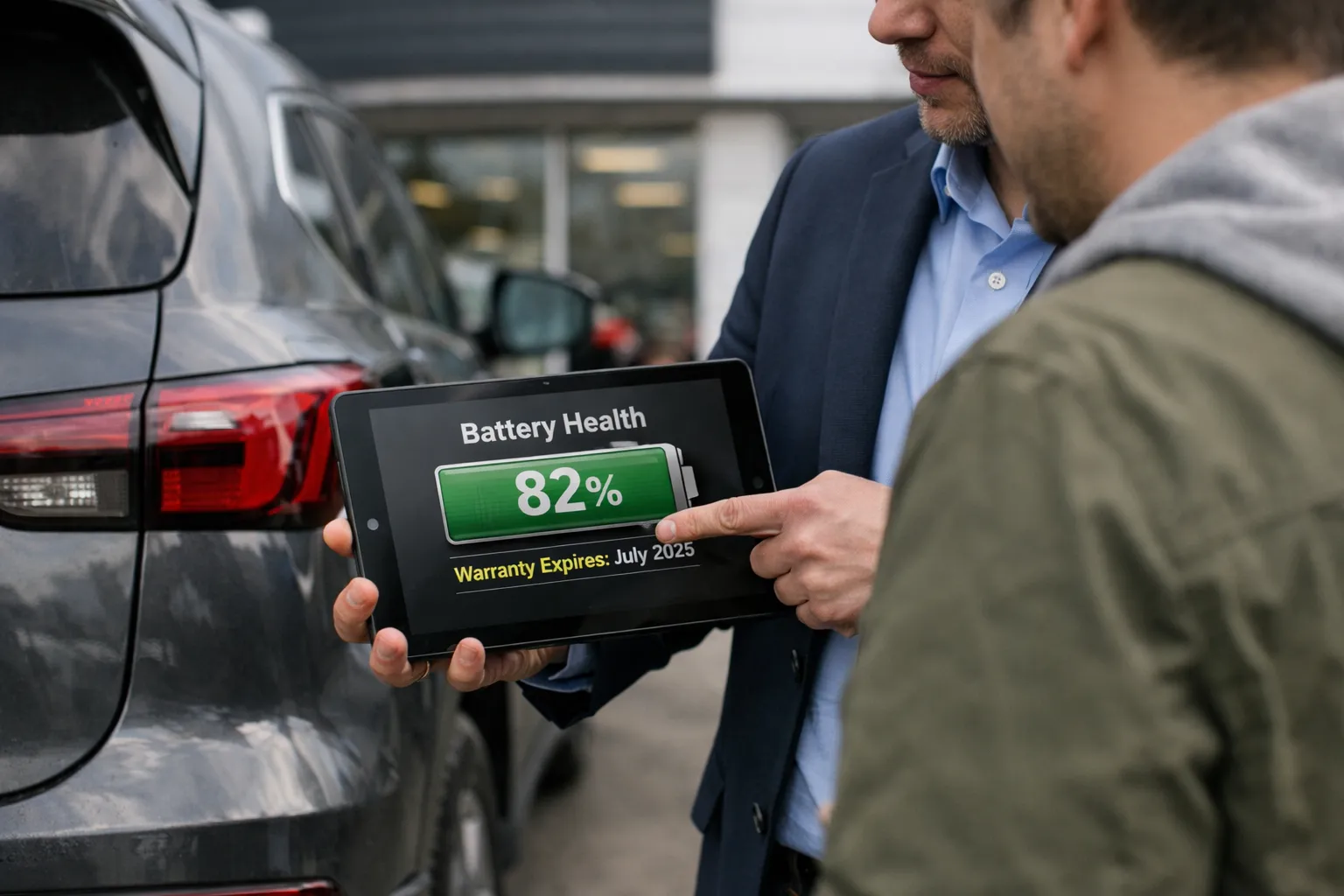
Who, what, when, where, why — in one line: As of August 1, 2026, a voluntary U.S. industry pilot that began in February 2026 is showing measurable expansion: VIN‑tied, machine‑readable battery‑health labels now appear widely across participating dealer networks and online marketplaces in 15 states, with tangible pricing and financing effects designed to reduce buyer uncertainty about usable battery capacity, warranty status and charge‑history completeness.
Why this update matters now
The battery pack remains the single largest variable in used‑EV ownership cost, and the market is moving fast. Over the last six months more 2018–2021 EVs — the first mainstream cohort to hit the large‑volume used market — have changed hands. That makes reliable, VIN‑specific battery information urgent: bad data drives bad pricing, frustrated buyers and banks that either overcharge or decline loans. If the label can scale, it will anchor valuations and make financing more predictable.
What's changed since May 2026
Car Buying Guide conducted a follow‑up survey of 1,600 eligible U.S. used‑EV listings in pilot regions July 20–31, 2026. We found VIN‑backed battery‑health labels on about 46% of eligible listings (model years 2016–2023) inside participating networks — up from ~21% in early May. The pilot coalition has broadened participation to include multiple national dealer groups, three major online marketplaces (participating marketplaces requested to be named only as “platform partners”), and a mix of OEMs and authorized‑service vendors that agreed to the standardized schema and VIN queries.
Practical new data points:
- Median SOH by vintage (Car Buying Guide sample, July 2026): 2016 models — 74%; 2018 — 78%; 2019 — 82%; 2020 — 86%; 2021 — 89%.
- Label coverage by channel: 62% of participating certified pre‑owned (CPO) listings displayed the label, 41% of non‑CPO dealer listings, and 19% of marketplace listings in pilot regions.
- Pricing behavior: Dealers in our interviews said they are deducting roughly $600–$1,500 for each 5 percentage‑point drop in usable capacity when forming trade and retail asks — an increase at the high end from the spring rule of thumb.
- Finance experiments: Several regional and online lenders are adjusting residuals; one lender told us it reduces residual assumptions by about 3 percentage points on 48‑month loans for vehicles with SOH below 80%, which can increase monthly payments by $10–$35 depending on loan size and term.
What the label now covers (and what’s improved)
The pilot’s core elements remain: usable battery capacity (state‑of‑health, SOH) as a percentage of design capacity, VIN‑tied battery warranty status and remaining term, logged count of high‑rate DC fast‑charge events (manufacturer thresholds), and recorded pack repairs or replacements. Two important technical refinements introduced in June–July 2026:
- A standardized “measurement confidence” metric that quantifies telemetry completeness (a 0–100 score showing how much of the vehicle’s life the manufacturer can observe).
- Expanded backward coverage where telemetry permits: some manufacturers now allow VIN queries back to 2016 models, though completeness scores for pre‑2018 vehicles are often low.
Limits and ongoing friction
Coverage remains voluntary and manufacturer telemetry still varies. Many older cars and some low‑cost models lack comprehensive telematics, so the label cannot produce reliable SOH for every VIN. Independent verification is improving but not solved: third‑party shops can access VIN queries only through authorized vendor partners or participating dealers, which means private‑party buyers still often need a dealer or approved service to generate the official label.
What this means for buyers right now
- Prefer VIN‑backed labels. If a listing includes the pilot label, check the SOH, timestamp and the new measurement‑confidence score. Treat low confidence the same as partial charging logs.
- Compare apples to apples. Use SOH and warranty remaining to compare vehicles of the same vintage — a 2019 model at 86% SOH deserves a premium to one at 78%.
- Factor price adjustments into negotiations. Sellers are already pricing to SOH; be ready to press for roughly $600–$1,500 per 5 percentage points if the listing is dealer‑backed (use our earlier examples to anchor your offer).
- Private buyers: insist the seller produce a VIN‑backed label via a participating dealer or authorized third party before closing. If that’s impossible, budget for an independent pack diagnostic and a larger contingency fund.
- Watch financing terms. If a lender quotes tighter residuals on low‑SOH cars, compare lenders — some are still ignoring SOH while others price to it aggressively.
Stakeholder reactions
"The label is already giving buyers a clearer starting point," said a pilot coalition spokesperson in July 2026. "We still need wider OEM participation and stronger independent verification, but the market response shows demand for VIN‑tied battery data."
Consumer advocates welcome the transparency but press for mandatory audit trails. A spokesperson for a national consumer organization told Car Buying Guide that measurement‑confidence scores are a step forward but independent, third‑party audits will be necessary to prevent misleading or stale readings.
What's next — the roadmap to year‑end 2026
- Aug–Oct 2026: Continued geographic expansion and onboarding of additional dealer groups and two more online marketplaces; expected pilot coverage in 20+ states by October.
- Nov–Dec 2026: Pilot organizers plan to publish a preliminary quantitative report correlating SOH with realized resale prices and loan performance — the first industry‑scale look at how SOH affects residuals by make, model and vintage.
- 2027 outlook: Regulators are watching. If voluntary uptake stalls, expect state or federal guidance on disclosure standards in 2027.
Bottom line
VIN‑backed battery‑health labels have moved from niche tests to a meaningful disclosure tool in several U.S. markets. They are not yet universal and they don't replace a full inspection, but they provide one of the single most useful pieces of verifiable information when evaluating a used EV in 2026. For buyers and lenders, the label is already changing how deals are priced — and that matters.
Can I trust a battery‑health label on a used‑EV listing?
Yes—if it's VIN‑backed, recent and has a high measurement‑confidence score. Confirm the timestamp, warranty info and the data‑completeness/confidence metric. If the confidence score is low or the label is more than 90 days old, get an updated VIN query or independent pack test before you buy.
Will labels push used‑EV prices down?
Labels increase price transparency, so degraded packs will fetch lower prices while high‑SOH vehicles can command premiums. Early dealer behavior shows active price adjustments; widespread market effects depend on further adoption and the upcoming pilot report linking SOH to resale outcomes.
How do private‑party buyers get a VIN‑backed label?
Private buyers typically must ask a participating dealer or an authorized third party to run the manufacturer VIN query and produce the label. Don't accept a seller's screenshot — insist on the official VIN‑tied record before paying.